Category
page 1Liliales families

Liliaceae
The lily family, Liliaceae, consists of about 15 genera and 610 species of flowering plants within the order Liliales. They are monocotyledonous, perennial, herbaceous geophytes, often growing from bulbs although some have rhizomes. The leaves are linear in shape, with their veins usually arranged parallel to the edges, single and arranged alternating on the stem, or in a rosette at the base. The flowers are large with six colored or patterned petaloid tepals (undifferentiated petals and sepals) arranged in two whorls of three, six stamens and a superior ovary. The fruit can be a berry or caps
%20in%20Behbahan.jpg)
Colchicaceae
alt=Colchicum persicum in Behbahan|thumb|Colchicum persicum in Behbahan, [[Iran]]
Colchicaceae is a family of flowering plants that includes 15 genera with a total of about 285 known species according to Christenhusz and Byng in 2016.

Melanthiaceae
Melanthiaceae, also called the bunchflower family, is a family of flowering herbaceous perennial plants native to the Northern Hemisphere. Along with many other lilioid monocots, early authors considered members of this family to belong to the family Liliaceae, in part because both their sepals and petals closely resemble each other and are often large and showy like those of lilies, while some more recent taxonomists have placed them in a family Trilliaceae. The most authoritative modern treatment, however, the APG III system of 2009 (unchanged from the 2003 APG II system and the 1998 APG sys

Alstroemeriaceae
Alstroemeriaceae is a family of flowering plants, with 254 known species in four genera, almost entirely native to the Americas, from Central America to southern South America. One species of Luzuriaga occurs in New Zealand, and the genus Drymophila is endemic to south-eastern Australia.
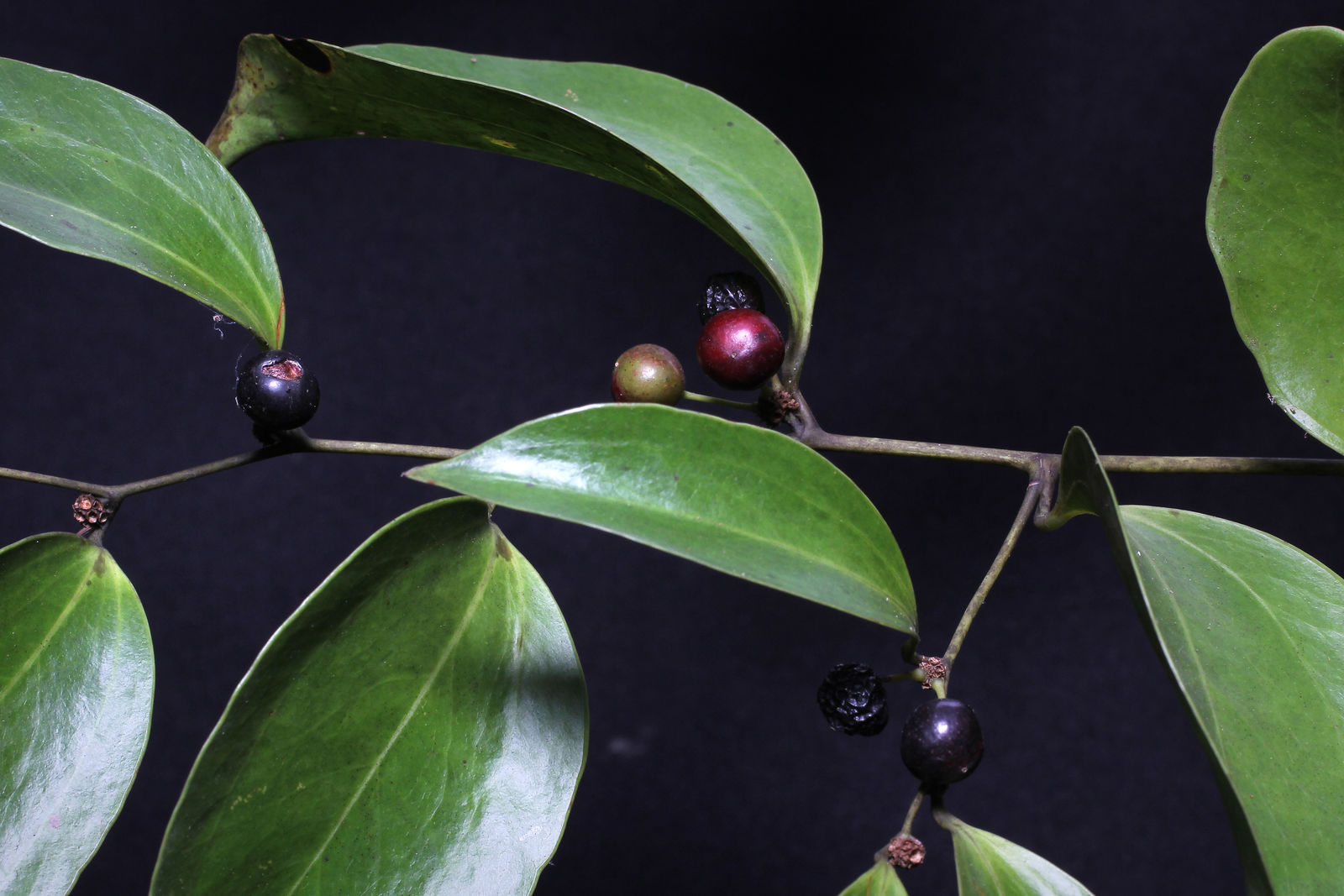
Smilacaceae
Smilacaceae, the greenbriers, is a family of flowering plants. While they were often assigned to a more broadly defined family Liliaceae, most recent botanists have accepted the two as distinct families, diverging around 55 million years ago during the Early Paleogene. One characteristic that distinguishes Smilacaceae from most of the other members of the Liliaceae-like Liliales is that it has true vessels in its conducting tissue. Another is that the veins of the leaves, between major veins, are reticulate (net-shaped), rather than parallel as in most monocots.

Philesiaceae
Philesiaceae is a family of flowering plants, including two genera, each with a single species. The members of the family are woody shrubs or vines endemic to southern Chile.

Corsiaceae
Corsiaceae is a family of monocotyledonous flowering plants. The APG II system (2003) treats the family in the order Liliales, in the clade monocots. This is a slight change from the APG system, of 1998, which left the family unplaced as to order, but did assign it also to the monocots.

Campynemataceae
Campynemataceae (Campynemaceae) is a family of flowering plants. The family consists of two genera and four species of perennial herbaceous plants endemic to New Caledonia and Tasmania.
Petermanniaceae
REDIRECT Petermannia
Category:Liliales families
Category:Monogeneric plant families
Category:Plant families endemic to Australia
Category:Monocots of Australia