Category
page 1Linguistics terminology

grammar
In linguistics, grammar is the system of rules that governs how a natural language is structured and used, as evidenced by its speakers or writers. Grammar rules may concern the use of clauses, phrases, and words. The term may also refer to the study of such rules, a subject that includes phonology, morphology, and syntax, together with phonetics, semantics, and pragmatics. There are in effect two different ways to study grammar: traditional grammar and theoretical grammar.

dialect
A dialect is a variety of language spoken by a particular group of people. This may include dominant and standardized varieties as well as vernacular, unwritten, or non-standardized varieties, such as those used in developing countries or isolated areas. The dialects of the same language are mainly distinguished from each other by differences in linguistic features such as phonology, morphology, syntax and vocabulary.

phonetics
Phonetics is a branch of linguistics that mainly concerns the articulation and perception of speech sounds. The field of phonetics is traditionally divided into three sub-disciplines: articulatory phonetics, acoustic phonetics, and auditory phonetics. Linguists who specialize in studying these physical properties of talking or signing are phoneticians. Traditionally, the minimal linguistic unit of phonetics is the phone or a speech sound. It differs from the minimal linguistic unit of phonology, which is a phoneme. Phonemes are abstract categorizations of phones and are defined as the smallest

phoneme
A phoneme () is a set of similar speech sounds that are perceptually regarded by the speakers of a language as a single basic sound—a smallest possible phonetic unit—that helps distinguish one word from another. All languages contain phonemes (or the spatial–gestural equivalent in sign languages), and all spoken languages include both consonant and vowel phonemes. Phonemes are studied under phonology, a branch of linguistics (a discipline encompassing language, writing, speech and related matters).

syntax
In linguistics, syntax ( ) is the study of how words and morphemes well-formed combine to form larger units such as phrases and sentences. Central concerns with syntax include word order, grammatical relations, hierarchical sentence structure (constituency), agreement, the nature of crosslinguistic variation, and the relationship between form and meaning (semantics). Diverse approaches, such as generative grammar and functional grammar, offer unique perspectives on syntax, reflecting its complexity and centrality to understanding human language.

phonology
Phonology (formerly also phonemics or phonematics) is the branch of linguistics that studies how languages systematically organize their phonemes or, for sign languages, their constituent parts of signs. The term can also refer specifically to the sound or sign system of a particular language variety. At one time, the study of phonology related only to the study of the systems of phonemes in spoken languages, but now it may relate to any linguistic analysis either:

morphology
identification, analysis and description of the structure of a given language's morphemes and other linguistic units

orthography
An orthography is a set of conventions for writing a language, including norms of spelling, punctuation, word boundaries, capitalization, hyphenation, and emphasis.

semantics
thumb|alt=Diagram of the relation between word, object, and thought|A central topic in semantics concerns the relation between language, world, and mental concepts.|class=skin-invert-image
Semantics is the study of linguistic meaning. It examines what meaning is, how words get their meaning, and how the meaning of a complex expression depends on its parts. Part of this process involves the distinction between sense and reference. Sense is given by the ideas and concepts associated with an expression while reference is the object to which an expression points. Semantics contrasts with syntax, w

suffix
In linguistics, a suffix is an affix which is placed after the stem of a word. Common examples are case endings, which indicate the grammatical case of nouns and adjectives, and verb endings, which form the conjugation of verbs.

morpheme
A morpheme is any of the smallest meaningful constituents within a linguistic expression and particularly within a word. Many words are themselves standalone morphemes, while other words contain multiple morphemes; in linguistic terminology, this is the distinction, respectively, between free and bound morphemes. The field of linguistic study dedicated to morphemes is called morphology.

definition
thumb|A definition states the meaning of a word using other words. This is sometimes challenging. Common dictionaries contain lexical descriptive definitions, but there are various types of definition – all with different purposes and focuses.

prefix
thumb|upright=1.3|A comparison of prepositions and directional prefixes in Greek, Latin, English, and German.

sociolinguistics
Sociolinguistics is the descriptive and scientific study of how language is shaped by and used differently within any given society. The field largely looks at how a language varies between distinct social groups and under the influence of assorted cultural norms, expectations, and contexts, including how that variation plays a role in language change. Sociolinguistics combines the older field of dialectology with the social sciences in order to identify regional dialects, sociolects, ethnolects, and other sub-varieties and styles within a language.
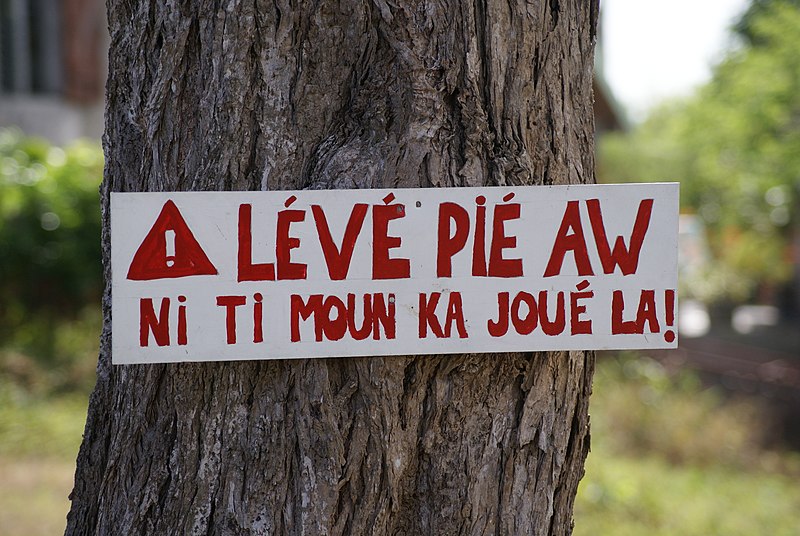
creole
stable natural languages that have developed from a pidgin

affix
In linguistics, an affix is a morpheme that is attached to a word stem to form a new word or word form. The main two categories are derivational and inflectional affixes. Derivational affixes, such as un-, -ation, anti-, pre- etc., introduce a semantic change to the word they are attached to. Inflectional affixes introduce a syntactic change, such as singular into plural (e.g. -(e)s), or present simple tense into present continuous or past tense by adding -ing, -ed to an English word. All of them are bound morphemes by definition; prefixes and suffixes may be separable affixes.

pidgin
A pidgin , or pidgin language, is a grammatically simplified form of contact language that develops between two or more groups of people that do not have a language in common: typically, its vocabulary and grammar are limited and often drawn from several languages. It is most commonly employed in situations such as trade, or where both groups speak languages different from the language of the country in which they reside (but where there is no common language between the groups).

lexicography
thumb

standard language
language variety used by a population in their public discourse (for public purposes); standardized language that has at least one standard variety besides its other varieties; variety that has undergone standardization

lexicology
Lexicology is the branch of linguistics that analyzes the lexicon of a specific language. A word is the smallest meaningful unit of a language that can stand on its own, and is made up of small components called morphemes. Lexicology examines every feature of a word – including formation, spelling, origin, usage, and definition.

slang
Slang is a vocabulary (words, phrases, and linguistic usage) of an informal register, common in everyday conversation but avoided in formal writing and speech. It also often refers to the language exclusively used by the members of particular in-groups in order to establish group identity, exclude outsiders, or both. The word itself came about in the 18th century and has been defined in multiple ways since its conception, with no single technical usage in linguistics.

natural language
language naturally spoken by humans, as opposed to "constructed" and "formal" languages
psycholinguistics
Psycholinguistics or psychology of language is the study of the interrelation between linguistic factors and psychological aspects. The discipline is mainly concerned with the mechanisms by which language is processed and represented in the mind and brain; that is, the psychological and neurobiological factors that enable humans to acquire, use, comprehend, and produce language.

diglossia
thumb|upright=1.3|The station board of Hapur Junction railway station in [[North India demonstrating digraphia of two formal registers, Hindi and Urdu, of a common vernacular, Hindustani, an example of triglossia.]]

grapheme
thumb|Various glyphs representing instances of the lower case letter , considered to be [[allographs of the same grapheme|class=skin-invert-image]]
pragmatics
In linguistics and the philosophy of language, pragmatics is the study of how context contributes to meaning. The field of study evaluates how human language is utilized in social interactions, as well as the relationship between the interpreter and the interpreted. Linguists who specialize in pragmatics are called pragmaticians. The field has been represented since 1986 by the International Pragmatics Association (IPrA).

jargon
Jargon, or technical language, is the specialized terminology associated with a particular field or area of activity. Jargon is normally employed in a particular communicative context and may not be well understood outside that context. The context is usually a particular occupation (that is, a certain trade, profession, vernacular or academic field), but any ingroup can have jargon. The key characteristic that distinguishes jargon from the rest of a language is its specialized vocabulary, which includes terms and definitions of words that are unique to the context, and terms used in a narrowe
lexicon
A lexicon (, rarely lexica) is the vocabulary of a language or branch of knowledge (such as nautical or medical). In linguistics, a lexicon is a language's inventory of lexemes. The word lexicon derives from Greek word (), neuter of () meaning 'of or for words'.
root
indivisible part of word that does not have any affix, may have a meaning and be usable alone or not, and may comprise multiple "radical" forms
lexeme
A lexeme () is a unit of lexical meaning that underlies a set of words that are related through inflection. It is a basic abstract unit of meaning, a unit of morphological analysis in linguistics that roughly corresponds to a set of forms taken by a single root word. For example, in the English language, run, runs, ran and running are forms of the same lexeme, which can be represented as RUN.
declension
In linguistics, declension (verb: to decline) is the changing of the form of a word, generally to express its syntactic function in the sentence by way of an inflection. Declension may apply to nouns, pronouns, adjectives, adverbs, and determiners. It serves to indicate number (e.g. singular, dual, plural), case (e.g. nominative, accusative, genitive, or dative), gender (e.g. masculine, feminine, or neuter), and a number of other grammatical categories. Inflectional change of verbs is called conjugation.
accent
a way of pronouncing a language that is distinctive to a country, area, social class, or individual

inflection
thumb|upright=0.8|Inflection of the Scottish Gaelic [[lexeme for 'dog', which is for singular, for dual with the number ('two'), and for plural|class=skin-invert-image]]
idiolect
Idiolect is an individual's unique use of language, including speech. This unique usage encompasses vocabulary, grammar, and pronunciation. This differs from a dialect, a common set of linguistic characteristics shared among a group of people.
sociolect
In sociolinguistics, a sociolect is a form of language (non-standard dialect, restricted register) or a set of lexical items used by a socioeconomic class, profession, age group, or other social group.
word stem
word part responsible for a word's lexical meaning
language variety
specific form of a language or language cluster

conjugation
creation of derived forms of a verb from its principal parts by inflection

prosody
part of linguistics concerned with elements of speech that are not individual phonetic segments, but properties of syllables and larger units of speech
register
form of language used for a particular purpose or in a particular communicative situation
intonation
variation of pitch in speech
argot
REDIRECT Cant (language)#Argot
tone
use of pitch to differentiate words in a language

vernacular
Vernacular is the ordinary, informal, spoken form of a language or dialect, particularly when perceived as having lower social status or less prestige than standard language, which is more codified, institutionally promoted, literary, or formal. More narrowly, any particular variety of a natural language that does not hold a widespread high-status perception, and sometimes even carries social stigma, is also called a vernacular, vernacular dialect, nonstandard dialect, etc. and is typically its speakers' native variety. Regardless of any such stigma, all nonstandard dialects are full-fledged v
metalanguage
In logic and linguistics, a metalanguage is a language used to describe another language, often called the object language. Expressions in a metalanguage are often distinguished from those in the object language by the use of italics, quotation marks, or writing on a separate line. The structure of sentences and phrases in a metalanguage can be described by a metasyntax. For example, to say that the word "noun" can be used as a noun in a sentence, one could write "noun" is a .
clitic
In morphology and syntax, a clitic ( , backformed from Greek "leaning" or "enclitic") is a morpheme that has syntactic characteristics of a word, but depends phonologically on another word or phrase. In this sense, it is syntactically independent but phonologically dependent—always attached to a host. A clitic is pronounced like an affix, but plays a syntactic role at the phrase level. In other words, clitics have the form of affixes, but the distribution of function words.
phraseme
A phraseme, also called a set phrase, fixed expression, multiword expression (in computational linguistics), or more specifically idiom, is a multi-word or multi-morphemic utterance whose components include at least one that is selectionally constrained or restricted by linguistic convention such that it is not freely chosen.
nomenclature
Nomenclature (, ) is a system of names or terms, or the rules for forming these terms in a particular field of arts or sciences. The theoretical field studying nomenclature is sometimes referred to as onymology or taxonymy. The principles of naming vary from the relatively informal conventions of everyday speech to the internationally agreed principles, rules, and recommendations that govern the formation and use of the specialist terminology used in scientific and any other disciplines.
allomorph
In linguistics, an allomorph is a variant phonetic form of a morpheme, or in other words, a unit of meaning that varies in sound and spelling without changing the meaning. The term allomorph describes the realization of phonological variations for a specific morpheme. The different allomorphs that a morpheme can become are governed by morphophonemic rules. These phonological rules determine what phonetic form, or specific pronunciation, a morpheme will take based on the phonological or morphological context in which it appears.
lemma
canonical representation of a lexeme
patois
Patois (, same or ) is speech or language that is considered nonstandard, although the term is not formally defined in linguistics. As such, patois can refer to pidgins, creoles, dialects or vernaculars, but not commonly to jargon or slang, which are vocabulary-based forms of cant.
synchrony and diachrony
pair of opposed concepts in linguistics
cant
language term for jargon or argot of a group
phonogram
grapheme which represents a phoneme or combination of phonemes
ethnolect
An ethnolect is generally defined as a language variety that marks speakers as members of ethnic groups who originally used another language or distinctive variety. According to another definition, an ethnolect is any speech variety (language, dialect, subdialect) associated with a specific ethnic group. It may be a distinguishing mark of social identity, both within the group and for outsiders. The term combines the concepts of an ethnic group and dialect.
X-bar theory
in generative grammar, the theory of syntactic category formation that ① phrases may contain intermediate constituents projected from a head X; and that ② this system of projected constituency may be common to more than one category (e.g. N, V, A, P)
prestige
term for the level of regard normally given to a language or dialect within a speech community relative to others
indexicality
In semiotics, linguistics, anthropology, and philosophy of language, indexicality is the phenomenon of a sign pointing to (or indexing) some element in the context in which it occurs. A sign that signifies indexically is called an index or, in philosophy, an indexical.
speech community
group of people who share expectations regarding linguistic usage

Indosphere
thumb|400px|Historic Indosphere cultural influence zone of [[Greater India for transmission of religion, music, arts, and cuisine