File:Guadeloupe_creole_2010-03-30.JPG · Wikimedia Commons · See Wikimedia Commons
creole
Sign in to saveAlso known as creole languages, creole language
stable natural languages that have developed from a pidgin
A creole is a stable, fully-developed language that has grown out of a pidgin—a simplified form of communication that emerged when people who didn't share a common language needed to communicate with each other. Creoles matter because they're real, complete languages used by communities of native speakers, and they show how human language naturally evolves and adapts when different groups of people come into contact.
AI-generated from the Wikipedia summary — may contain errors.
Wikidata facts
- Image
- Guadeloupe creole 2010-03-30.JPG
Show 4 more facts
- different from
- pidgin
- Commons category
- Creole languages
- topic's main category
- Category:Creole languages
- has list
- list of creole languages
via Wikidata · CC0
~40 min read
Encyclopedic overview
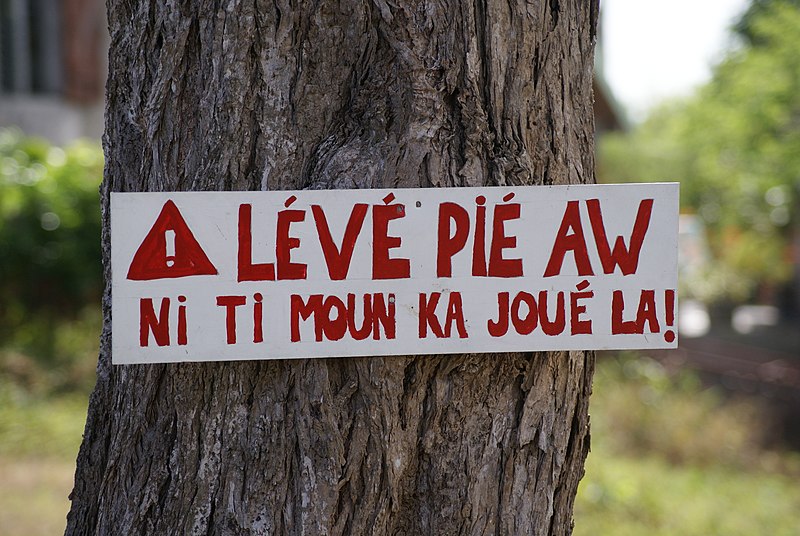
An Antillean Creole traffic sign in Guadeloupe stating Lévé pié aw / Ni ti moun ka joué la!, literally translating as "Lift your foot [i.e. slow down]. Children are playing here!" in 2010.
A creole language, or simply creole, is a stable form of contact language that develops from the process of different languages simplifying and mixing into a new form (often a pidgin), and then that form expanding and elaborating into a full-fledged language with native speakers, all within a fairly brief period. While the concept is similar to that of a mixed or hybrid language, creoles are often characterized more narrowly by a tendency to systematize their inherited grammar (e.g., by eliminating irregularities). Like any language, creoles are characterized by a consistent system of grammar, possess large stable vocabularies, and are acquired by children as their native language. These three features distinguish a creole language from a pidgin. Creolistics, or creology, is the study of creole languages and, as such, is a subfield of linguistics. Someone who engages in this study is called a creolist.
Excerpted from Wikipedia’s “creole” article, available under the CC BY-SA 4.0 licence.
Gallery (2)
Available in 89 languages
- Español
- Français
- Deutsch
- 中文
- 日本語
- Русский
- Português
- Italiano
- العربية
- हिन्दी
- Afrikaans
- Albanian
- Albanian
- Armenian
- Asturian
- Azerbaijani
- Bahasa Indonesia
- Basque
Show 70 more
- Belarusian
- Betawi
- Breton
- Bulgarian
- Catalan
- Croatian
- Czech
- Danish
- Esperanto
- Estonian
- Finnish
- Galician
- Gan Chinese
- gcr
- Georgian
- Greek
- Haitian Creole
- Hebrew
- Hungarian
- Icelandic
- Ido
- Interlingua
- Irish
- Latin
- Latvian
- Limburgish
- Lingua Franca Nova
- Lithuanian
- Low German
- Lower Sorbian
- Macedonian
- Malay
- Mazanderani
- nds_nl
- Nederlands
- Nigerian Pidgin
- Northern Frisian
- Norwegian
- Norwegian Nynorsk
- Occitan
- Papiamento
- Pashto
- Piedmontese
- Polski
- Romanian
- Sardinian
- Serbian
- Serbian (Latin)
- simple
- Sindhi
- Slovak
- Slovenian
- Svenska
- Swahili
- Tamil
- Tiếng Việt
- Türkçe
- Ukrainian
- Upper Sorbian
- Urdu
- Venetian
- Walloon
- Welsh
- Western Frisian
- Wu Chinese
- zh_min_nan
- zh_yue
- فارسی
- ไทย
- 한국어
via Wikidata sitelinks · CC0