Category
page 1Lithics

knife
thumb|upright=1.5|alt=Large knife with polished wooden handle, close to a leather sheath|A Bowie knife of [[pattern-welded steel]]

arrow
300px|thumb|Traditional target arrow (top) and replica medieval arrow (bottom)
thumb|Modern arrow with plastic fletchings and nock

flint
right|thumb|A piece of flint long, weighing 171 grams

anvil
thumb|upright=1.35|Single-horn anvil
thumb|A blacksmith working [[iron with a hammer and anvil]]
thumb|A blacksmith working with a [[sledgehammer, assistant (striker) and Lokomo anvil in Finland]]
.png)
adze
thumb|Adze

chalcedony
Chalcedony ( or ) is a cryptocrystalline form of silica, composed of very fine intergrowths of quartz and moganite. These are both silica minerals, but they differ in that quartz has a trigonal crystal structure, while moganite is monoclinic. Chalcedony's standard chemical structure (based on the chemical composition of quartz) is (silicon dioxide).

hand axe
stone tool

microlith
A microlith is a small stone tool usually made of flint or chert and typically several centimeters in length and half a centimetre wide. They were made by humans from at least the Upper Paleolithic, across Africa, Europe, Asia and Australia. The microliths were used in spear points and arrowheads.
Levallois technique
distinctive type of stone knapping technique used by ancient humans

Le Grand-Pressigny
commune in Indre-et-Loire, France

quern-stone
thumb|Disc quern made of basalt stone
thumb|Nepali women using quern-stones to grind grains
stone tool
any tool, partially or entirely, made out of stone

bolas
Bolas or bolases (: bola; from Spanish and Portuguese bola, "ball", also known as a boleadora or boleadeira) is a type of throwing weapon made of weights on the ends of interconnected cords, used to capture animals by entangling their legs. Bolas were most famously used by the gauchos, but have been found in excavations of Pre-Columbian settlements, especially in Patagonia, where indigenous peoples (particularly the Tehuelche) used them to catch 200-pound guanacos and rheas. The Mapuche and the Inca army used them in battle. Mapuche warriors used bolas in their confrontations with the Chilean
hardstone carving
art of carving and engraving of stones or gems
touchstone
small tablet of dark stone used for assaying precious metal alloys

chert
Chert () is a hard, fine-grained sedimentary rock composed of microcrystalline or cryptocrystalline quartz, the mineral form of silicon dioxide (SiO2). Chert is characteristically of biological origin, but may also occur inorganically as a chemical precipitate or a diagenetic replacement, as in petrified wood. Where chert occurs in chalk or marl, it is usually called flint.

metate
thumb|Metate, mano and corn, all circa 12th century AD, from Chaco Canyon, USA
thumb|Mano, metate and bowl of corn. Museum display of Ancestral Pueblo artifacts at [[Mesa Verde National Park.]]
A metate (or mealing stone) is a type or variety of quern, a ground stone tool used for processing grain and seeds. In traditional Mesoamerican cultures, metates are typically used by women who would grind nixtamalized maize and other organic materials during food preparation (e.g., making tortillas). Similar artifacts have been found in other regions, such as the sil-batta in Bihar and Jharkhand, India
scraper
stone hand-tool
lithic flake
portion of rock removed from an objective piece by percussion or pressure
chopping tool
prehistoric stone tool
Kongemose culture
mesolithic hunter-gatherer culture in southern Scandinavia
thunderstone
flint arrowheads and axes, turned up by farmer's plows, considered to have fallen from the sky and worshiped as gods
lithic core
in archaeology, a stone artifact left over from toolmaking
burin
type of Stone Age tool
lithic reduction
prehistoric process of reducing and cutting a stone by removing shards or flakes in order to make a pointed, sharp or blunt tool
chopper
type of crude stone tool
blade
type of stone tool; a long narrow flake produced by laminar debitage
Lomekwi
Lomekwi is an archaeological site located on the west bank of Lake Turkana in Kenya. It is an important milestone in the history of human archaeology. An archaeological team from Stony Brook University in the United States discovered traces of Lomekwi by chance in July 2011, and made substantial progress with four years of in-depth excavations.

eolith
thumb|"Hammerstone" eolith, recognized to be of natural origin by Boule in 1905
An eolith (from Ancient Greek ἠώς (ēṓs), meaning "dawn", and λίθος (líthos), meaning "stone") is a flint nodule that appears to have been crudely knapped. Eoliths were once thought to have been artifacts, the earliest stone tools, but are now believed to be geofacts (stone fragments produced by fully natural geological processes such as glaciation).
conchoidal fracture
way that brittle materials break or fracture when they do not follow any natural planes of separation
.jpg)
racloir
thumb|Type of Mousterian Racloir
thumb|Racloir from Galería (TG11) of Archaeological Site of Atapuerca|Atapuerca
projectile point
object that was hafted to weapon that was capable of being thrown or projected
cleaver
biface stone tool
Tayacian
The Tayacian is a Palaeolithic stone tool industry that is a variant of the Mousterian. It was first identified as distinct by Abbé Breuil from the site of La Micoque in Les-Eyzies-de-Tayac although since then the cave at Fontéchevade has become the "reference site for this industry".

molcajete
thumb|350px|Molcajete and tejolote with peppers to be ground
A molcajete (; Mexican Spanish, from Nahuatl molcaxitl) and tejolote (from Nahuatl texolotl) are stone tools, the traditional Central American and especially, the Mexican version of the mortar and pestle used for grinding various food products.

hammerstone
thumb|250px|various hammerstones
thumb|right|An example of a cobble used as a hammerstone

cryptocrystalline texture
Cryptocrystalline is a rock texture made up of such minute crystals that its crystalline nature is only vaguely revealed even microscopically in thin section by transmitted polarized light. Among the sedimentary rocks, chert and flint are cryptocrystalline. Carbonado, a form of diamond, is also cryptocrystalline. Volcanic rocks, especially of the felsic type such as felsites and rhyolites, may have a cryptocrystalline groundmass as distinguished from pure obsidian (felsic) or tachylyte (mafic), which are natural rock glasses. Agate and onyx are examples of cryptocrystalline silica (chalcedony)
.png)
Emirian
thumb|upright=1.2|Expansion of European early modern humans|early modern humans from Africa through the [[Levant.]]
.jpg)
knapping
thumb|Flintknapping a stone tool
Batan
stone
retouching
in archaeology, reworking or refining a stone tool by trimming or flaking
celt
prehistoric tool, similar to adze, ax, or hoe
Petrosphere
spherical man-made object of any size that is composed of stone
Spongolite
thumb|240px|Spongolite texture, click to enlarge (2MB)
denticulate tool
type of stone tool
chaîne opératoire
methodological tool for analysing technical processes and social acts involved in the step-by-step production, use, and eventual disposal of artifacts
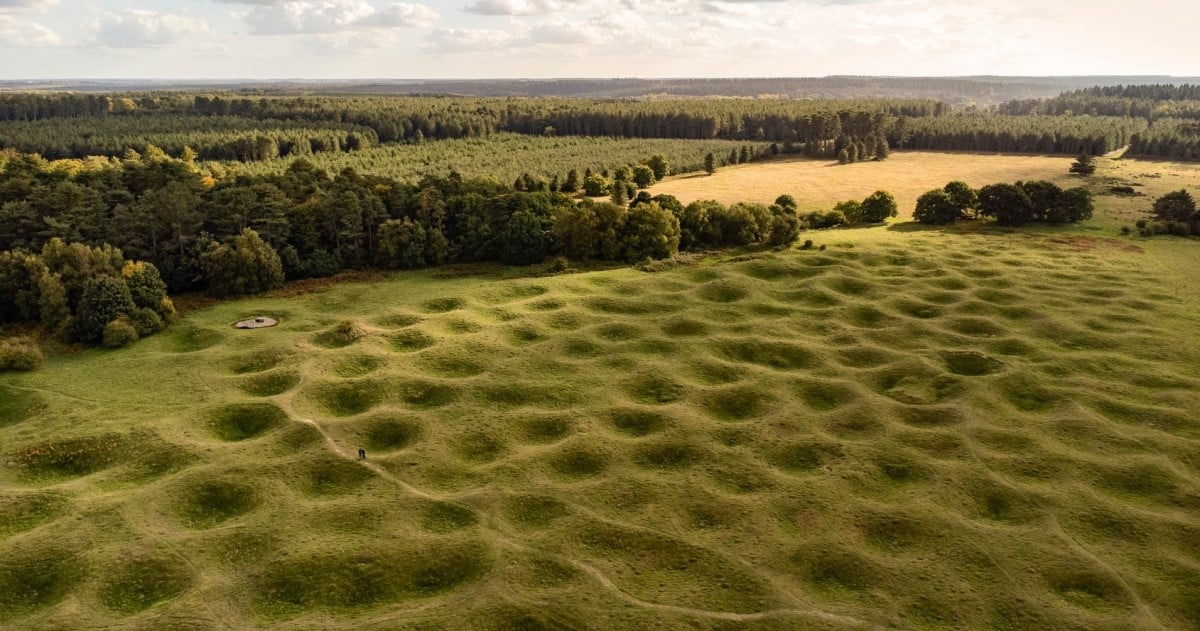
Grime's Graves
flint mine in Norfolk, England, UK
Khormusan culture
Khormusan industry was a Paleolithic archeological industry in Nubia dated at 42,000 to 18,000 BP.
use-wear analysis
analysis of traces of use in Archeology
flake tool
type of stone tool
microburin
thumb|
A microburin is a characteristic waste product from manufacture of lithic tools — sometimes confused with an authentic burin — which is characteristic of the Mesolithic, but which has been recorded from the end of the Upper Paleolithic until the Chalcolithic. This type of lithic artifact was first named by Henri Breuil who defined it as "a type of angular, smooth, with a terminal retouch in the form of a small notch". Breuil initially thought that the microburins had a functional use as a type of microlithic burin. However, he later came to realize that the manufacturing technique was d
Elmenteitan
The Elmenteitan culture was a prehistoric lithic industry and pottery tradition with a distinct pattern of land use, hunting and pastoralism that appeared and developed on the western plains of Kenya, East Africa during the Pastoral Neolithic c.3300-1200 BP. It was named by archaeologist Louis Leakey after Lake Elmenteita (also Elementaita), a soda lake located in the Great Rift Valley, about northwest of Nairobi.
tranchet axe
type of edged stone tool
Yubetsu technique
special technique to make microblades
ground stone
prehistoric stone tool
Callaïs
thumb|380x380px|An example of a variscite "callaïs" necklace of Neolithic origin, dated 4500 - 4000 BC, found in Arzon. The necklace now located in the Musée d'Histoire et d'Archéologie de Vannes.
Callaïs is the generic name for ancient green-blue precious stones used for making pendants and beads by western European cultures of the later Neolithic and early Bronze Age. The term includes turquoise and variscite but not jade. "Callaïs" was described by Pliny the Elder as being paler than lapis lazuli. Callaïs objects have been found in Neolithic tombs from the mid-5th millennium BC in the Carna
mano
hand-held stone tool used with a metate or quern to process or grind food by hand
debitage
thumb|Example of lithic refitting
thumb|Series of refitted debris
Eccentric flint
mayan archaeological artifact
geofact
thumb|Eolith from France. Once believed to be an early [[hammerstone, in 1905 Marcellin Boule debunked its man-made status]]
A geofact (a portmanteau of geology and artifact) is a natural stone formation that is difficult to distinguish from a man-made artifact. Geofacts could be fluvially reworked and be misinterpreted as an artifact, especially when compared to Paleolithic artifacts.