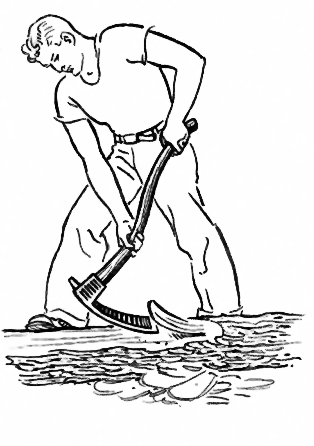
File:Adz_(PSF).png · Wikimedia Commons · See Wikimedia Commons
I don't have sufficient context provided to write an accurate overview. The context only shows "thumb|Adze" which appears to be a caption or file reference, not actual information about what an adze is or why it matters. I would need descriptive content about the tool to create an accurate, factual overview as requested.
AI-generated from the Wikipedia summary — may contain errors.
Wikidata facts
- Image
- TroughAdze.jpg
Show 3 more facts
- described by source
- Encyclopædia Britannica 11th edition
- Commons category
- Adzes
- different from
- axe
via Wikidata · CC0
~11 min read
Encyclopedic overview
13 sectionsContents
- History
- Africa
- South Pacific
- Northwest Coastal America
- New Guinea and Melanesia
- Modern adzes
- Foot adze
- Hand adze
- Bulgarian adze
- See also
- Citations
- General and cited references
- External links
thumb|Adze
An adze () or adz is an ancient and versatile cutting tool similar to an axe but with the cutting edge perpendicular to the handle rather than parallel. Adzes have been used since the Stone Age. They are used for smoothing or carving wood in hand woodworking, and as a hoe for agriculture and horticulture. Two basic forms of an adze are the hand adze (short hoe)—a short-handled tool swung with one hand—and the foot adze (hoe)—a long-handled tool capable of powerful swings using both hands, the cutting edge usually striking at foot or shin level. A similar tool is called a mattock, which differs by having two blades, one perpendicular to the handle and one parallel.
Excerpted from Wikipedia’s “adze” article, available under the CC BY-SA 4.0 licence.
Gallery (20)
Available in 64 languages
- Español
- Français
- Deutsch
- 中文
- 日本語
- Русский
- Português
- Italiano
- العربية
- हिन्दी
- Achinese
- Afrikaans
- Albanian
- Aragonese
- Armenian
- Bahasa Indonesia
- Bangla
- Basque
Show 45 more
- Bavarian
- Bulgarian
- Catalan
- Chuvash
- Czech
- Danish
- Esperanto
- Estonian
- Extremaduran
- Finnish
- Galician
- Georgian
- Hausa
- Hebrew
- Hungarian
- Icelandic
- Irish
- Komi
- Lingua Franca Nova
- Lithuanian
- Low German
- Macedonian
- Malay
- Nederlands
- Northern Frisian
- Norwegian
- Old English
- Pampanga
- Polski
- Punjabi
- Romanian
- Serbian
- Serbian (Latin)
- simple
- Sindhi
- Sundanese
- Svenska
- Talysh
- Tamil
- Ukrainian
- Welsh
- zh_yue
- فارسی
- ไทย
- 한국어
via Wikidata sitelinks · CC0