Category
page 1Lizard families
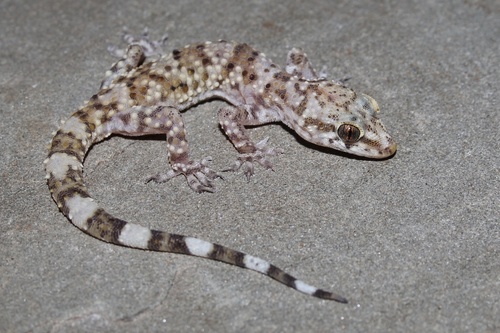
gecko
Gekkonidae (the common geckos) is the largest family of geckos, containing over 950 described species in 62 genera. The Gekkonidae contain many of the most widespread gecko species, including house geckos (Hemidactylus), the tokay gecko (Gekko), day geckos (Phelsuma), the mourning gecko (Lepidodactylus), and dtellas (Gehyra). Gekkonid geckos occur globally and are particularly diverse in tropical areas. Many species of these geckos exhibit an adhering ability to surfaces through Van der Waals forces utilizing intermolecular forces between molecules of their setae (foot hair) and molecules of t
.jpg)
Lacertidae
thumb|Troodos lizardPhoenicolacerta troodica
thumb|Terminology and scalation of lacertids
The Lacertidae are the family of the wall lizards, true lizards, or sometimes simply lacertas, which are native to Afro-Eurasia. It is a diverse family with at about 360 species in 39 genera. They represent the dominant group of reptiles found in Europe.

Anguidae
Anguidae refers to a large and diverse family of lizards native to the Northern Hemisphere. It contains 9 genera and 89 extant species. Common characteristics of this group include a reduced supratemporal arch, striations on the medial faces of tooth crowns, osteoderms, and a lateral fold in the skin of most taxa. The group is divided into two living subfamilies, the legless Anguinae, which contains slow worms and glass lizards, among others, found across the Northern Hemisphere, and Gerrhonotinae, which contains the alligator lizards, native to North and Central America. The family Diplogloss

Agamidae
Agamidae is a family containing 582 species in 64 genera of iguanian lizards indigenous to Africa, Asia, Australia, and a few locations in Southern Europe. Many species are commonly called dragons or dragon lizards.

Iguanidae
The Iguanidae is a family of lizards composed of the iguanas, chuckwallas, and their prehistoric relatives, including the widespread green iguana.

Varanidae
The Varanidae are a family of lizards in the superfamily Varanoidea and order Anguimorpha. The family, a group of carnivorous and frugivorous lizards, includes the living genus Varanus and a number of extinct genera more closely related to Varanus than to the earless monitor lizard (Lanthanotus). Varanus includes the Komodo dragon (the largest living lizard), crocodile monitor, savannah monitor, the goannas of Australia and Southeast Asia, and various other species with a similarly distinctive appearance. Their closest living relatives are the earless monitor lizard and Chinese crocodile lizar

Teiidae
Teiidae is a family of lacertoidean lizards native to the Americas. Members of this family are generally known as whiptails or racerunners; however, tegus also belong to this family. Teiidae is sister to the Gymnopthalmidae, and both families comprise the Teiioidea. The Teiidae includes several parthenogenic species – a mode of clonal reproduction. Presently, the Teiidae consists of approximately 150 species in eighteen genera.

Pygopodidae
Pygopodidae, commonly known as snake-lizards, or flap-footed lizards, are a family of legless lizards with reduced or absent limbs, and are a type of gecko. The 47 species are placed in two subfamilies and eight genera. They have unusually long, slender bodies, giving them a strong resemblance to snakes. Like snakes and most geckos, they have no eyelids, but unlike snakes, they have external ear holes and flat, unforked tongues. They are native to Australia and New Guinea.

Cordylidae
Cordylidae is a family of small- to medium-sized lizards that occur in southern and eastern Africa. They are commonly known as girdled lizards, spinytail lizards, or girdle-tail lizards.
Phrynosomatidae
The Phrynosomatidae are a diverse family of lizards, sometimes classified as a subfamily (Phrynosomatinae), found from Panama to the extreme south of Canada. Many members of the group are adapted to life in hot, sandy deserts, although the spiny lizards prefer rocky deserts or even relatively moist forest edges, and the short-horned lizard lives in prairie or sagebrush environments. The group includes both oviparous (egg-laying) and viviparous species, with the latter being more common in species living at high elevations. Oviparous and viviparous species of Phrynosomatidae lizards co-localize

Corytophanidae
Corytophanidae is a family of iguanian lizards, also called casquehead lizards or helmeted lizards, endemic to the New World. Nine species of casquehead lizards from three genera are recognized.
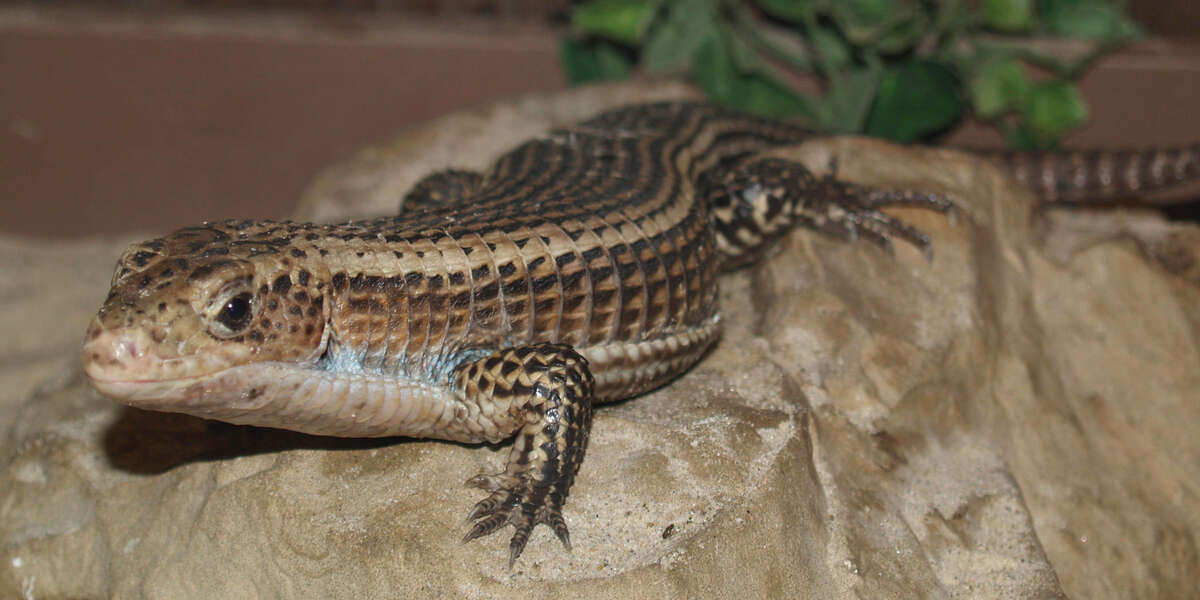
Gerrhosauridae
The Gerrhosauridae are a family of lizards native to Africa and Madagascar. They are close relatives of skinks and were once classified in the same family as them.
Dibamidae
Dibamidae or blind skinks is a family of lizards characterized by their elongated cylindrical body and an apparent lack of limbs. Female dibamids are entirely limbless and the males retain small flap-like hind limbs, which they use to grip their partner during mating. They have a rigidly fused skull, lack pterygoid teeth and external ears. Their eyes are greatly reduced, and covered with a scale.
%20(cropped).jpg)
Crotaphytidae
The Crotaphytidae, or collared lizards, are a family of desert-dwelling reptiles native to the Southwestern United States and northern Mexico. Alternatively they are recognized as a subfamily, Crotaphytinae, within the clade Pleurodonta. They are very fast-moving animals, with long limbs and tails; some species are capable of achieving bipedal running at top speed. This species is carnivorous, feeding mainly on insects and smaller lizards. The two genera contain 12 species.
%20male%20Toliara.jpg)
Opluridae
The Opluridae, or Madagascan iguanas, are a family of moderately-sized lizards native to Madagascar and Grande Comore. There are eight species across two genera, with most of them being under Oplurus. The other genus, Chalarodon, is easily distinguishable from Oplurus as it contains species with a dorsal crest, particularly distinct in males, and has a smoother tail covered in similarly sized scales. Genus Oplurus has large segmented spiny scales, and no dorsal crest along the spine.
Tropiduridae
The Tropiduridae are a family of iguanid lizards. The family is sometimes considered a subfamily, Tropidurinae. The subfamily is native to South America, including the islands of Trinidad and the Galápagos. Commonly known as Neotropical ground lizards, most are ground-dwelling animals, and the subfamily includes some lizards adapted to relatively cold climates, including those of the Andes mountains and Tierra del Fuego. Several species give birth to live young.
Hoplocercidae
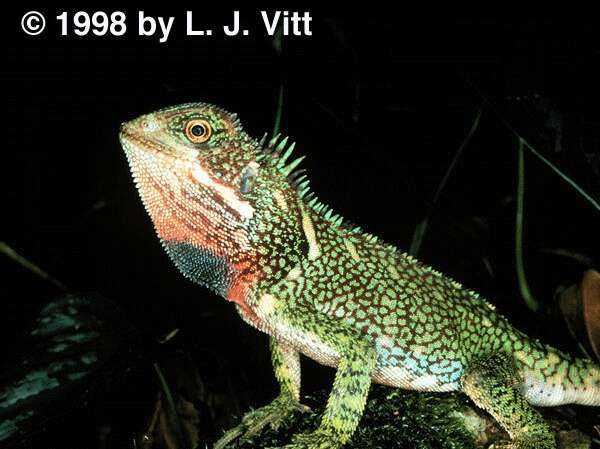
Hoplocercidae are a family of lizards native to the tropical forests, woodlands and savanna-like habitats of Central and South America. Alternatively they are recognized as a subfamily, Hoplocercinae. 20 species in two genera are described.

Diplodactylidae
The Diplodactylidae are a family in the suborder Gekkota (geckos), with over 150 species in 25 genera. These geckos occur in Australia, New Zealand, and New Caledonia. Diplodactylids are the most ecologically diverse and widespread family of geckos in both Australia and New Caledonia, and are the only family of geckos found in New Zealand. Three diplodactylid genera (Oedura, Rhacodactylus, and Hoplodactylus) have recently been split into multiple new genera.
Polychrotidae
The Polychrotidae family (sometimes classified as the Polychrotinae subfamily instead) of iguanian lizards contains the living genus Polychrus (commonly called bush anoles) and the extinct genus Afairiguana. The family Polychrotidae was once thought to encompass all anoles, including those in the genus Anolis (which are now included in the family Dactyloidae). Studies of the evolutionary relationships of anoles based on molecular information has shown that Polychrus is not closely related to Anolis, but instead closer to Hoplocercidae. It is therefore not part of Dactyloidae and instead is tre
Gymnophthalmidae
Gymnophthalmidae is a family of lizards with at least 250 species, sometimes known commonly as spectacled lizards or microteiids. They are called "spectacled" because of their transparent lower eyelids, which allow them to still see with closed eyes. As in most lizards, except geckos, these eyelids are movable. The Alopoglossidae have been recently moved from this family.

Eublepharidae
The Eublepharidae are a family of geckos (Gekkota) consisting of 43 described species in 6 genera. They occur in Asia, Africa, North America, and Central America. Eublepharid geckos lack adhesive toepads and, unlike other geckos, have movable eyelids, thus commonly called eyelid geckos. Like other members of Gekkota, the Eublepharidae exhibits tail autotomy due to the fracture planes near their vent. A new tail will then grow in its place, usually lacking the original color and texture. The muscles in the old tail will continue to flex for up to 30 minutes after the drop to distract predators.

Phyllodactylidae
The Phyllodactylidae are a family of geckos (Gekkota) consisting of 163 species in 10 genera, distributed throughout the New World, North Africa, Europe and the Middle East. The family was first delineated based on a molecular phylogenetic analysis in 2008, and all members possess a unique single codon deletion in the phosducin (PDC) gene. The phyllodactylid genus Bogertia has been recently synonymized with Phyllopezus. The name of the family comes from the leaf shaped fingers.

Sphaerodactylidae
The Sphaerodactylidae are a family of geckos (Gekkota) distributed in North America, Central America, South America, and the Caribbean, as well as in Southern Europe, North Africa, the Middle East, and into Central Asia. The family contains 12 living genera and over 200 living species. The family name comes from the ball shape of their finger joints.

Carphodactylidae
The Carphodactylidae, informally known as the southern padless geckos, are a family of geckos, lizards in the infraorder Gekkota. The family consists of 34 described species in 7 genera, all of which are endemic to Australia. They belong to the superfamily Pygopodoidea (or Diplodactyloidea), an ancient group of east Gondwanan geckos now only found in Australasia. Despite their well-developed limbs, molecular phylogenies have demonstrated that Carphodactylidae is the sister group to Pygopodidae, a highly specialized family of legless lizards.
Trogonophidae
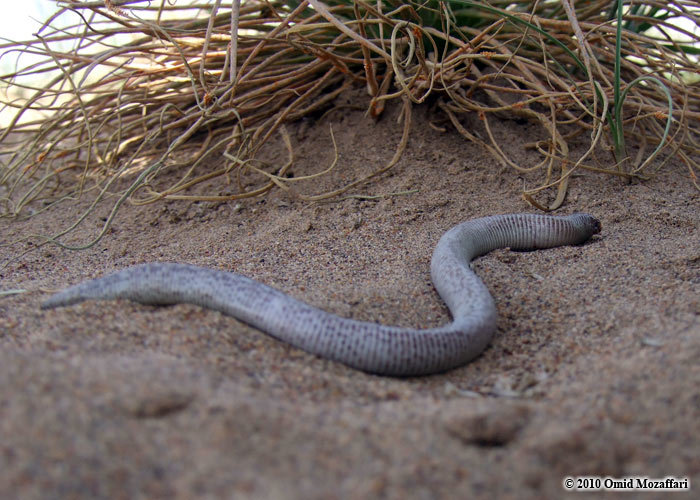
Trogonophidae (Palearctic worm lizards or desert ringed lizards) is a small family of amphisbaenians, containing six species in four genera.
Xenosauridae
Xenosauridae is a family of anguimorph lizards whose only living representative is the genus Xenosaurus, which is native to Central America. Xenosauridae also includes the extinct genera Exostinus and Restes. Also known as knob-scaled lizards, they have rounded, bumpy scales and osteoderms. Most living species prefer humid, rocky habitats, although they are widespread within their native regions, with some inhabiting semi-arid scrub environments. They are carnivorous or insectivorous, and give birth to live young.

Dactyloidae
Dactyloidae are a family of lizards commonly known as anoles (singular anole ) and native to warmer parts of the Americas, ranging from southeastern United States to Paraguay. Instead of treating it as a family, some authorities prefer to treat it as a subfamily, Dactyloinae, of the family Iguanidae. In the past they were included in the family Polychrotidae together with Polychrus (bush anoles), but the latter genus is not closely related to the true anoles.

Leiosauridae
Leiosauridae is a family of iguanian lizards containing six genera and 34 species. The family is endemic to Central America and South America.
Liolaemidae
Liolaemidae are a family of iguanian lizards. They were traditionally included in the family Iguanidae as subfamily Liolaeminae, which some more recent authors prefer to delimit in a more restricted way. This family is only found within South America with the widest range being in Argentina, Bolivia, Brazil, Chile, Peru, Uruguay, and Paraguay. A common name for this group is liolaemids. Liolaemidae are typically herbivores that have a diet high in fruit. Because of this special diet, Liolaemidae have a larger small intestine when compared to other similar omnivorous and insectivorous lizards.
Helodermatidae
The Helodermatidae or beaded lizards are a small family of lizards endemic to North America today, mainly found in the Isthmus of Tehuantepec in Oaxaca, the central lowlands of Chiapas, on the border of Guatemala, and in the Nentón River Valley, though they were formerly more widespread in the ancient past. Traditionally, the Gila monster and the Mexican beaded lizard were the only species recognized, although the latter has recently been split into several species.
Bipedidae
Bipedidae is a family of amphisbaenians that includes the extant genus Bipes represented by three species from Baja California and the southern coast of Mexico and the extinct genus Anniealexandria represented by one species that lived in what is now Wyoming during the earliest Eocene around 55 million years ago. Phylogenetic analysis indicates that Bipedidae is most closely related to the family Blanidae, which includes the living genus Blanus.

Aigialosauridae
Aigialosauridae (from Greek, aigialos, meaning "seashore", and sauros, "lizard") is a family of Late Cretaceous semiaquatic pythonomorph lizards closely related to the mosasaurs. Regarded by some paleontologists as a distinct monophyletic group and by others as an adaptive grade within the basal mosasauroids, recent molecular and morphological data suggests that they are the oldest known members of the lineage leading to the mosasaurs.

Rhineuridae
Rhineuridae is a family of amphisbaenians (commonly called worm lizards) that includes one living genus and species, Rhineura floridana, as well as many extinct species belonging to both Rhineura and several extinct genera. The living R. floridana is found only in Georgia and Florida, but extinct species ranged across North America, some occurring as far west as Oregon. The family has a fossil record stretching back 60 million years to the Paleocene and was most diverse in the continental interior during the Eocene and Oligocene.
Leiocephalidae
REDIRECT Curly-tailed lizard
Dolichosauridae
Dolichosauridae (from Latin, dolichos = "long" and Greek sauros= lizard) is a family of Cretaceous aquatic lizards. They are widely considered to be the earliest and most primitive members of Mosasauria, though some researchers have recovered them as more closely related to snakes.
Cadeidae
REDIRECT Cadea (lizard)