Category
page 1Lymphocytes

lymphocyte
A lymphocyte is a type of white blood cell (leukocyte) in the immune system of most vertebrates. Lymphocytes include T cells (for cell-mediated and cytotoxic adaptive immunity), B cells (for humoral, antibody-driven adaptive immunity), and innate lymphoid cells (ILCs; "innate T cell-like" cells involved in mucosal immunity and homeostasis), of which natural killer cells are an important subtype (which functions in cell-mediated, cytotoxic innate immunity). They are the main type of cell found in lymph, which prompted the name "lymphocyte" (with cyte meaning cell). Lymphocytes make up between 1

B-cell
type of white blood cell
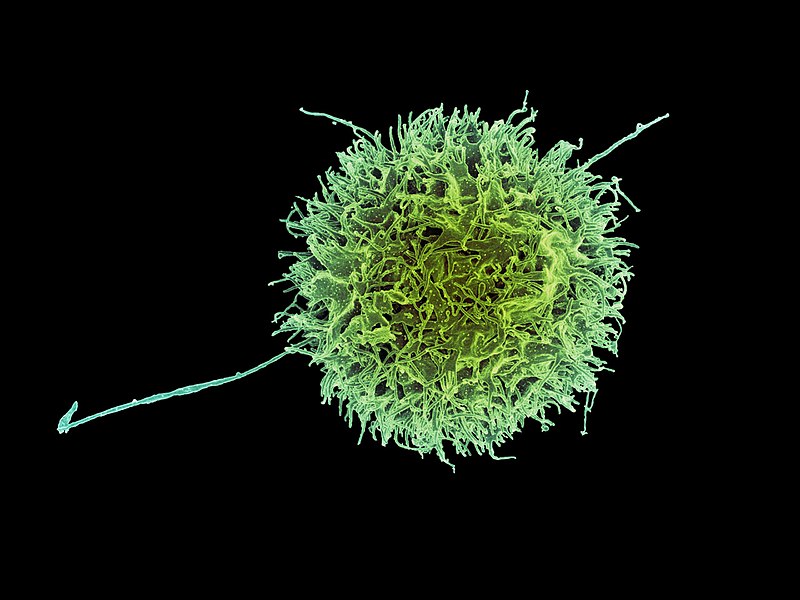
natural killer cell
type of cytotoxic lymphocyte
plasma cell
white blood cell that secretes large volumes of antibodies
V(D)J recombination
process in which immune receptor V, D, and J, or V and J gene segments, are recombined within a single locus
memory B cell
cell type
B-cell receptor
transmembrane protein on the surface of a B cell
memory T cell
cell type
natural killer T cell
group of T cells that share properties of both T cells and natural killer (NK) cells

innate lymphoid cell
cell of the immune system
tumor infiltrating lymphocyte
lymphocyte that show specificity for autologous tumor cells
naive B cell
cell type
lymphopoiesis
Lymphopoiesis (lĭm'fō-poi-ē'sĭs) (or lymphocytopoiesis) is the generation of lymphocytes, one of the five types of white blood cells (WBCs). It is more formally known as lymphoid hematopoiesis.
thymocyte
A thymocyte is an immune cell present in the thymus, before it undergoes transformation into a T cell. Thymocytes are produced as stem cells in the bone marrow and reach the thymus via the blood.
cytokine-induced killer cell
group of immune effector cells
B-1 cell
B cell lymphocytes
reactive lymphocyte
lymphocytes that become large as a result of antigen stimulation
prolymphocyte
thumb|Prolymphocyte, schematic image
thumb|230px|Prolymphocyte, micrograph in a peripheral blood smear. They are medium-sized lymphocytes with prominent nucleoli.
A prolymphocyte is a white blood cell with a certain state of cellular differentiation in lymphocytopoiesis. In the 20th century it was believed that a sequence of general maturation changed cells from lymphoblasts to prolymphocytes and then to lymphocytes (the lymphocytic series), with each being a precursor of the last. Today it is believed that the differentiation of cells in the lymphocyte line is not always simply chronologic bu
RAG1:RAG2 recombinase [nucleoplasm]
instance of macromolecular complex in Homo sapiens with Reactome ID (R-HSA-8865713)
regulatory B cell
type of cell