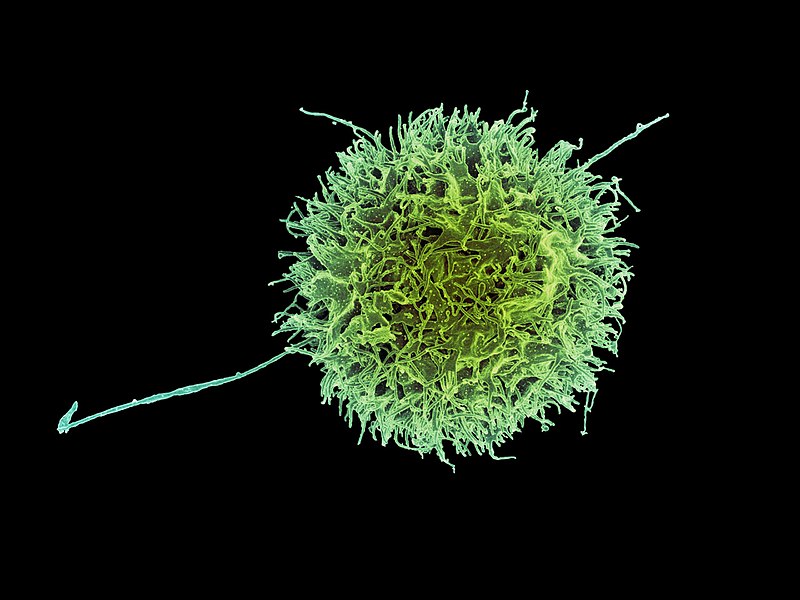
File:Human_Natural_Killer_Cell_(29120480442).jpg · Wikimedia Commons · See Wikimedia Commons
natural killer cell
Sign in to saveAlso known as NK cell, Large Granular Lymphocytes, Large granular lymphocytes, LGL, D007694, Killer Cells, Natural, NK, NK cells
type of cytotoxic lymphocyte
Key facts
- System
- Immune system
- Function
- Cytotoxic lymphocyte
- Mesh
- D007694
via Wikipedia infobox
Research
80,782 papers- Natural killer cell metabolism.Molecular immunology · 2019
- Natural killer cell-derived exosome-based cancer therapy: from biological roles to clinical significance and implications.Molecular cancer · 2024
- Natural Killer Cell Immunotherapy for Osteosarcoma.Advances in experimental medicine and biology · 2020
- Natural killer cell effector functions in antiviral defense.The FEBS journal · 2022
- Natural killer cell exhaustion in SARS-CoV-2 infection.Innate immunity · 2022
via PubMed
Wikidata facts
- Instance of
- cell type
- Subclass of
- agranulocytes
- Part of
- innate immune response
Show 2 more facts
- Commons category
- NK cells
- different from
- natural killer T cell
via Wikidata · CC0
~36 min read
Encyclopedic overview
Natural killer cells, also known as NK cells, are a type of cytotoxic lymphocyte critical to the innate immune system. They are a kind of large granular lymphocyte (LGL), belong to the rapidly expanding family of known innate lymphoid cells (ILC), and represent 5–20% of all circulating lymphocytes in humans. The role of NK cells is analogous to that of cytotoxic T cells in the vertebrate adaptive immune response. NK cells provide rapid responses to virus-infected cells, stressed cells, tumor cells, and other intracellular pathogens based on signals from several activating and inhibitory receptors. While cytotoxic T cells can only activate by detecting the antigen presented on major histocompatibility complex class I (MHC class I) molecules on infected cell surfaces, NK cells recognize and kill stressed cells that are lacking the MHC class I molecules. They were named "natural killers" because of the notion that they do not require activation to kill cells that are missing "self" markers of MHC class I. This role is especially important because harmful cells that are missing MHC I markers cannot be detected and destroyed by other immune cells, such as T lymphocyte cells.
NK cells can be identified by the presence of CD56 and the absence of CD3 (CD56, CD3). NK cells differentiate from CD127 common innate lymphoid progenitor, which is downstream of the common lymphoid progenitor from which B and T lymphocytes are also derived. NK cells are known to differentiate and mature in the bone marrow, lymph nodes, spleen, tonsils, and thymus, where they then enter into the circulation. NK cells differ from natural killer T cells (NKTs) phenotypically, by origin and by respective effector functions; often, NKT cell activity promotes NK cell activity by secreting interferon gamma. In contrast to NKT cells, NK cells do not express T-cell antigen receptors (TCR) or pan T marker CD3 or surface immunoglobulins (Ig) B cell receptors, but they usually express the surface markers CD16 (FcγRIII) and CD57 in humans, NK1.1 or NK1.2 in C57BL/6 mice. The NKp46 cell surface marker constitutes, at the moment, another NK cell marker of preference being expressed in both humans, several strains of mice (including BALB/c mice) and in three common monkey species.
Excerpted from Wikipedia’s “natural killer cell” article, available under the CC BY-SA 4.0 licence.