Category
page 1Magic symbols
.png)
swastika
thumb|The swastika is a symbol with many styles and meanings and has been used in many cultures and religions around the world for millennia.
thumb|The Cultural appropriation|appropriation of the swastika by the [[Nazi Party (1920–1945) is the most recognisable modern usage of the symbol in the Western world.]]

runic script
.jpg)
tarot deck
thumb|Trumps of the Tarot de Marseilles, a standard 18th-century playing card pack, later also used for divination
thumb|A Tarot reading|3-card tarot spread used for divination. The deck is the Smith-Waite Centennial Tarot Deck (a faithful reproduction of the original [[Rider-Waite-Smith deck from 1909).]]
%2001.svg)
ankh
thumb|upright=0.5|The ankh has a T-shape topped by a droplet-shaped loop.
The ankh or key of life is an ancient Egyptian hieroglyphic symbol used to represent the word for "life" and, by extension, as a symbol of life itself.

pentagram
thumb|upright=1.2|Pentagram
A pentagram (sometimes known as a pentalpha, pentangle, or star pentagon) is a regular five-pointed star polygon, formed from the diagonal line segments of a convex (or simple, or non-self-intersecting) regular pentagon. Drawing a circle around the five points creates a similar symbol referred to as the pentacle, which is used widely by Wiccans and in paganism, or as a sign of life and connections, but there is also a inverted version.
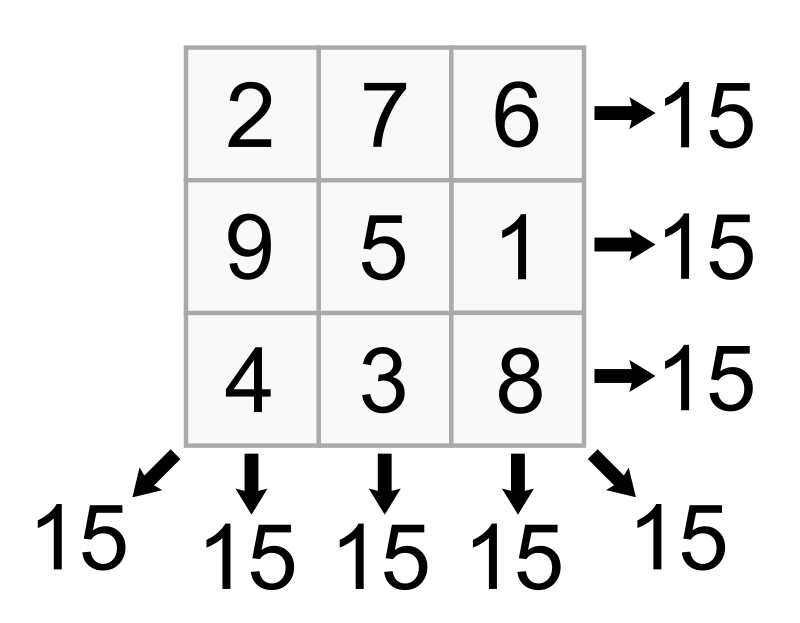
magic square
sums of each row, column, and main diagonals are equal

ouroboros
thumb|right|A dragon-like ouroboros in a 1478 drawing in an alchemical tract

Eye of Horus
ancient Egyptian symbol of protection, royal power and good health

Baphomet
thumb|An 1856 depiction of the Sabbatic Goat from by Éliphas Lévi. The arms bear the [[Latin words (dissolve) and (coagulate), reflecting the spiritual alchemy of Lévi's work.]]
Sator Square
word square containing a five-word Latin palindrome
nazar
eye-shaped amulet believed to protect against the evil eye

Black Sun (symbol)
The Black Sun is a type of sun wheel symbol originating in Nazi Germany and later employed by neo-Nazis and other far-right individuals and groups. It first appeared in Nazi Germany as a design element in a castle at Wewelsburg, remodeled and expanded by the head of the Schutzstaffel (SS), Heinrich Himmler, which he intended to serve as the SS's center. The symbol appeared nowhere else in Nazi Germany. The symbol's design consists of twelve radial sig runes similar to those that made up the SS logo.
sun cross
motif of a circle containing four or more spokes forming a cross

Valknut
thumb|Valknut variations.On the left :wikt:unicursal|unicursal trefoil forms; on the right tricursal linked triangle forms.
Seal of Solomon
ring worn by Solomon, in which was a stone from which, according to the Rabbins, he learned whatever he wished to know
.jpg)
Wolfsangel
'''''' (, translation: "wolf's hook") or '''' () is a heraldic charge from mainly Germany and eastern France, which was inspired by medieval European wolf traps that consisted of a Z-shaped metal hook (called the Wolfsangel, or the crampon in French) that was hung by a chain from a crescent-shaped metal bar (called the ', or the in French). The stylized symbol of the Z-shape (also called the ', meaning the "double-hook") can include a central horizontal bar to give a Ƶ-symbol, which can be reversed and/or rotated; it is sometimes mistaken as being an ancient rune due to its similarity to the "
magic circle
circle of space marked out by practitioners of many branches of ritual magic
tree of life
mystic and kabbalistic simbology related to life whose meaning depends on culture or religion

Indalo
thumb|upright|Indalo Man
The Indalo is a Bronze Age magical symbol found in the cave of "Los Letreros" ("The Signboards") in Sierra de María-Los Vélez Natural Park in Vélez Blanco, Almería, Andalusia, Spain. It has been customary to paint the Indalo symbol on the front of houses and businesses to protect them from evil, and it is considered to be a god totem. The indalo has its origin in the Levante, Spain and dates back to 2500 BC. The pictograph was named in memory of Saint Indaletius.
.svg)
pentacle
thumb|Pentagram, a common symbol on a pentacle
A pentacle (also spelled and pronounced as pantacle in Thelema, following Aleister Crowley, though that spelling ultimately derived from Éliphas Lévi) is a talisman that is used in magical evocation, and is usually made of parchment, paper, cloth, or metal (although it can be of other materials), upon which a magical design is drawn. Symbols may also be included (sometimes on the reverse), a common one being the six-point form of the Seal of Solomon.
veve
A veve (also spelled vèvè or vevè) is a religious symbol commonly used in different branches of Vodun throughout the African diaspora, such as Haitian Vodou and Louisiana Voodoo. The veve acts as a "beacon" for the lwa, and will serve as a lwas representation during rituals.
Monas Hieroglyphica
literary work
unicursal hexagram
six-pointed figure which can be drawn with a single line; mystical or occult symbol
Rose Cross
symbol of a cross with a rose at its centre, associated with Rosicrucianism and other mystical movements
Symbol of Chaos
eight-arrowed symbol originally devised by Michael Moorcock
Hexafoil
thumb|A geometrical hexafoil
Horus on the Crocodiles
group of ancient Egyptian amulets