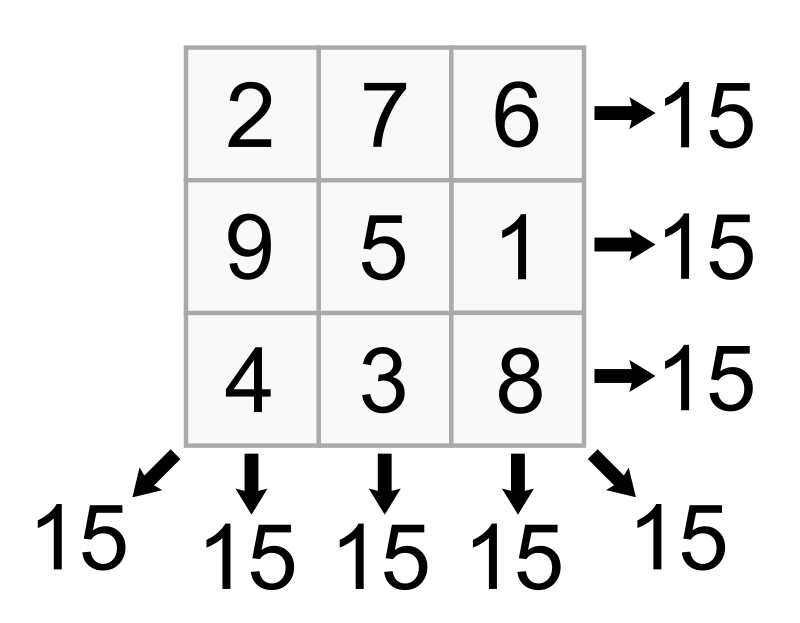
File:Magicsquareexample.svg · Wikimedia Commons · See Wikimedia Commons
magic square
Sign in to saveAlso known as diagonally magic square, normal magic square
sums of each row, column, and main diagonals are equal
A magic square is a grid of numbers where the sums of each row, column, and main diagonal all add up to the same total. While magic squares are primarily recreational puzzles that have fascinated mathematicians and puzzle enthusiasts for centuries, they also have applications in areas like combinatorics and recreational mathematics.
AI-generated from the Wikipedia summary — may contain errors.
Wikidata facts
- Image
- Albrecht Dürer - Melencolia I (detail).jpg
Show 7 more facts
- described by source
- Encyclopædia Britannica 11th edition
- Commons category
- Magic squares
- Stack Exchange tag
- stackoverflow.com/tags/magic-square
- topic's main category
- Category:Magic squares
- has characteristic
- magic constant
- studied by
- graph theory
- maintained by WikiProject
- WikiProject Mathematics
Sources (3)
via Wikidata · CC0
~40 min read
Encyclopedic overview
The smallest (and unique up to rotation and reflection) non-trivial case of a magic square, order 3, magic sum 15
In mathematics, especially historical and recreational mathematics, a magic square is a square array of numbers, usually positive integers, where the sums of the numbers in each row, each column, and both main diagonals are the same. The order of a magic square is the number of integers along one side (n), and the constant sum is called the magic constant or magic sum. If the array includes just the positive integers
Excerpted from Wikipedia’s “magic square” article, available under the CC BY-SA 4.0 licence.