Category
page 1Magistri militum

Theodoric the Great
king of the Germanic Ostrogoths and ruler of Italy (493–526)

Belisarius
Flavius Belisarius (; ; March 565) was a military commander of the Byzantine Empire under Emperor Justinian I. Belisarius was instrumental in the reconquest of much of the Mediterranean territory belonging to the former Western Roman Empire, which had been lost less than a century prior. He is considered one of the greatest military commanders of Byzantium and in history generally.

Maurice
Byzantine Emperor (539-602)

Zeno
Byzantine Emperor (425–491)

Aëtius
Roman general and statesman ( c. 390 – 454)
%20th%C3%A9odosienne%20de%20la%20villa%20romaine%20de%20Chiragan%20-%20Mus%C3%A9e%20Saint-Raymond%20Ra%2082.jpg)
Majorian
Majorian (; 7 August 461) was Western Roman emperor from 457 to 461. A prominent commander in the Western military, Majorian deposed Avitus in 457 with the aid of his ally Ricimer at the Battle of Placentia. Possessing little more than Italy and Dalmatia, as well as some territory in Hispania and northern Gaul, Majorian campaigned vigorously for three years against the Empire's enemies. In 461, he was murdered at Dertona in a conspiracy, and his successors until the fall of the Empire in 476 were puppets either of barbarian generals or the Eastern Roman court.

Avitus
Eparchius Avitus (died 456/7) was Roman emperor of the Western Empire from July 455 to October 456. He was a senator of Gallic extraction and a high-ranking officer both in the civil and military administration, as well as Bishop of Piacenza.

Constantius III
Western Roman Emperor (370-421)

Anthemius
Procopius Anthemius (; died 11 July 472) was the Western Roman emperor from 467 to 472. Born in the Eastern Roman Empire, Anthemius quickly worked his way up the ranks. He married into the Theodosian dynasty through Marcia Euphemia, daughter of Eastern emperor Marcian. He soon received a significant number of promotions to various posts, and was presumed to be Marcian's planned successor. However, Marcian's sudden death in 457, together with that of Western emperor Avitus, left the imperial succession in the hands of Aspar. He instead appointed Leo, a low-ranking officer, to the Eastern throne

Stilicho
Stilicho (; – 22 August 408) was a military commander in the Roman army who, for a time, became the most powerful man in the Western Roman Empire. He was partly of Vandal origins and married to Serena, the niece of emperor Theodosius I. He became guardian for the underage Honorius. After years of struggle against barbarian and Roman enemies, political and military disasters finally allowed his enemies in the court of Honorius to remove him from power. His fall culminated in his arrest and execution in 408.
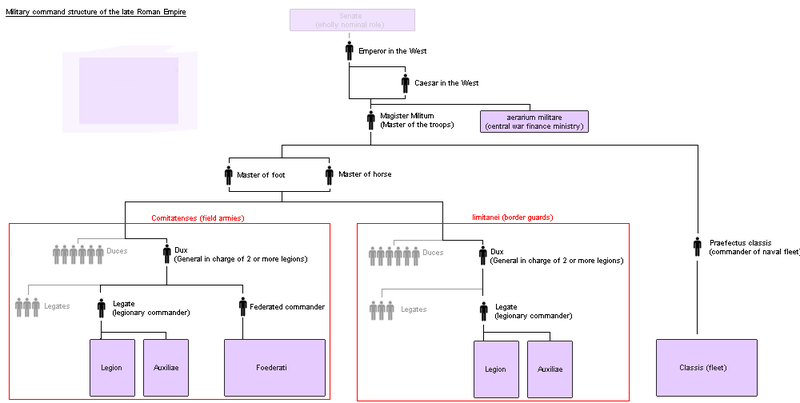
magister militum
Imperial Roman military office

Ricimer
Ricimer ( , ; – 19 August 472) was a Romanized Germanic general, who ruled the remaining territory of the Western Roman Empire from 456 after defeating Avitus, until his death in 472, with a brief interlude in which he contested power with Procopius Anthemius. Deriving his power from his position as magister militum of the Western Empire, Ricimer exercised political control through a series of puppet emperors. Ricimer's death led to unrest across Italy and the establishment of a Germanic kingdom on the Italian Peninsula.
%2003.JPG)
Aspar
thumb|Detail of a dish depicting Aspar and his elder son Ardabur (consul 447)|Ardabur ( 434).
Orestes
Roman politician and general (420-476)

Aegidius
Aegidius (died 464 or 465) was the ruler of the short-lived Kingdom of Soissons from 461 to 464/465. Before his ascension he was an ardent supporter of the Western Roman emperor Majorian, who appointed him magister militum per Gallias ("Master of the Soldiers for Gaul") in 458. After the general Ricimer assassinated Majorian and replaced him with Emperor Libius Severus, Aegidius rebelled and began governing his Gallic territory as an independent kingdom. He may have pledged his allegiance to the Eastern Roman emperor Leo I.
Arbogast
Frankish general (340-394)
Gundobad
Gundobad (; ; 452 – 516) was King of the Burgundians (473–516), succeeding his father Gundioc of Burgundy. Previous to this, he had been a patrician of the moribund Western Roman Empire in 472–473, three years before its collapse, succeeding his uncle Ricimer. He is perhaps best known today as the probable issuer of the Lex Burgundionum legal codes, which synthesized Roman law with ancient Germanic customs. He was the husband of Caretene.

Bonifatius
thumb|300px|Coin of Bonifatius Comes Africae (422-431 AD).
Teodato Ipato
doge of Venice

Gainas
Gainas (?-400 AD, Greek: Γαϊνάς) was a Gothic leader who served the Eastern Roman Empire as magister militum during the reigns of Theodosius I and Arcadius. He played an important role in the events in the eastern part of the empire by the end of the 4th century.

Heraclius the Elder
Byzantine general
Maurizio Galbaio
Doge of Venice
Vitalian
6th-century Byzantine general
Theodoric Strabo
Ostrogoth chieftain
Sittas
Sittas (; died 538) was a Byzantine military commander during the reign of Emperor Justinian I (r. 527–565). During the Iberian War against the Sassanid Empire, Sittas was given command of forces in Armenia, similar to the status of Belisarius in Mesopotamia. He won a victory over the Sassanids at the battle of Satala.
Richomeres
Flavius Richomeres or Richomer, Ricomer (died 393) was a Frank who lived in the late 4th century. He took service in the Roman army and made a career as comes, magister militum, and consul. He was an uncle of the general Arbogastes. He is possibly to be identified with the Richomeres who married Ascyla, whose son Theodemer later became king of the Franks.

Flavius Bauto
Flavius Bauto (died c. 385) was a Romanised Frank who served as a magister militum of the Roman Empire and was a powerful figure in the court of emperor Valentinian II.
Germanus
Byzantine general
Theophylact I
medieval Italian noble

Illus
Flavius Illus (; died 488) was a Roman general who played an important role in the reigns of the Eastern Emperors Zeno and Basiliscus.
Justin
Byzantine aristocrat and general
Justinian
6th-century Byzantine military general
Flavius Areobindus Dagalaifus Areobindus
Byzantine general and politician (460-512)

Artabanes
Artabanes (, Armenian: Artawan, from Parthian Artawân, fl. 538–554) was an Byzantine general of Armenian origin who served under Justinian I (). Initially a rebel against Byzantine authority, he fled to the Sassanid Persians but soon returned to Byzantine allegiance. He served in Africa, where he won great fame by killing the rebel general Guntharic and restoring the province to imperial allegiance. He became engaged to Justinian's niece Praejecta, but did not marry her due to the opposition of the Empress Theodora. Recalled to Constantinople, he became involved in a failed conspiracy against
Flavius Felix
Roman consul 428
Philippicus
Byzantine general
Solomon
Byzantine general
Marcellinus
Roman general (5th c.)
Castinus
Flavius Castinus was an influential Roman general and politician at the court of Emperor's' Honorius and Valentinian III, and most likely for some time before. He played a role in several military campaigns in Gaul and Hispania. He held the position of patricius and also served as consul for the year 424.
John Troglita
Byzantine general

Comentiolus
Comentiolus (, Komentiolos; died 602) was a prominent Eastern Roman (Byzantine) general at the close of the 6th century during the reign of Emperor Maurice (). He played a major role in Maurice's Balkan campaigns, and fought also in the East against the Sassanid Persians. Comentiolus was executed in 602 after the Byzantine army rebelled against Maurice and Emperor Phocas () usurped the throne.
Sarus
Gothic chieftain

Armatus
Flavius Armatus (died 477), also known as Harmatius, was an Eastern Roman military commander, magister militum under Emperors Leo I, Basiliscus and Zeno, and consul. He was instrumental in the rebellion of Basiliscus against Zeno, and in his subsequent fall.
Priscus
Byzantine general
Sabinianus
Roman consul (6th c.)
Ardabur
Roman general and politician, consul 427
Peter
brother of the Byzantine Emperor Maurice

Onoulphus
Onoulphus, also Onoulf, Unulf and Hunulf (died 493) was a military leader in the 5th century. His origins lay in the non Roman tribal groups led by Attila the Hun (died 453) in the Middle Danube region, but his career as a soldier brought him into the violent internal politics of the Roman empire during the period when the last Western Roman emperors lived and died.
Gerontius
Roman general
Fravitta
Flavius Fravitta (Greek: ; died 404/405) was a leader of the Goths and a top-ranking officer in the army of the Eastern Roman Empire.
Ecdicius
Ecdicius Avitus ( – after 475) was an Arverni aristocrat, senator, and magister militum praesentalis from 474 until 475.
Sergius I of Naples
Duke of Naples
Narses
Byzantine army officer
Bonus
Byzantine general and statesman
Areobindus
Roman general (magister militum) and consul of 434
John Mystacon
Byzantine general
Nevitta
Flavius Nevitta (fl. 357-363) was a military leader and official in the Roman Empire. His career is closely linked to that of Flavius Claudius Julianus, the Emperor Julian. He was master of the cavalry and in 362 served as consul.
Longinus
consul 486
Giovanni Fabriciaco
Doge of Venice
Patricius
Roman consul 500 AD, Byzantine general and statesman