Category
page 1Manuscripts

manuscript
thumb|right|Christ Pantocrator seated in a capital "U" in an [[illuminated manuscript from the Badische Landesbibliothek, Germany (from )]]
thumb|right|Image of two facing pages of the illuminated manuscript of "Isagoge", fols. 42b and 43a. On the top of the left hand page is an illuminated letter "D" – initial of "De urinarum differencia negocium" (The matter of the differences of urines). Inside the letter is a picture of a master on bench pointing at a raised flask while lecturing on the "Book on urines" of Theophilus. The right hand page is only shown in part. On its very bottom is an illu

illuminated manuscript
manuscript in which the text is supplemented by the addition of decoration
.jpg)
palimpsest
thumb|350px|The Codex Ephraemi Rescriptus, a Greek manuscript of the Bible from the 5th century, is a palimpsest.
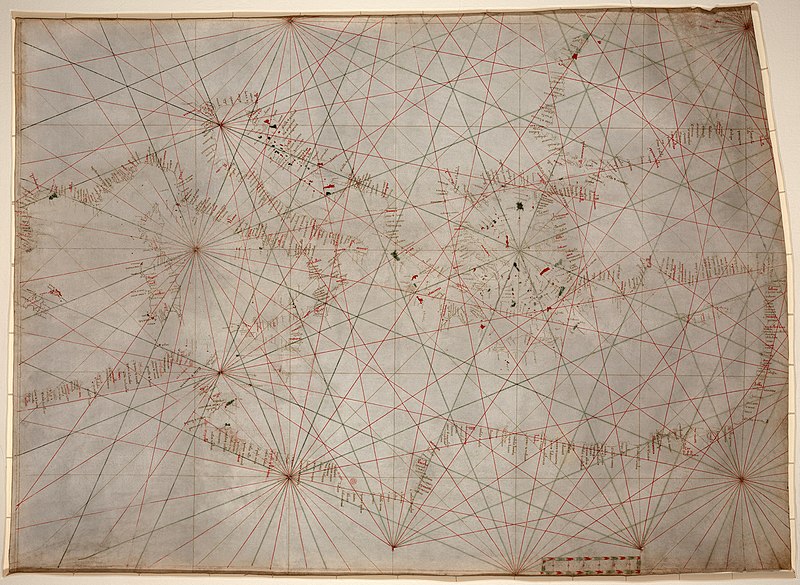
portolan chart
nautical charts, first made in the 13th century

scriptorium
thumb|Miniature of Vincent of Beauvais writing in a manuscript of the Speculum Historiale in French, Bruges, c. 1478–1480, [[British Library Royal 14 E. i, vol. 1, f. 3, probably representing the library of the Dukes of Burgundy.]]

autograph
thumb|upright=1.35|"B-A-C-H is beginning and end of all music", signed autograph document by [[Max Reger (dated 7 May 1912)]]An autograph is a person's own handwriting or signature. The word autograph comes from Ancient Greek (, autós, "self" and , gráphō, "write"), and can mean more specifically:
a manuscript written by the author of its content. In this meaning the term autograph can often be used interchangeably with holograph.
a celebrity's handwritten signature. Autograph collecting is the activity of collecting such autographs.
.jpg)
Hunminjeongeum
Hunminjeongeum () is a 1446 work that formally introduced the first native Korean alphabet. That alphabet was originally also called "Hunminjeongeum", although it is now widely called "Hangul" (international spelling; spelled in South Korea "Hangeul") or "Chosŏn'gŭl" (in North Korea).
Oxyrhynchus Papyri
literary & non-literary manuscripts recovered from Al-Minya, Egypt

codicology
thumb|upright=1.5|Reims gospel codex (book)
autograph
document handwritten by its author
interpolation
entry or passage in a text that was not written by the original author
lacuna
gap in a manuscript, inscription, text, painting, or a musical work

rubric
thumb|Dominican Rite|Dominican [[Missal, c. 1240, with rubrics in red (Historical Museum of Lausanne)]]
thumb|Rubrics in an illuminated gradual of c. 1500
A rubric is a word or section of text that is traditionally written or printed in red ink for emphasis. The word derives from the Latin , meaning red ochre or red chalk, and originates in medieval illuminated manuscripts from the 13th century or earlier. In these, red letters were used to highlight initial capitals (particularly of psalms), section headings and names of religious significance, a practice known as rubrication, which was a sep

stichometry
thumb|300px|A List of Total Line Counts for Christian Texts: The title is 'Versus Scribturarum Sanctarum' or 'Lines of Holy Scriptures.' The second line says 'Genesis Versus IIIId' or 'Genesis Lines 4500.' The third line says 'Exodus Versus IIIdcc (= 3700). From the Codex Claromontanus (5th or 6th century AD), Leaf 467v, National Library, Paris, France.
Nuzi Texts
akkadian tablets
crossed letter
form of manuscript where two separate texts are written on the same page at right angles
Ramírez Codex
manuscript on Aztec history from the late XVIth century
Manuscript culture
Manuscripts for information storage and dissemination

Masonic manuscripts
Masonic manuscripts that are important in the study of the emergence of Freemasonry
Pact of Brunnen
National Mission for Manuscripts
Codex Petropolitanus
Wikimedia disambiguation page
Hypsiphrone
Hypsiphrone is Codex XI, Tractate 4 of the Nag Hammadi writings, named from the translation of a Greek feminine name word 'Hypsiphrone' or 'Hupsiph[rone]' rendered as she of high mind. The text is highly fragmentary, and only parts of several paragraphs have survived.
art of Carolingian illumination
decoration of manuscripts in the Carolingian period
rotulus
thumb|Volumen and Rotulus
Pahlavi Psalter
Middle-Persian translation of a Syriac version of the Book Of Psalms
Mitanni letter
Cuneiform tablet