Category
page 1Market segmentation

demography
alt=The Demography of the World Population from 1950 to 2100. Data source: United Nations — World Population Prospects 2017|thumb|350x350px|The Demography of the World Population from 1950 to 2100. Data source: United Nations — World Population Prospects 2017
market segmentation
process of dividing a broad consumer market into sub-groups with shared characteristics
factor analysis
statistical method used to describe correlation through fewer possibly latent variables
positioning
a marketing strategy to define the place a brand occupies in the minds of customers and how it distinguishes from competitor products
niche market
subset of the market on which a specific product is focusing
target market
group of people toward which an organization has decided to aim its marketing efforts
targeted advertising
type of advertising
target audience
intended or ideal recipient of a message or artistic expression
linear discriminant analysis
method used in statistics, pattern recognition and machine learning
regional lockout
type of digital rights management

geo-blocking
thumb | right | alt=Netflix does not currently offer its streaming service in China due to a challenging regulatory environment. | Netflix does not currently offer its streaming service in China due to a challenging regulatory environment.
Geo-blocking, geoblocking or geolocking is technology that restricts access to Internet content based upon the user's geographical location. In a geo-blocking scheme, the user's location is determined using Internet geolocation techniques, such as checking the user's IP address against a blacklist or whitelist, GPS queries in the case of a mobile device, acc
persona
fictional character created to represent the different user types within a targeted demographic
narrowcasting
Narrowcasting is the dissemination of information to a specialised audience, rather than to the broader public-at-large; it is the opposite of broadcasting. It may refer to advertising or programming via radio, podcast, newspaper, television, or the Internet. The term "multicast" is sometimes used interchangeably, although strictly speaking this refers to the technology used, and narrowcasting to the business model. Narrowcasting is sometimes aimed at paid subscribers, such as in the case of cable television.
mass customization
use of flexible computer-aided manufacturing systems to produce custom output
behavioral targeting
microtargeting
Microtargeting is the use of online data to tailor advertising messages to individuals, based on the identification of recipients' personal vulnerabilities. Such tactics can be used for promoting a product or a political candidate. Direct marketing data mining techniques that are used often involve predictive market segmentation (aka cluster analysis). Microtargeting's tactics rely on transmitting a tailored message to a subgroup on the basis of unique information about that subgroup.
psychographic
Psychographics is defined as "market research or statistics classifying population groups according to psychological variables" The term psychographics is derived from the words "psychological" and "demographics" Two common approaches to psychographics include analysis of consumers' activities, interests, and opinions (AIO variables), and values and lifestyles (VALS).

geotargeting
thumb|Wikimedia banner as example of geotargeting for its donation drive, here specifically targeting Netherlands.
In geomarketing and internet marketing, geotargeting is the method of delivering different content to visitors based on their geolocation. This includes country, region/state, city, metro code/zip code, organization, IP address, ISP, or other criteria. A common usage of geotargeting is found in online advertising, as well as internet television with sites such as iPlayer and Hulu. In these circumstances, content is often restricted to users geolocated in specific countries; this a
latent class model
model for clustering multivariate discrete data
personalized marketing
marketing strategy using data analysis to deliver individualized messages and products
Bass diffusion model
or Bass model, a mathematical marketing model
Segmenting and positioning
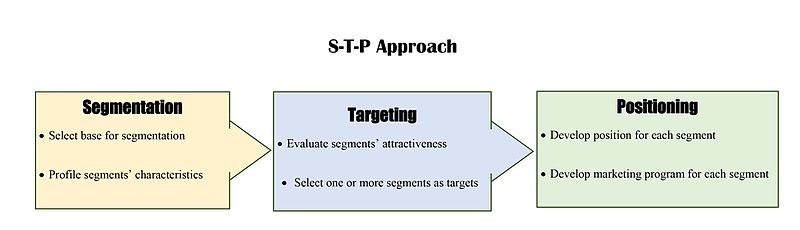
In marketing, segmenting, targeting and positioning (STP) is a framework that implements market segmentation. Market segmentation is a process, in which groups of buyers within a market are divided and profiled according to a range of variables, which determine the market characteristics and tendencies. The S-T-P framework implements market segmentation in three steps:
Segmenting means identifying and classifying consumers into categories called segments.
Targeting identifies the most attractive segments, usually the ones most profitable for the business.
Positioning proposes distinctive co
micromarketing
Micromarketing was first referred to in the UK marketing press in November 1988 in respect of the application of geodemographics to consumer marketing. The subject of micromarketing was developed further in an article in February 1990, which emphasised understanding markets at the local level, and also the personalisation of messages to individual consumers in the context direct marketing. Micromarketing has come to refer to marketing strategies which are variously customised to either local markets, to different market segments, or to the individual customer.