Category
page 1Mechanical engineering

work
energy transferred to an object via the application of force on it through a displacement

mechanical engineering
type of engineering discipline (not the studies)

heat transfer
transport of thermal energy in physical systems
.svg)
hydraulics
thumb|Hydraulics and other studies
thumb|An open channel, with a uniform depth. Open-channel hydraulics
thumb|Illustration of hydraulic and hydrostatic, from the "Table of Hydraulics and Hydrostatics", from Cyclopædia, or an Universal Dictionary of Arts and Sciences, edited by [[Ephraim Chambers, 1728, Vol. 1]]

simple machine
mechanical device that changes the direction or magnitude of a force
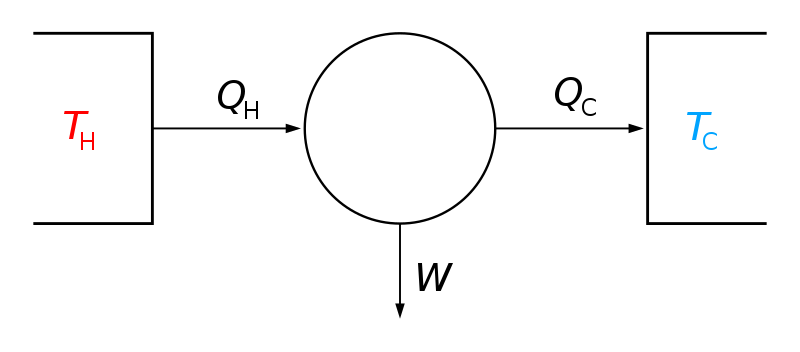
equation of state
equation describing the state of matter under a given set of physical conditions

refrigerant
Refrigerants are working fluids that carry heat from a cold environment to a warm environment while circulating between them. For example, the refrigerant in an air conditioner carries heat from a cool indoor environment to a hotter outdoor environment. Similarly, the refrigerant in a kitchen refrigerator carries heat from the inside the refrigerator out to the surrounding room. A wide range of fluids are used as refrigerants, with the specific choice depending on the temperature range needed and constraints related to the system involved.

tribology
Tribology is the science and engineering of understanding friction, lubrication and wear phenomena for interacting surfaces in relative motion. It is highly interdisciplinary, drawing on many academic fields, including physics, chemistry, materials science, mathematics, biology and engineering. The fundamental objects of study in tribology are tribosystems, which are physical systems of contacting surfaces. Subfields of tribology include biotribology, nanotribology and space tribology. It is also related to other areas such as the coupling of corrosion and tribology in tribocorrosion and the c

metalworking
thumb|A fireman turning a bar of metal on a lathe on the USS Harry S. Truman in 2004
Metalworking is the process of shaping and reshaping metals in order to create useful objects, parts, assemblies, and large scale structures. As a term, it covers a wide and diverse range of processes, skills, and tools for producing objects on every scale: from huge ships, buildings, and bridges, down to precise engine parts and delicate jewellery.
shaft
rotating machine element used to transmit power from one part to another

control engineering
engineering discipline that applies automatic control theory to design systems with desired behaviors in control environments
power engineering
subfield of electrical engineering, which deals with power generation, conversion, storage, transport and forwarding in electrical networks and use of electrical energy

heating, ventilation, and air conditioning
technology of indoor and vehicular environmental comfort

micro-electromechanical systems
thumb|MEMS microcantilever resonating inside a scanning electron microscope
thumb|Proposal submitted to DARPA in 1986 first introducing the term "microelectromechanical systems"
machine element
elementary component of a machine

dynamometer
thumb|360x360px|A chassis dynamometer.
dimensional analysis
analysis of the relationships between different physical quantities by identifying their base quantities and units of measure
Rube Goldberg machine
Deliberately complex contraption
surface roughness
component of surface finish (surface texture)

maintenance
thumb|A tractor being mechanically repaired in Werneuchen, 1966
thumb|Field repair of aircraft engine (1915–1916)
platform screen door
at train station platforms, a door that separates the platform from the train, due to architectural constraints, climate control, and/or for safety
duty cycle
fraction of a given period in which a signal or system is active
mass transfer
net movement of mass from one location, usually meaning a stream, phase, fraction or component, to another
compression
application of inward ("pushing") forces to a material or structure

chiller
thumb|upright=1.35|right|York International liquid-cooled chiller
A chiller is a machine that removes heat from a liquid coolant via a vapor-compression, adsorption refrigeration, or absorption refrigeration cycles. This liquid can then be circulated through a heat exchanger to cool equipment, or another process stream (such as air or process water). As a necessary by-product, refrigeration creates waste heat that must be exhausted to ambience, or for greater efficiency, recovered for heating purposes. Vapor compression chillers may use any of a number of different types of compressors. Most c
orifice plate
restriction used to measure flow or to control pressure or flow, sometimes given specialised names
expansion joint
construction detail designed to absorb temperature-induced volume changes of construction parts

turbomachinery
thumb|Mounting of a steam turbine produced by [[Siemens, Germany]]
thumb|Aircraft engine, in this case on a Boeing 777
Turbomachinery, in mechanical engineering, describes machines that transfer energy between a rotor and a fluid, including both turbines and compressors. While a turbine transfers energy from a fluid to a rotor, a compressor transfers energy from a rotor to a fluid. It is an important application of fluid mechanics.
South-pointing chariot
ancient Chinese two-wheeled vehicle
residual stress
remaining stress in a solid material after removal of the original cause
Euler–Bernoulli beam theory
Method for load calculation in construction
contact mechanics
study of the deformation of solids that touch each other

photoelasticity
thumb|Plastic utensils in a photoelasticity experiment
structural load
forces, deformations, or accelerations applied to a structure or its components
structural failure
engineering event in which the structural integrity of a construction is compromised by failure of components of the structure
bolted joint
type of joining technique using bolts and nuts as fasteners
air handler
air handler

longeron
thumb|right|Interior of a Boeing/Stearman PT-17 showing small channel section stringers
thermal engineering
scientific field
Reynolds transport theorem
3D generalization of the Leibniz integral rule
backlash
in mechanical engineering, looseness due to clearance between components
tail lift
mechanical device installed on the rear of a carrier vehicle and used to facilitate moving goods to and from the level of the vehicle bed
fan coil unit
HVAC device
sight glass
cold galss
Wells turbine
low-pressure air turbine
engineering fit
geometric dimensioning and tolerance in engineering
interference fit
fastening achieved by friction after two parts are pushed together
processability
product design characteristic reflecting its ease of manufacture, maintenance or (and) repair
air preheater
device to heat air in preparation for a following process
reciprocating motion
repetitive up-and-down or back-and-forth linear motion
fillet
concave or convex rounded edge or corner of a manufactured object
vacuum engineering
Technology to lower gas pressures for various technical and scientific purposes
airflow
Airflow, or air flow, is the movement of air. Air behaves in a fluid manner, meaning particles naturally flow from areas of higher pressure to those where the pressure is lower. Atmospheric air pressure is directly related to altitude, temperature, and composition.

Pinch analysis
methodology for minimising energy consumption of chemical processes

friction loss
loss of energy in a pipe through friction along the edge
pneumatic tool
power tool driven by compressed air or carbon dioxide
joining technology
methods of assembly of engineering structures by mechanical joint of two or more elements

turboexpander
right|thumb|272px|Schematic diagram of a turboexpander driving a compressor

recuperator
thumb|400px|Types of recuperator, or cross plate heat exchanger
A recuperator is a counter-flow energy recovery heat exchanger that recovers waste heat in the supply and exhaust air streams of an air-handling system or in the exhaust gases of an industrial process. Generally, they extract heat from the exhaust and use it to preheat air entering the combustion system, reducing the need for fuel and boosting the system's energy efficiency.
bond graph
graphical description of a physical dynamic system