Category
page 1Mechanics

mechanics
thumb|right|A gyroscope in equilibrium

pulley
A pulley is a wheel on an axle or shaft enabling a taut cable or belt passing over the wheel to move and change direction, or transfer power between itself and a shaft.

wedge
thumb|A wood splitting wedge
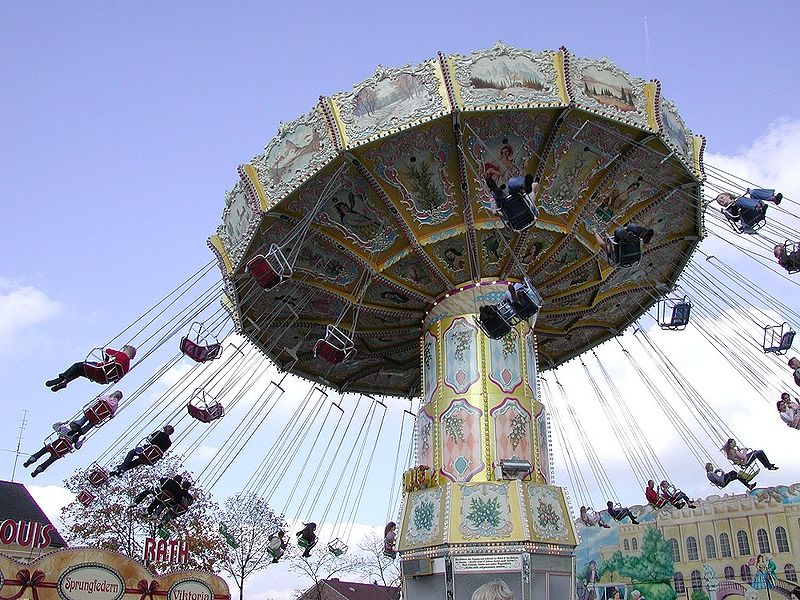
centrifugal force
type of inertial force

centripetal force
force that makes a moving body follow a curved path

physical object
singular aggregation of tangible substance(s) such as matter or radiation, with overall properties

trajectory
thumb|350px|Illustration showing the directional trajectory of a bullet fired at an uphill target

right-hand rule
common mnemonic for understanding orientation of axes in three-dimensional space

collision
alt=A 3D simulation demonstrating collision with a ball knocking over some blocks.|thumb|A 3D simulation demonstrating a collision with a ball knocking over a bunch of blocks
In physics, a collision is any event in which two or more bodies exert forces on each other in a relatively short time. Although the most common use of the word collision refers to incidents in which two or more objects collide with great force, the scientific use of the term implies nothing about the magnitude of the force.

implosion
a process in which objects are destroyed by collapsing (or being squeezed in) on themselves
torsion
twisting of an object due to an applied torque

truss
thumb|Truss bridge for a single-track railway, converted to pedestrian use and pipeline support. In this example the truss is a group of triangular units supporting the bridge.
thumb|Typical detail of a steel truss, which is considered as a revolute joint
thumb|Historical detail of a steel truss with an actual revolute joint
A truss is an assembly of members such as beams, connected by nodes, that creates a rigid structure.
applied mechanics
practical application of mechanics
solid mechanics
branch of science that studies the behavior of solid materials

fracture
thumb|Ductile failure of a metallic specimen strained axially

brachistochrone curve
curve connecting two points such that a bead sliding frictionlessly in a uniform gravitational field moves to the other endpoint the fastest
couple
system of forces with a resultant moment but no resultant force
Stokes' theorem
theorem in vector calculus

buckling
thumb|Buckled skin panels on a Boeing B-52 Stratofortress|B-52 aircraft. Thin skin panels buckle at very low loads. In the case shown here, the weight of the forward fuselage structure ahead of the nose undercarriage is sufficient to cause the panels to buckle. Buckled panels are still effective in carrying shear by diagonal tension.
thumb|On the front of a new Siemens Venture railway coach made of stainless steel, unevenness caused by buckling becomes apparent because of the reflection on the polished surface.
In structural engineering, buckling is the sudden change in shape (deformation) of
mechanical wave
wave which is an oscillation of matter
parallel axis theorem
theorem in planar dynamics
mechanical advantage
measure of the force amplification achieved by using a tool, mechanical device or machine system
chain drive
way of transmitting mechanical power
Mohr's circle
geometric engineering calculation technique
degree of freedom
(of mechanical system) number of independent parameters that define its configuration; number of parameters that determine the state of a physical system and is important to the analysis of systems of bodies
quality factor
dimensionless measure for the damping of an oscillator
structural mechanics
computation of deformations, deflections, and internal forces or stresses within structures
yield
phenomenon of deformation due to structural stress
reduced mass
"effective" inertial mass appearing in the two-body problem of Newtonian mechanics; quantity which allows the two-body problem to be solved as if it were a one-body problem
Atwood machine
classroom demonstration used to illustrate principles of classical mechanics
tautochrone curve
curve for which the time taken by an object sliding without friction in uniform gravity to its lowest point is independent of its starting point
virtual work
in analytical mechanics, the work of a force on a particle along a virtual displacement

photoelasticity
thumb|Plastic utensils in a photoelasticity experiment
free body diagram
diagram where all forces on a body or part of a system are drawn
power-to-weight ratio
calculation commonly applied to engines and mobile power sources
geomechanics
Geomechanics (from the Greek γεός, i.e. prefix geo- meaning "earth"; and "mechanics") is the study of the mechanical state of the Earth's crust and the processes occurring in it under the influence of natural physical factors. It involves the study of the mechanics of soil and rock.
coefficient of restitution
measure used to characterise inelastic collisions
vis viva
physical quantity, historically invented by G. Leibniz, equivalent to (in modern terminology) twice the kinetic energy
list of moments of inertia
Wikimedia list article
traction
physical process in which a tangential force is transmitted across an interface between two bodies through dry friction or an intervening fluid film resulting in motion, stoppage or the transmission of power
mechanical filter
Type of signal processing filter
factor of safety
factor by which an engineered system's capacity is increased over the expected requirement to ensure safety in the face of error or uncertainty
Virtual displacement
Displacement in analytical mechanics
Varignon's theorem (mechanics)
theorem
radial distribution function
description of particle density in statistical mechanics
pressure drop
difference in pressure between two points of a fluid
Fall factor
mathematical ratio relevant to climbing safety
six degrees of freedom
freedom of movement of a rigid body in three-dimensional space
effective potential
mathematical expression
lumped-element model
modeling of a highly complex system as multiple interconnected, simple components
König's theorem
named after Samuel König
gravity train
type of train

Cremona diagram
Diagram in mechanics
list of centroids
Wikimedia list article
metal bellows
elastic vessels
center of percussion
perpendicular impacts at the CoP will produce no reactive shock at the pivot of a rigid beam
Multibody system
computational mechanics
discipline concerned with the use of computational methods to study mechanics
mechanical shock
term in mechanics
differential pulley
device consisting of a movable pulley, two wheels with different diameters fixed together serving as the fixed pulley and a chain loop; device multiplying force; machine used to lift heavy loads