Category
page 1Mechanisms (engineering)

lever
A lever is a simple machine consisting of a beam or rigid rod pivoted at a fixed hinge, or fulcrum. A lever is a rigid body capable of rotating on a point on itself. On the basis of the locations of fulcrum, load, and effort, the lever is divided into three types. It is one of the six simple machines identified by Renaissance scientists. A lever amplifies an input force to provide a greater output force, which is said to provide leverage, which is mechanical advantage gained in the system, equal to the ratio of the output force to the input force. As such, the lever is a mechanical advantage d

kinematics
Kinematics is a subfield of physics and
a branch of geometry. In physics, kinematics studies the geometrical aspects of motion of physical objects independent of forces that set them in motion. Constrained motion such as linked machine parts are also described as kinematics. In geometry, kinematics studies the time dependence of geometrical quantities such as position, distance and angular measure with respect to a frame of reference. Most frequently, the quantities that kinematics deals with are the time derivatives of these quantities and the relations between them. Objects whose motion is
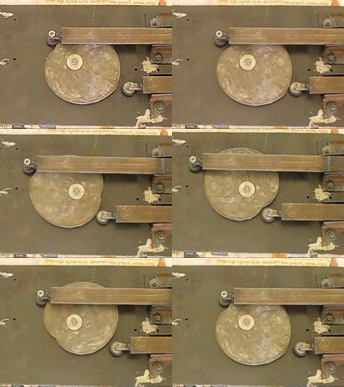
mechanism
device designed to transform input forces and movement into a desired set of output forces and movement

railroad switch
mechanical installation providing a branching of a railway track

differential
type of simple planetary gear train
firearm trigger
mechanism that actuates the firing sequence of a firearm or other weapon when pushed down by a finger
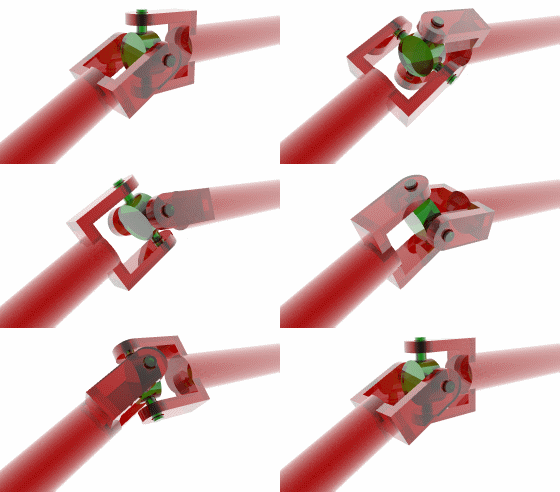
universal joint
mechanism with bendable rotation axis

cam
rotating or sliding piece, with eccentric or variegated profile, in a mechanical linkage
Geneva drive
mechanism that transforms continuous rotation into an intermittent rotary motion

treadmill
thumb|right|Example of modern treadmill
thumb|Treadmills at a YMCA

winch
thumb|Self-tailing winch on a sailboat. A Sheet (sailing)|sheet line runs from the sail (left, not shown) behind the winch to a block (lower right, not shown) and only from there back to the winch (lower part). The handle is detachable to ease line handling.
thumb|Front of a MAN SE|MAN-based [[fire engine with a built-in winch, e.g. for towing damaged cars after an accident]]
A winch is a mechanical device that is used to pull in (wind up) or let out (wind out) or otherwise adjust the tension of a rope or wire rope (also called "cable" or "wire cable").
transmission
component for motion-related rotary transmission of torque and rotational frequency
Rube Goldberg machine
Deliberately complex contraption

ballast
right|thumb|upright=2|Cross section of a vessel with a single ballast tank at the bottom
mechanical advantage
measure of the force amplification achieved by using a tool, mechanical device or machine system
mechanical pencil
writing implement
ratchet
mechanical device that allows continuous linear or rotary motion in only one direction

gimbal
thumb|Illustration of a simple three-axis gimbal set; the center ring can be vertically fixed
percussion cap
a small metallic cap or cup, usually of copper or brass, containing a shock-sensitive explosive compound
gear train
interconnected series of two or more gears in a machine
centrifugal governor
mechanism for automatically controlling the speed of an engine

coupling
thumb|An improvised flexible coupling made of car tyre pieces connects the drive shafts of an engine and a water pump. This one is used to cancel out Run-out|misalignment and dampen vibrations.
frame|Rotating coupling
A coupling is a device used to connect two shafts together at their ends for the purpose of transmitting power. The primary purpose of couplings is to join two pieces of rotating equipment while permitting some degree of misalignment or end movement or both. In a more general context, a coupling can also be a mechanical device that serves to connect the ends of adjacent parts or
solenoid valve
electromechanically operated valve
eccentric
circular disk rigidly fixed to a rotating axle with its centre offset from that of the axle

windlass
thumb|Turnbridge windlass lifting road bridge over [[Huddersfield Broad Canal]]
thumb|200px|Differential windlass
ski binding
device that connects ski boot to the ski
linkage
assembly of bodies connected to manage forces and movement

Trammel of Archimedes
thumb|Trammel of Archimedes animated model
kinematic chain
assembly of rigid bodies connected by joints to provide constrained motion that is the mathematical model for a mechanical system
float switch
Level sensor
mecanum wheel
type of omnidirectional wheel

trunnion
thumb|right|320px|The trunnions are the protrusions from the side of the barrel that rest on the carriage.

compliant mechanism
flexible mechanism that achieves force and motion transmission through elastic body deformation

governor
device used to measure and regulate the speed of a machine

mechanical efficiency
quotient of mechanical output and input power
Stewart platform
type of parallel manipulator
dashpot
thumb|Diagramatic symbol used to represent a dashpot.
A dashpot, also known as a damper, is a mechanical device that resists motion via viscous damping. The resulting force is proportional to the velocity, but acts in the opposite direction, slowing the motion and absorbing energy. Kinetic energy is converted to heat. It is commonly used in conjunction with a spring.
direct drive mechanism
transmitting of torque from an electric motor to the output devicewithout any gearing
differential pulley
device consisting of a movable pulley, two wheels with different diameters fixed together serving as the fixed pulley and a chain loop; device multiplying force; machine used to lift heavy loads
speed limiter
governor used to limit the top speed of a vehicle
steering column
device for connecting a steering wheel to a vehicle steering mechanism
jackscrew
thumb|A 2.5-ton screw jack. The jack is operated by inserting the bar (visible lower left) in the holes at the top and turning.
A jackscrew, or screw jack, is a type of jack that is operated by turning a leadscrew. It is commonly used to lift moderate and heavy weights, such as vehicles; to raise and lower the horizontal stabilizers of aircraft; and as adjustable supports for heavy loads, such as the foundations of houses.
torque limiter
clutch type, limits torque transmission by slipping or uncoupling

scissors mechanism
uses linked, folding supports in a criss-cross 'X' pattern
kinematic diagram
graph showing a machine or mechanism as links and joints
quill drive
mechanism in transmission optimizing
CoreXY
CoreXY is a kinematic motion system, popularized by its use to move the printhead of a 3D printer, or the toolhead in CNC machines, in the horizontal plane. The advantage of this technique is that the two motors used to perform the movement in the horizontal plane are stationary and do not have to move themselves, which can result in less moving mass. Instead, drive belts are used which are connected in an intricate way to provide movement in a Cartesian coordinate system. Compared to conventional Cartesian coordinate 3D printers for fused filament, it can provide increased printing speed due
stick bomb
spring-loaded device made from flat sticks
Cam timer
electromechanical system for controlling events