Category
page 1Medical equipment
.jpg)
stethoscope
The stethoscope (from Ancient Greek () and () ) is a medical device for auscultation, or listening to internal sounds of an animal or human body. It typically has a small disc-shaped resonator that is placed against the naked skin, with either one or two tubes connected to two earpieces. A stethoscope can be used to listen to the sounds made by the heart, lungs or intestines, as well as blood flow in arteries and veins. In combination with a manual sphygmomanometer, it is commonly used when measuring blood pressure. It was invented in 1816 by René Laennec and the binaural version by Arthur Lea

syringe
thumb|Disposable syringe with needle, with parts labelled: plunger, barrel, needle adaptor, needle hub, needle bevel, needle shaft

medical ultrasonography
diagnostic and therapeutic technique

tweezers
thumb|upright=1.35|Two types of modern-day conventional metal tweezers with pointed tips
thumb|upright=1.35|A pair of bronze tweezers attributed to the Minoan civilization,
Tweezers are small hand tools used for grasping objects too small to be easily handled with the human fingers. Tweezers are thumb-driven forceps most likely derived from tongs used to grab or hold hot objects since the dawn of recorded history. In a scientific or medical context, they are normally referred to as just "forceps", a name that is used together with other grasping surgical instruments that resemble pliers, pinc

nail clippers
tool for trimming toe or finger nails
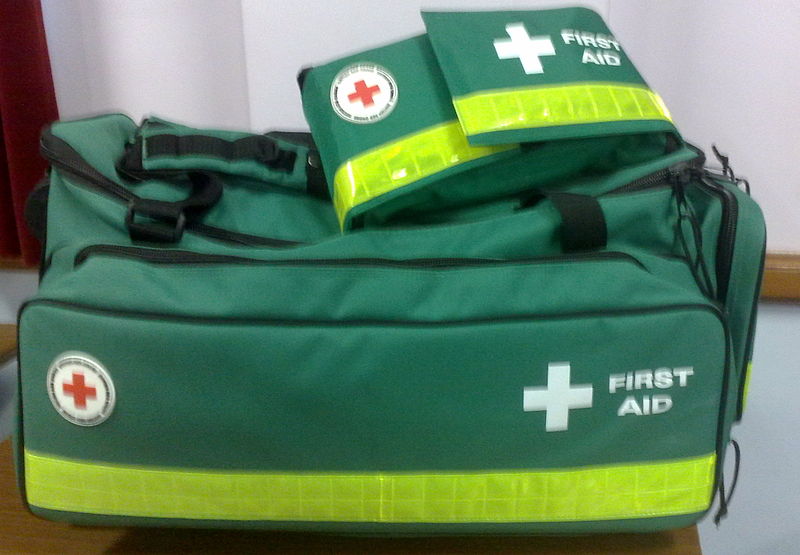
first aid kit
collection of supplies and equipment that is used to give medical treatment
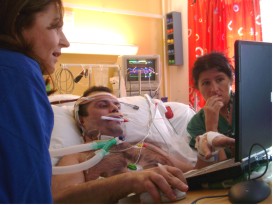
extracorporeal membrane oxygenation
extracorporeal technique of providing both cardiac and respiratory support

autoclave
thumb|Cutaway illustration of a cylindrical-chamber autoclave
An autoclave is a machine used to carry out industrial and scientific processes requiring elevated temperature and pressure in relation to ambient pressure and temperature. Autoclaves are found in many medical settings, laboratories, and other places that need to ensure the sterility of an object.

stretcher
thumb|EMTs using a stretcher in 2001.
thumb|Armed escort carries the wounded to the Senegalese border, Guinea-Bissau, 1974.
A stretcher, gurney, litter, or pram is an apparatus used for moving patients who require medical care. A basic type (cot or litter) must be carried by two or more people. A wheeled stretcher (known as a gurney, trolley, bed or cart) is often equipped with variable height frames, wheels, tracks, or skids.

crutch
alt=|thumb|Underarm (axillary) crutches used to keep weight off the injured leg.
alt=Man using forearm crutches|thumb|A man using forearm crutches
A crutch is a mobility aid that transfers weight from the legs to the upper body. It is often used by people who cannot use their legs to support their weight, for reasons ranging from short-term injuries to lifelong disabilities.

sphygmomanometer
A sphygmomanometer ( ), also known as a blood pressure monitor, blood pressure machine, or blood pressure gauge, is a device used to measure blood pressure, composed of an inflatable cuff to collapse and then release the artery under the cuff in a controlled manner, and a mercury or aneroid manometer to measure the pressure. Manual sphygmomanometers are used with a stethoscope when using the auscultatory technique.

stroboscope
thumb|A bouncing ball captured with a stroboscopic flash at 25 images per second.
thumb|A strobe light flashing at the proper period can appear to freeze or reverse cyclical motion

defibrillator
REDIRECT Defibrillation
liquid nitrogen
liquid state of the element nitrogen
hot water bottle
container usually made from plastic or other materials filled with hot water used for heating
tracheal intubation
placement of a tube into the trachea through the mouth or nose to provide a patient with oxygen and anesthesia
free-electron laser
type of laser
.jpg)
tourniquet
thumb|Tourniquet being applied to an arm on a Mannequin#Medical education|training dummy
alt=|thumb|A Combat Application Tourniquet (CAT) of the 7th generation, commonly used by combat medics (military environment) and EMS (civilian environment)
air purifier
device to remove contaminants from the air

ophthalmoscopy
Ophthalmoscopy, (from Ancient Greek ὀφθαλμός (ophthalmós), meaning "eye", and σκοπέω (skopéō), meaning "to look") also called funduscopy, is a test that allows a health professional to see inside the fundus of the eye and other structures using an ophthalmoscope (or funduscope). It is done as part of an eye examination and may be done as part of a routine physical examination. It is crucial in determining the health of the retina, optic disc, and vitreous humor.

nebulizer
In medicine, a nebulizer (American English) or nebuliser (English) is a drug delivery device used to administer medication in the form of a mist inhaled into the lungs. Nebulizers are commonly used for the treatment of asthma, cystic fibrosis, COPD and other respiratory diseases or disorders. They use oxygen, compressed air or ultrasonic power to break up solutions and suspensions into small aerosol droplets that are inhaled from the mouthpiece of the device. An aerosol is a mixture of gas and solid or liquid particles.
oxygen concentrator
device which removes nitrogen from air
speculum
medical device for investigating orifices
Nd:YAG laser
type of laser
air ioniser
device that uses high voltage to ionise air molecules
nasogastric intubation
feeding tube going into the stomach through the nose and throat

eyepatch
An eyepatch is a small patch that is worn in front of one eye. It may be a cloth patch attached around the head by an elastic band or by a string, an adhesive bandage, or a plastic device which is clipped to a pair of glasses. It is often worn by people to cover a lost, infected, or injured eye, but it also has a therapeutic use in children for the treatment of amblyopia. Eyepatches used to block light while sleeping are referred to as a sleep mask.
life support system
technology that allows survival in hostile environments

airlock
thumb|right|280 px|An airlock on board Space Shuttle Atlantis
obstetrical forceps
tool used for the delivery of a baby

pessary
thumb|right|Gold-plated stem pessary (intrauterine device) from 1920
A pessary is a prosthetic device inserted into the vagina for structural and pharmaceutical purposes. It is most commonly used to treat stress urinary incontinence to stop urinary leakage and to treat pelvic organ prolapse to maintain the location of organs in the pelvic region. It can also be used to administer medications locally in the vagina or as a method of contraception.
cardiopulmonary bypass
technique that temporarily takes over the function of the heart and lungs during surgery
endotracheal tube
catheter used to deliver air
incubator
device used to grow and maintain microbiological cultures or cell cultures

Diathermy
Diathermy is electrically induced heat or the use of high-frequency electromagnetic currents as a form of physical therapy and in surgical procedures. The earliest observations on the reactions of the human organism to high-frequency electromagnetic currents were made by Jacques Arsene d'Arsonval. The field was pioneered in 1907 by German physician Karl Franz Nagelschmidt, who coined the term diathermy from the Greek words () and (), literally meaning 'heating through' (adjectival forms: 'diathermal' and 'diathermic').

otoscope
alt=Components of an otoscope|thumb|Components of an otoscope
thumb|Anatomy of the human ear
thumb|Right tympanic membrane as seen through a speculum
thumb|A doctor performs an otoscopy examination.
An otoscope or auriscope is a medical device used by healthcare professionals to examine the ear canal and eardrum. This may be done as part of routine physical examinations, or for evaluating specific ear complaints, such as earaches, sense of fullness in the ear, or hearing loss.
optical coherence tomography
imaging technique

cannula
thumb|alt=Diagram showing a cannula|A cannula
feeding tube
medical device used to provide nutrition to people
.jpg)
laryngoscopy
Laryngoscopy () is endoscopy of the larynx, a part of the throat. It is a medical procedure that is used to obtain a view, for example, of the vocal folds and the glottis. Laryngoscopy may be performed to facilitate tracheal intubation during general anaesthesia or cardiopulmonary resuscitation or for surgical procedures on the larynx or other parts of the upper tracheobronchial tree.
transcutaneous electrical nerve stimulation
nerve stimulation for therapeutic purposes

trocar
thumb|Disposable trocars
thumb|Laparoscopic instruments for insertion through trocars

e-textile
alt=Printed tartan fabric with wireless charging coils, overlaid with multiple illuminated electronic circuit boards|thumb|Screen printed e-textile coils showing wireless powering of flexible circuits through the fabric.
thumb|An e-textile circuit swatch
thumb|upright|A dress with red LEDs built into the fabric

intubation
Intubation (sometimes entubation) is a medical procedure involving the insertion of a tube into the body. Most commonly, intubation refers to tracheal intubation, a procedure during which an endotracheal tube is inserted into the trachea to support patient ventilation. Other examples of intubation include balloon tamponade using a Sengstaken–Blakemore tube (a tube into the gastrointestinal tract), urinary catheterization, and nasogastric intubation using a feeding tube.
port
small medical appliance that is installed beneath the skin
peak expiratory flow
person's maximum speed of expiration
tongue depressor
tool used in medical practice
ISO 13485
ISO standard
hospital bed
special bed used in hospital

Orchidometer
thumb|300px|A schematic of an orchidometer
An orchidometer (or orchiometer) is a medical instrument used to measure the volume of the testicles.
fetoscopy
Fetoscopy is an endoscopic procedure during pregnancy to allow surgical access to the fetus, the amniotic cavity, the umbilical cord, and the fetal side of the placenta. A small (3–4 mm) incision is made in the abdomen, and an endoscope is inserted through the abdominal wall and uterus into the amniotic cavity. Fetoscopy allows for medical interventions such as a biopsy (tissue sample) or a laser occlusion of abnormal blood vessels (such as chorioangioma) or the treatment of spina bifida.

bedpan
thumb|Different types of bedpans
A bedpan or bed pan is a device used as a receptacle for the urine and/or feces of a person who is confined to a bed and therefore not able to use a toilet or chamber pot.
ice pack
filled bag designed to be frozen
negative-pressure wound therapy
therapeutic technique using a suction dressing to remove excess exudation and promote healing in acute or chronic wounds and second- and third-degree burns
penile prosthesis
medical device, implanted for the surgical treatment of organic erectile dysfunction
vaginal dilator
medical instrument used to stretch the vagina
patient lift
assistive device in health care
nasal cannula
device used to deliver supplemental oxygen or airflow to a patient or person in need of respiratory help

Vacutainer
right|frame|A range of Vacutainer tubes containing blood
high flow therapy
treatment