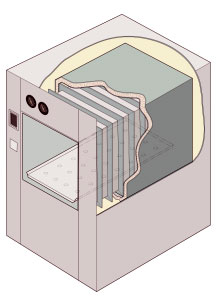
File:Rectangular-medical-autoclave-cutaway.jpg · Wikimedia Commons · See Wikimedia Commons
autoclave
Sign in to saveAlso known as lab sterilizer, autoclave sterilizer, steam sterilizer, autoclaves
thumb|Cutaway illustration of a cylindrical-chamber autoclave An autoclave is a machine used to carry out industrial and scientific processes requiring elevated temperature and pressure in relation to ambient pressure and temperature. Autoclaves are found in many medical settings, laboratories, and other places that need to ensure the sterility of an object.
Key facts
- Laboratory equipment.name
- Autoclave
- Laboratory equipment.image
- File:Rectangular-medical-autoclave-cutaway.jpg
- Laboratory equipment.caption
- Cutaway illustration of a jacketed rectangular-chamber autoclave
- Laboratory equipment.uses
- Sterilization
- Laboratory equipment.inventor
- Charles Chamberland
- Laboratory equipment.related
- Waste autoclave
via Wikipedia infobox
Wikidata facts
- Image
- Melag Autoclave 11.JPG
- Has use
- laboratory safety
Show 7 more facts
- MCN code
- 8419.81.10
- Commons category
- Autoclaves
- replaces
- Steam digester
- discoverer or inventor
- Charles Chamberland
- time of discovery or invention
- 1879-00-00
- uses
- vapor
- WordLift URL
- data.wordlift.io/wl01714/entity/autoclave.html
via Wikidata · CC0
~15 min read
Encyclopedic overview
8 sectionsContents
- Uses
- Air removal
- In medicine
- In research
- Quality assurance
- Additional images
- References
- External links
thumb|Cutaway illustration of a cylindrical-chamber autoclave An autoclave is a machine used to carry out industrial and scientific processes requiring elevated temperature and pressure in relation to ambient pressure and temperature. Autoclaves are found in many medical settings, laboratories, and other places that need to ensure the sterility of an object.
The autoclave was invented by Charles Chamberland in 1879, although a precursor known as the steam digester was created by Denis Papin in 1679. The name comes from Greek auto-, meaning "self", and Latin clavis meaning "key", thus a self-locking device. All autoclaves operate according to the same fundamental principles as a kitchen pressure cooker. The simplest autoclaves (so-called "stovetop autoclaves") are largely indistinguishable from pressure cookers used in food preparation.
Excerpted from Wikipedia’s “autoclave” article, available under the CC BY-SA 4.0 licence.