Category
page 1Medical tests

virus
A virus is a submicroscopic infectious agent that replicates only inside the living cells of an organism. Viruses infect all life forms, from animals and plants to microorganisms, including bacteria and archaea. Viruses are found in almost every ecosystem on Earth and are the most numerous type of biological entity. Since Dmitri Ivanovsky's 1892 article describing a non-bacterial pathogen infecting tobacco plants and the discovery of the tobacco mosaic virus by Martinus Beijerinck in 1898, more than 16,000 of the millions of virus species have been described in detail. The study of viruses is
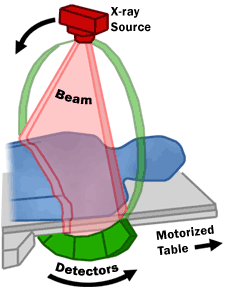
computed tomography
medical imaging procedure using X-rays to produce cross-sectional images
.jpg)
stethoscope
The stethoscope (from Ancient Greek () and () ) is a medical device for auscultation, or listening to internal sounds of an animal or human body. It typically has a small disc-shaped resonator that is placed against the naked skin, with either one or two tubes connected to two earpieces. A stethoscope can be used to listen to the sounds made by the heart, lungs or intestines, as well as blood flow in arteries and veins. In combination with a manual sphygmomanometer, it is commonly used when measuring blood pressure. It was invented in 1816 by René Laennec and the binaural version by Arthur Lea

electrocardiography
thumb|Use of monitoring (medicine)|real time monitoring of the heart in an [[intensive care unit in a German hospital (2015), the monitoring screen above the patient displaying an electrocardiogram and various values of parameters of the heart like heart rate and blood pressure]]

bloodletting
right|framed|Ancient Greek painting on a vase, showing a physician (iatros) bleeding a patient
Bloodletting (or blood-letting) is the deliberate withdrawal of blood from a patient to prevent or cure illness and disease. Bloodletting, whether by a physician or by leeches, was based on an ancient system of medicine in which blood and other bodily fluids were regarded as "humors" that had to remain in proper balance to maintain health. It was the most common medical practice performed by surgeons from antiquity until the late 19th century, a span of over 2,000 years. In Europe, the practice conti

Pap test
screening test used to detect potentially pre-cancerous and cancerous processes in the endocervical canal
screening
medical practice of testing a group or population for disease or medical conditions, who may not yet exhibit disease symptoms, enabling earlier intervention and disease management
medical test
medical procedure performed to detect, diagnose, or monitor diseases, disease processes, susceptibility, or to determine a course of treatment
pulse oximetry
medical procedure
genetic testing
medical testing related to genetic disorders
rapid antigen test
a medical test to know in less than a few hour a certain condition
temperature measurement
recording of temperature
COVID-19 rapid antigen test
rapid test for SARS-CoV-2 infection
Snellen chart
eye chart used to measure visual acuity
magnetoencephalography
Magnetoencephalography (MEG) is a functional neuroimaging technique for mapping brain activity by recording magnetic fields produced by electrical currents occurring naturally in the brain, using very sensitive magnetometers. Arrays of SQUIDs (superconducting quantum interference devices) are currently the most common magnetometer, while the SERF (spin exchange relaxation-free) magnetometer is being investigated for future machines. Applications of MEG include basic research into perceptual and cognitive brain processes, localizing regions affected by pathology before surgical removal, determi
extracellular exosome
membrane-bound extracellular vesicles
drug testing
technical analysis of a biological specimen to determine the presence or absence of drugs or their metabolites
bone marrow examination
medical test performed on blood samples
viral load
amount of virus found in host tissue or a given volume of fluid

neurofeedback
thumb|470x470px|Neurofeedback training process diagram
false positives and false negatives
types of error in data reporting, where false positive is an error in which a test result incorrectly indicates the presence of a condition, while a false negative is the opposite error where the test fails to indicate the actual presence
gold standard test
diagnostic test or benchmark that is the best available under reasonable conditions

thoracentesis
Thoracentesis , also known as thoracocentesis (), pleural tap, needle thoracostomy, or needle decompression (often used term), is an invasive medical procedure to remove fluid or air from the pleural space for diagnostic or therapeutic purposes. A cannula, or hollow needle, is carefully introduced into the thorax, generally after administration of local anesthesia. The procedure was first performed by Morrill Wyman in 1850 and then described by Henry Ingersoll Bowditch in 1852.
evoked potentials
electrical potential evoked in the nervous system

tympanometry
Tympanometry is an acoustic evaluation of the condition of the middle ear eardrum (tympanic membrane) and the conduction bones by creating variations of air pressure in the ear canal.
rapid diagnostic test
a medical diagnostic test that is quick and easy to perform, suitable for preliminary or emergency medical screening and for use in medical facilities with limited resources
pulmonary function test
test to evaluate respiratory system
Rinne test
screening test for hearing named after Heinrich Adolf Rinne
nucleic acid test
group of techniques to detect a particular nucleic acid sequence
esophageal motility study
medical test
epiretinal membrane
disease of the eye in response to changes in the vitreous humor or more rarely, diabetes
bronchial challenge test
medical test used to assist in the diagnosis of asthma
rapid strep test
test for strep throat
transcranial Doppler
ultrasonography to measure the blood flow in the brain
point-of-care testing
medical diagnostic testing performed at or near the time and place of patient care
molecular diagnostics
subfield of biotechnology

Dix–Hallpike test
diagnostic maneuver used to identify benign paroxysmal positional vertigo

phonocardiogram
thumb|Phonocardiograms of common murmurs.
pulmonary wedge pressure
pressure measured by wedging a pulmonary catheter with an inflated balloon into a small pulmonary arterial branch
Reaction Agostini
medical diagnostic method
Monoyer chart
eye chart used to measure visual acuity
Postcoital test
test used for the evaluation of infertility
string galvanometer
instrument that provided the first practical electrocardiogram
magnetocardiography
Magnetocardiography (MCG) is a technique to measure the magnetic fields produced by electrical currents in the heart using extremely sensitive devices such as the superconducting quantum interference device (SQUID). If the magnetic field is measured using a multichannel device, a map of the magnetic field is obtained over the chest; from such a map, using mathematical algorithms that take into account the conductivity structure of the torso, it is possible to locate the source of the activity. For example, sources of abnormal rhythms or arrhythmia may be located using MCG.
pack year
A pack-year is a clinical quantification of cigarette smoking used to measure a person's exposure to tobacco. This is used to assess their risk of developing lung cancer or other pathologies related to tobacco use. However, it is difficult to rely on the assessment based on the pack-year due to the different nature of the packaging by different companies.
allergy test
medical diagnostic method
viral culture
laboratory test
Schiller's test
medical test to diagnose cervical cancer
Rivalta test
Fluid test determining blood vessels
Elimination diet
procedure to identify foods that produce adverse effects
rapid urease test
also known as the CLO test, is a rapid diagnostic test for diagnosis
sputum culture
Medical test to detect & identify bacteria or fungi in lung airways
water deprivation test
diagnostic method in medicine
mitotic index
degree to which a cell population proliferates, used in oncology to evaluate the aggressiveness of tumors
E chart
eye chart used to measure visual acuity
Ham test
test to diagnose PNH
OraQuick
OraQuick is an at-home HIV test manufactured by Orasure Technologies that was approved by the United States Food and Drug Administration for use by medical professionals in 2002 and for at-home use in 2012. It is one of only two at-home HIV tests available. OraQuick can be purchased by anyone above aged 17 over-the-counter at any major retail stores or online.
Harvard Step Test
fitness test
ballistocardiography
Ballistocardiography (BCG) is the measurement of ballistic forces generated by the heart. The downward movement of blood through the descending aorta produces an upward recoil, moving the body upward with each heartbeat. As different parts of the aorta expand and contract, the body continues to move downward and upward in a repeating pattern. Ballistocardiography is a technique for producing a graphical representation of repetitive motions of the human body arising from the sudden ejection of blood into the great vessels with each heart beat. It is a vital sign in the 1–20 Hz frequency range w
Throat culture
medical diagnostic method