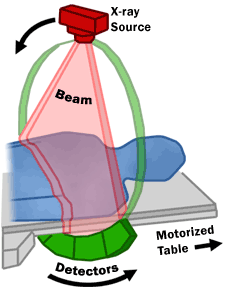
File:Drawing_of_CT_fan_beam_(left)_and_patient_in_a_CT_imaging_system.gif · Wikimedia Commons · See Wikimedia Commons
computed tomography
Sign in to saveAlso known as X-ray computed tomography, CT scan, CAT scan, CT, CAT, CT machine, CT Machine, tomography
medical imaging procedure using X-rays to produce cross-sectional images
Computed tomography, or CT, is a medical imaging technique that uses X-rays to create detailed cross-sectional pictures of the inside of your body. Doctors use CT scans to diagnose diseases, plan treatments, and monitor health conditions by examining these internal images.
AI-generated from the Wikipedia summary — may contain errors.
Research
794,142 papers- Computed Tomography to Replace Invasive Coronary Angiography?Circulation. Cardiovascular imaging · 2019Knaapen PDOI: 10.1161/CIRCIMAGING.119.008710
- Computed Tomography Angiography.Deutsches Arzteblatt international · 2019Görich J, Buß SDOI: 10.3238/arztebl.2019.0460a
- Computed tomography--a paean.Postgraduate medicine · 1981Howard RBDOI: 10.1080/00325481.1981.11715697
- Quarter Century Clinical PET/Computed Tomography: Transforming Medical Oncology Practice.PET clinics · 2024Subramaniam RMDOI: 10.1016/j.cpet.2024.01.001
- Contrast-enhanced breast computed tomography: can lymph node metastasis be predicted from primary tumor?European radiology · 2024Vedantham SDOI: 10.1007/s00330-023-10399-4
- Cranial computed tomography.Irish journal of medical science · 1990Griffin JFDOI: 10.1007/BF02937264
- Computed tomography of the heart.Radiology · 1981Higgins CBDOI: 10.1148/radiology.140.2.7255736
- Fractal Analysis in Myocardial Computed Tomography Perfusion: All That One Cannot See.JACC. Cardiovascular imaging · 2022Branch K, Alessio ADOI: 10.1016/j.jcmg.2022.06.010
via PubMed
Wikidata facts
- Instance of
- medical imaging
- Subclass of
- tomography
- Image
- Moderní výpočetní tomografie s přímo digitální detekcí rentgenového záření.jpg
Show 4 more facts
- short name
- КТ
- Commons category
- Computed tomography
- topic's main category
- Category:X-ray computed tomography
- ICD-9-CM
- 88.38
via Wikidata · CC0
~40 min read
Encyclopedic overview
A computed tomography scan (CT scan), formerly known in a more rudimentary state as computed axial tomography scan (CAT scan), is a medical imaging technique used to obtain detailed internal images of the body. The personnel that perform CT scans are called radiographers or radiology technologists.
CT scanners use a rotating X-ray tube and a row of detectors placed in a gantry to measure X-ray attenuations by different tissues inside the body. The multiple X-ray measurements taken from different angles are then processed on a computer using tomographic reconstruction algorithms to produce tomographic (cross-sectional) images (virtual "slices") of a body. CT scans can be used in patients with metallic implants or pacemakers, for whom magnetic resonance imaging (MRI) is contraindicated. 1977 Dutch newsreel about CT scan
Excerpted from Wikipedia’s “computed tomography” article, available under the CC BY-SA 4.0 licence.
Gallery (12)
Available in 74 languages
- Español
- Français
- Deutsch
- 中文
- 日本語
- Русский
- Português
- Italiano
- العربية
- हिन्दी
- Armenian
- Assamese
- Azerbaijani
- Bahasa Indonesia
- Bangla
- Basque
- Belarusian
- Bosnian
Show 55 more
- Breton
- Bulgarian
- Catalan
- Central Kurdish
- Colognian
- Croatian
- Czech
- Danish
- Esperanto
- Estonian
- Finnish
- Galician
- Greek
- Hakka Chinese
- Hebrew
- Hungarian
- Icelandic
- Irish
- Kannada
- Kashmiri
- Kazakh
- Kurdish
- Latin
- Latvian
- Lithuanian
- Malay
- Malayalam
- Moroccan Arabic
- Nederlands
- Norwegian
- Norwegian Nynorsk
- Pashto
- Polski
- Serbian
- Serbian (Latin)
- simple
- Sindhi
- Sinhala
- Slovak
- Slovenian
- Svenska
- Tamil
- Tatar
- Tibetan
- Tiếng Việt
- Türkçe
- Ukrainian
- Uzbek
- Waray
- Welsh
- Wu Chinese
- zh_yue
- فارسی
- ไทย
- 한국어
via Wikidata sitelinks · CC0