Category
page 1Men's clothing
trousers
Trousers (British English), slacks, or pants (Northern, American, Canadian, and Australian English) are an item of clothing worn from the waist to anywhere between the knees and the ankles, covering both legs separately (rather than with cloth extending across both legs as in robes, skirts, dresses, and kilts).
Shorts are similar to trousers, but with legs that come down only as far as the knee, but may be considerably shorter depending on the style of the garment. To distinguish them from shorts, trousers may be called "long trousers" in certain contexts such as school uniform, where tailored

jeans
thumb|A pair of jeans
thumb|right|Microscopic image of faded fabric

kilt
thumb|300px|One of the earliest depictions of the kilt is this German print showing Highlanders around 1630
A kilt ( ) is a garment resembling a wrap-around knee-length skirt, made of twill-woven worsted wool with heavy pleats at the sides and back and traditionally a tartan pattern. Originating in the Scottish Highland dress for men, it is first recorded in the 16th century as the great kilt, a full-length garment whose upper half could be worn as a cloak. The small kilt or modern kilt emerged in the 18th century, and is essentially the bottom half of the great kilt. Since the 19th century, i

beret
A beret ( , ; ; ; ) is a soft, round, flat-crowned cap made of hand-knitted wool, crocheted cotton, wool felt, or acrylic fibre.

sarong
thumb|Dutch military personnel wearing sarong, 1949
thumb|Three women wearing sarongs in 1905
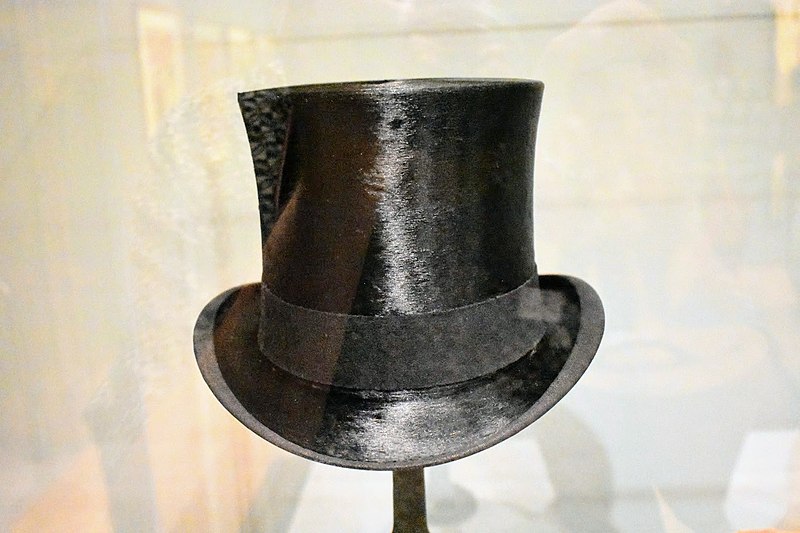
top hat
tall-crowned hat initially made of beaver felt and later, of silk plush

tuxedo
semi-formal Western dress code for evening events, originating in British and North American conventions for attire in the 19th century

leggings
Leggings are several types of leg attire that have varied through the years. Modern usage from the 1960s onwards has come to refer to elastic close-fitting high-rise garments worn over the legs typically by women, such as leg warmers or tights. Usage from the 18th century refers to men's wear usually made of cloth or leather that is wrapped around the leg down to the ankle. In the 19th century, leggings usually referred to infants' leg clothing that were matched with a jacket, as well as leg-wrappings made of leather or wool and worn by soldiers and trappers. Leggings prominently returned to w

tunic
A tunic is a garment for the torso, usually simple in style, reaching from the shoulders to a length somewhere between the hips and the ankles. It might have arm-sleeves, either short or full-length. Most forms have no fastenings. The name derives from the Latin tunica, the basic garment worn by both men and women in ancient Rome, which in turn was based on earlier Greek garments that covered wearers' waists.

poncho
thumb|upright=1.3|Mapuche|Araucanos and [[Huasos in Chile, 19th century]]
thumb| A market scene, Ruana in [[Bogotá, circa 1860]]
thumb|A Peruvian chalán dancing marinera on a [[Peruvian Paso horse]]
full dress suit
most formal men's suit for gala and state occasions, formal Western dress code
frock coat
men's formal knee-length coat

barretina
thumb|Catalan men wearing barretines

burnous
thumb|Urban Algerian man wearing a white/beige burnous, 19thcentury
A burnous (), also burnoose, burnouse, bournous or barnous, is a long cloak of coarse woollen fabric with a pointed hood, often white, traditionally worn by Arab and Berber men in North Africa. Historically, the white burnous was worn during important events by men of high positions. Today, men of different social standing may wear it for ceremonial occasions, such as weddings or on religious and national holidays.
morning dress
jacket worn with men's morning dress

sirwal
thumb|19th century Ottomans dressed with Shalvar
thumb|(1829) MADDEN, Richard Robert wearing Ottoman-style Shalvar in Syria

thong
The thong is a garment generally used as either underwear or in some countries, as a swimsuit. It may also be worn for traditional ceremonies or competitions.

breeches
thumb|200px|right| Breeches are still worn as livery for special occasions in several European courts. Here, a coachman in the Netherlands wears them during , 2013.
thumb|200px|right|Breeches as worn in the United States in the late 18th century: Elijah Boardman by [[Ralph Earl, 1789]]
Breeches or britches ( ) are an article of clothing covering the body from the waist down, with separate coverings for each leg, usually stopping just below the knee, though in some cases reaching to the ankles. Formerly a standard item of Western men's clothing, they had fallen out of use by the mid-19th centur

pakol
thumb|200x200px|Pakol hat of the Chitral Scouts
thumb|A guard at Baltit Fort wearing a pakol, Karimabad, Hunza
The pakol (Urdu: پکول; Shina and ) is a traditional soft, flat, rolled-up and round-topped cap originating from the Gilgit and Chitral areas in northern Pakistan. It is typically made of wool and found in a variety of earthy colours, such as brown, black, grey, ivory, or dyed red using walnut. Today it is widely worn in Pakistan, the eastern region of Afghanistan, and parts of northern India.

pelerine
thumb|300px|Pelerine, muslin with [[whitework embroidery, c.1835. The Metropolitan Museum of Art Costume Institute: 2009.300.3886.]]
A pelerine is a small cape-like garment that covers the shoulders, similar to a fichu. Historically, the pelerine possibly originated in a type of 15th century armor padding that protected the neck and shoulders by itself, if the padded fabric was reinforced internally with metal, and/or acted as padding between armor and the skin in the neck-to-shoulder region. The pelerine often had fasteners so that pauldrons could be attached.
.jpg)
Kabney
thumbnail|upright|Ruling king Jigme Khesar Namgyel Wangchuck with saffron kabney (reserved for the Bhutanese king and chief abbot).
thumb|upright|Gho with orange kabney.
A kabney (, Wylie: bkab-ne) is a silk sash worn as a part of the gho, the traditional male attire in Bhutan. It is raw silk, normally with fringes. Kabney is worn over the traditional coat gho; it runs from the left shoulder to the right hip, and is worn at special occasions or when visiting a dzong. Kabney is also referred as Bura, which means wild silk.

guayabera
thumb|Two guayaberas seen from the back, showing the alforza pleats and the Western-style yoke
sagging
manner of wearing pants
.jpg)
dashiki
thumb|A musician in Ghana, dressed in a dashiki

armband
An armband is a piece of material worn around the arm. They may be worn for pure ornamentation, or to mark the wearer as belonging to group, or as insignia having a certain rank, status, office or role, or being in a particular state or condition. Sprung armbands, known as sleeve garters, have been used by men to keep overlong sleeves from dropping over the hands and thereby interfering with their use. Armbands may also refer to inflatable armbands used to assist flotation for swimmers or for use with sphygmomanometers, in which case they are generally referred to as cuffs.
churidar
Churidars, also churidar pyjamas, are tightly-fitting trousers worn by both men and women on the Indian subcontinent. Churidars are a variant of the common shalwar pants. However, while shalwars are cut wide at the top and narrow at the ankle, churidars narrow much higher on the leg, allowing the contours of the legs to be revealed. In addition, they are usually cut on the bias, imparting a natural stretchiness, an important quality for close-fitting garments.
black lounge suit
men's semiformal daytime attire

bliaut
right|thumb|150px|Woman wearing a one-piece bliaut and cloak or mantle, c. 1200, west door of Angers [[Cathedral.]]
The bliaut or bliaud is an overgarment that was worn by both sexes from the eleventh to the thirteenth century in Western Europe, featuring voluminous skirts and horizontal puckering or pleating across a snugly fitted under bust abdomen. The sleeves are the most immediately notable difference when comparing the bliaut to other female outer clothing of the Middle Ages. They fit closely from the shoulder to approximately the elbow, and then widen from the elbow to drape to floor- o

justacorps
A justacorps or justaucorps () is a knee-length coat worn by men in the latter half of the 17th century and throughout the 18th century. It is of French origin, where it had developed from a cape-like garment called a casaque. It was introduced into England as a component of a three-piece ensemble, which also included breeches and a long vest or waistcoat. This ensemble served as the prototype for the modern-day three-piece suit. The justacorps itself evolved into the frock coat.
right|thumb|250px|Luis Francisco de la Cerda, 9th Duke of Medinaceli|Luis Francisco de la Cerda (later Duke of Med
Zamarra
Spanish sheepskin coat
Tilmàtli
thumb|150px|Aztec warrior priests and priests as depicted in the Codex Mendoza, wearing battle suits and tilmàtli tunics.
thumb|150px|Saint Juan Diego, wearing a tilmàtl during the 1531 [[Our Lady of Guadalupe Marian apparitions.]]
thumb|left|250px|Emperor [[Moctezuma II wearing a tilmàtli.]]
thumb|Nezahualpiltzintli wearing an elaborate tilmàtli.
A tilmàtli (or tilma; , ) was a type of outer garment worn by men as a cloak/cape, documented from the late Postclassic and early Colonial eras among the Aztec and other peoples of central Mexico.
traje de luces
traditional costume of bullfighters
jebba
clothing
Bekiezsa
type of fur-lined overcoat
Kanzu
thumb|250px|Men wearing kanzus at a wedding in Kampala, Uganda.
A kanzu is a white or cream coloured robe worn by men in the African Great Lakes region. It is referred to as a tunic in English, and as the thawb in Arab countries. The kanzu is an ankle or floor length garment. It serves as the national costume of Tanzania as well as the Comoros, where it is called a kandu as well as a thawb. The robe is also worn in some coastal Muslim regions of Tanzania and Kenya. The men of Uganda consider it their most important dress. Kanzu is a Ganda word of Swahili origin, which means "robe" or "tunic".
semi-formal wear
subset of clothing
swim trunks
short trousers for swimming