Category
page 1Mesozoic paleogeography

Gondwana
Gondwana ( ; ) was a large landmass, sometimes referred to as a supercontinent. The remnants of Gondwana make up around two-thirds of today's continental area, including South America, Africa, Antarctica, Australia, Zealandia, Arabia, and the Indian subcontinent.

Laurasia
Laurasia () was the more northern of two large landmasses that formed part of the Pangaea supercontinent from around (Mya), the other being Gondwana. It separated from Gondwana (beginning in the late Triassic period) during the breakup of Pangaea, drifting further north after the split and finally broke apart with the opening of the North Atlantic Ocean 56 Mya. The name is a portmanteau of Laurentia and Eurasia.
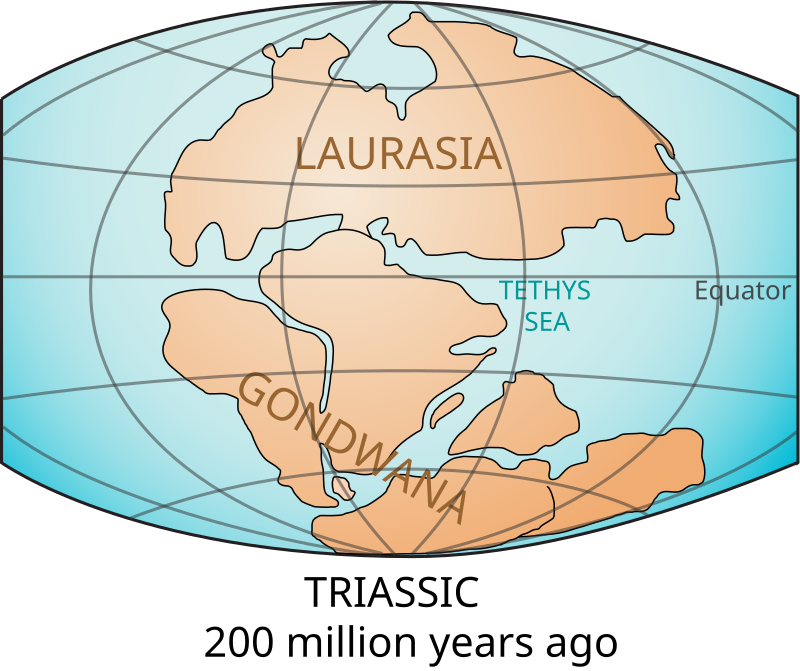
Tethys Ocean
prehistoric ocean

Panthalassa
thumb|upright=1.3|The Panthalassa superocean 250 million years ago
thumb|upright=1.3|The supercontinent Pangaea in the early Mesozoic (at 200 Ma) surrounded by Panthalassa.
thumb|upright=1.3|The Pacific Plate began forming when the [[triple junction at the center of Panthalassa destabilized about 190 million years ago.]]
Panthalassa, also known as the Panthalassic Ocean or Panthalassan Ocean (from Greek "all" and "sea"), was the vast superocean that encompassed planet Earth and surrounded the supercontinent Pangaea, the latest in a series of supercontinents in the history of Earth. During the
Euramerica
REDIRECT Laurasia#Euramerica/Laurussia
list of ancient oceans
Planet earth former oceans