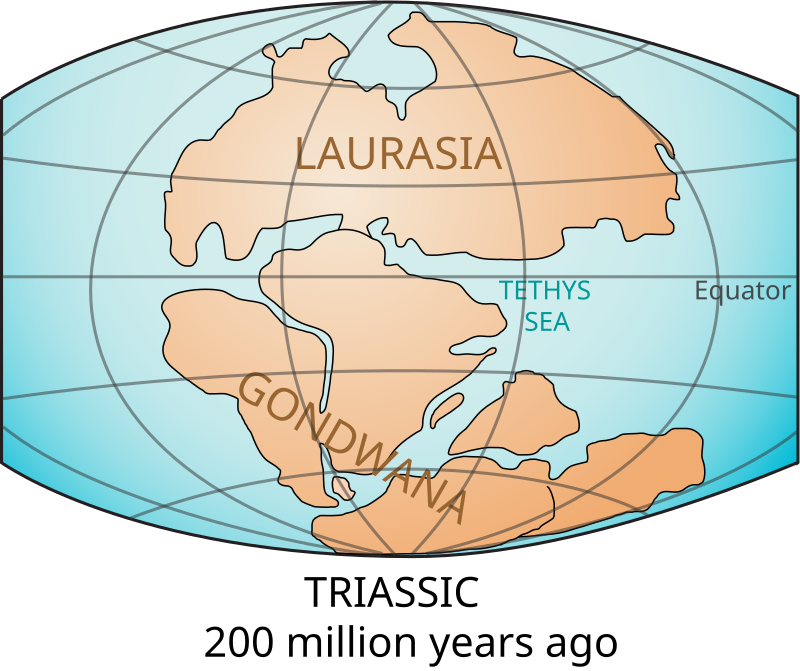
File:Laurasia-Gondwana.svg · Wikimedia Commons · See Wikimedia Commons
The Tethys Ocean was a vast body of water that existed between 250 and 65 million years ago, separating the continents of Gondwana and Laurasia. Understanding this ancient ocean helps scientists reconstruct how Earth's continents moved and collided over time, ultimately shaping the geography and geology we see today.
AI-generated from the Wikipedia summary — may contain errors.
Wikidata facts
- Part of
- World Ocean
- Image
- Laurasia-Gondwana.svg
Show 6 more facts
- Commons category
- Tethys Ocean
- start time
- 850000000-
- end time
- 5000000-00
- name
- Тетис
- described by source
- Granat Encyclopedic Dictionary
- has boundary
- Gondwana
via Wikidata · CC0
~17 min read
Encyclopedic overview
First phase of the Tethys Ocean's forming: the (first) Tethys Sea starts dividing Pangaea into two supercontinents, Laurasia and Gondwana.
The Tethys Ocean (/ˈtiːθɪs, ˈtɛ-/ TEETH-iss, TETH-; Greek: Τηθύς Tēthús), also called the Tethys Sea or the Neo-Tethys, was a prehistoric ocean during much of the Mesozoic Era and early-mid Cenozoic Era. It was the predecessor to the modern Indian Ocean, the Mediterranean Sea, and the Eurasian inland marine basins (primarily represented today by the Black Sea and Caspian Sea).
Excerpted from Wikipedia’s “Tethys Ocean” article, available under the CC BY-SA 4.0 licence.
Gallery (5)
Available in 66 languages
- Español
- Français
- Deutsch
- 中文
- 日本語
- Русский
- Português
- Italiano
- العربية
- हिन्दी
- Afrikaans
- Armenian
- Asturian
- Azerbaijani
- Bahasa Indonesia
- Bangla
- Bashkir
- Basque
Show 47 more
- Belarusian
- Bhojpuri
- Bosnian
- Bulgarian
- Catalan
- Chuvash
- Czech
- Danish
- Esperanto
- Estonian
- Filipino
- Finnish
- Galician
- Georgian
- Greek
- Hebrew
- Hungarian
- Kannada
- Kara-Kalpak
- Latin
- Latvian
- Lithuanian
- Malayalam
- Mingrelian
- Nederlands
- Norwegian
- Norwegian Nynorsk
- Polski
- Romanian
- Serbian
- Serbian (Latin)
- simple
- Slovak
- Slovenian
- Sundanese
- Svenska
- Tamil
- Tiếng Việt
- Türkçe
- Ukrainian
- Uzbek
- Waray
- Western Panjabi
- Wu Chinese
- Zaza
- فارسی
- 한국어
via Wikidata sitelinks · CC0