Category
page 1Metamonads

Giardia lamblia
parasitic microorganism that causes giardiasis
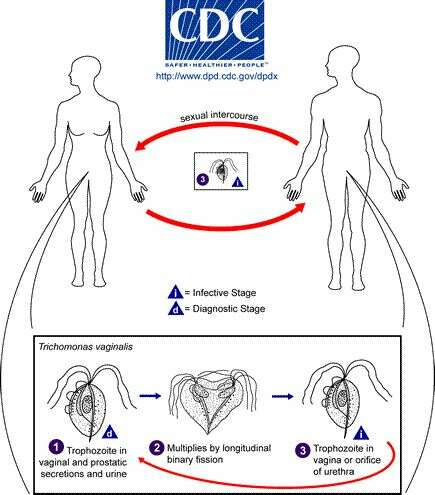
Trichomonas vaginalis
species of flagellated protist

Giardia
Giardia ( or ) is a genus of anaerobic flagellated protozoan parasites of the phylum Metamonada that colonise and reproduce in the small intestines of several vertebrates, causing the disease giardiasis. Their life cycle alternates between a binucleated motile trophozoite and an infective, metabolically inert, environmentally resistant tetranucleate cyst. Cysts are transmitted between hosts through the fecal–oral route, contaminated water and/or food. Giardia were first seen by the Dutch microscopist Antonie van Leeuwenhoek in 1681 under the light microscope. The genus is named after French zo
metamonad
The metamonads are a large group of flagellate amitochondriate microscopic eukaryotes. They include the retortamonads, diplomonads, parabasalids, oxymonads, and a range of more poorly studied taxa, most of which are free-living flagellates. All metamonads are anaerobic (many being aerotolerant anaerobes), and most members of the four groups listed above are symbiotes or parasites of animals, as is the case with Giardia lamblia which causes diarrhea in mammals.
Trichomonas
Trichomonas is a genus of anaerobic excavate parasites of vertebrates. It was first discovered by Alfred François Donné in 1836 when he found these parasites in the vagina of a patient suffering from vaginitis, an inflammation of the vagina. Donné named the genus from its morphological characteristics. The prefix tricho- originates from the Ancient Greek word (thrix) meaning hair, describing Trichomonas's flagella. The suffix -monas ( – single unit), describes its similarity to unicellular organisms from the genus Monas.

parabasalid
The parabasalids are a group of flagellated protists within the supergroup Excavata. Most of these eukaryotic organisms form a symbiotic relationships with animals. These include a variety of forms found in the intestines of termites and cockroaches, many of which have symbiotic bacteria that help them digest cellulose in woody plants. Other species within this supergroup are known parasites and include human pathogens.

Diplomonadida
The diplomonads (Greek for "two units") are a group of flagellates, most of which are parasitic. They include Giardia duodenalis, which causes giardiasis in humans. They are placed among the metamonads, and appear to be particularly close relatives of the retortamonads.

Mixotricha paradoxa
Mixotricha paradoxa is a species of protozoan that lives inside the gut of the Australian termite species Mastotermes darwiniensis.
Retortamonadida
The retortamonads are a small group of flagellates, most commonly found in the intestines of animals as commensals, although a free-living species called the Chilomastix cuspidata exists. They are grouped under the taxon Archezoa. They are usually around 5-20 μm in length, and all of their small subunit ribosomal RNA gene sequences are very similar to each other. There are two genera: Retortamonas with two flagella, and Chilomastix with four. In both cases there are four basal bodies anterior to a prominent feeding groove, and one flagellum is directed back through the cell, emerging from the
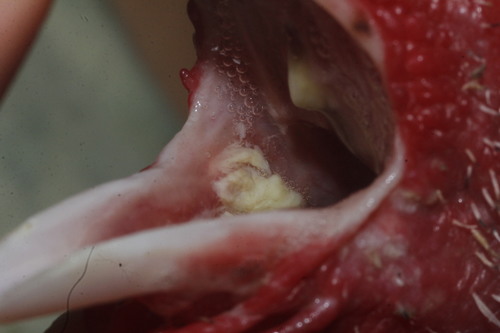
Trichomonas gallinae
parasite of pigeons and doves
Trichomonadida
Trichomonadida is an order of anaerobic protists, included with the parabasalids. Members of this order are referred to as trichomonads.

Oxymonadida
The oxymonads (or Oxymonadida) are a group of flagellated protists found exclusively in the intestines of animals, mostly termites and other wood-eating insects. Along with the similar parabasalid flagellates, they harbor the symbiotic bacteria that are responsible for breaking down cellulose. There is no evidence for presence of mitochondria (not even anaerobic mitochondrion-like organelles like hydrogenosomes or mitosomes) in oxymonads and three species have been shown to completely lack any molecular markers of mitochondria.
Monocercomonoides
Monocercomonoides is a genus of flagellate Excavata belonging to the order Oxymonadida. It was established by Bernard V. Travis and was first described as those with "polymastiginid flagellates having three anterior flagella and a trailing one originating at a single basal granule located in front of the anteriorly positioned nucleus, and a more or less well-defined axostyle". It is the first eukaryotic genus to be found to completely lack mitochondria, and all hallmark proteins responsible for mitochondrial function. The genus also lacks any other mitochondrion-related organelles such as hydr

Trichonympha
Trichonympha is a genus of single-celled, anaerobic parabasalids of the order Hypermastigia that is found exclusively in the hindgut of lower termites and wood roaches. Trichonympha's bell shape and thousands of flagella make it an easily recognizable cell. The symbiosis between lower termites/wood roaches and Trichonympha is highly beneficial to both parties: Trichonympha helps its host digest cellulose and in return receives a constant supply of food and shelter. Trichonympha also has a variety of bacterial symbionts that are involved in sugar metabolism and nitrogen fixation.
Histomonas meleagridis
Histomonas meleagridis is a species of parasitic protozoan that infects a wide range of birds including chickens, turkeys, peafowl, quail and pheasants, causing infectious enterohepatitis, or histomoniasis (blackhead diseases). H. meleagridis can infect many birds, but it is most deadly in turkeys. It inhabits the lumen of cecum and parenchyma of liver, where it causes extensive necrosis. It is transmitted by another cecal parasite, the nematode Heterakis gallinarum.

Hexamita
Hexamita is a genus of parasitic diplomonads. It is related to Giardia. H. columbae and H. meleagridis live in the intestines of birds. H. muris and H. pitheci live in the intestines of mammals. H. salmonis and H. truttae live in the intestines of fish. Species in the Hexamita family are most commonly spread through fecal matter.
Trimastix
Trimastix is a genus of excavate protists, the sole occupant of the order Trimastigida. Trimastix are bacterivorous, free living and anaerobic. It was first observed in 1881 by William Kent. There are few known species, and the genus's role in the ecosystem is largely unknown. However, it is known that they generally live in marine environments within the tissues of decaying organisms to maintain an anoxic environment. Much interest in this group is related to its close association with other members of Preaxostyla. These organisms do not have classical mitochondria, and as such, much of the r
Trichomonas tenax
species of single-celled organism
Chilomastix mesnili
species of flagellata
Spironucleus
Spironucleus is a diplomonad genus that is bilaterally symmetrical and can be found in various animal hosts. This genus is a binucleate flagellate, which is able to live in the anaerobic conditions of animal intestinal tracts. A characteristic of Spironucleus that is common to all metamonads is that it does not have aerobic mitochondria, but instead rely on hydrogenosomes to produce energy. Spironucleus has six anterior and two posterior flagella. The life cycle of Spironucleus involves one active trophozoite stage and one inactive cyst stage. Spironucleus undergoes asexual reproduction via lo
Cthulhu macrofasciculumque
species of flagellated protist
Oxymonas
Oxymonas is a genus of Excavata.
Anaeromonadea
Preaxostyla, also known as Anaeromonadea, is a group of excavate protists, comprising the oxymonads, Trimastix, and Paratrimastix. This group is studied as a model system for reductive evolution of mitochondria, because it includes both organisms with anaerobic mitochondrion-like organelles (Trimastix and Paratrimastix), and those that have completely lost their mitochondria (oxymonads Monocercomonoides, Streblomastix, and Blattamonas).

Retortamonas
Retortamonas is a genus of flagellated excavates. It is one of only two genera belonging to the family Retortamonadidae along with the genus Chilomastix.