Category
page 1Metamorphoses characters

Zeus
Zeus (, ) is the chief deity of the Greek pantheon. He is a sky and thunder god in ancient Greek religion and mythology, who rules as king of the gods on Mount Olympus.

Aphrodite
Aphrodite (, ) is an ancient Greek goddess associated with love, lust, beauty, pleasure, passion, procreation, and as her syncretised Roman counterpart , desire, sex, fertility, prosperity, and victory. Aphrodite's major symbols include seashells, myrtles, roses, doves, sparrows, and swans. The cult of Aphrodite was largely derived from that of the Phoenician goddess Astarte, a cognate of the East Semitic goddess Ishtar, whose cult was based on the Sumerian cult of Inanna. Aphrodite's main cult centers were Cythera, Cyprus, Corinth, and Athens. Her main festival was the Aphrodisia, which was c

Apollo

Athena

Artemis
In ancient Greek religion and mythology, Artemis (; ) is the goddess of hunting, the wilderness, wild animals, transitions, nature, vegetation, childbirth, care of children, and chastity. She was often said to roam the forests and mountains, attended by an entourage of nymphs. The goddess Diana is her Roman equivalent.

Poseidon
thumb|right|280px|Poseidon greeting Theseus (on the right). Detail, Attic red-figured calyx-krater by Syriscos Painter, 450-500BC from Agrigento. BnF Museum (Cabinet des médailles), Paris

Achilles
In Greek mythology, Achilles ( ) or Achilleus () was a hero of the Trojan War who was known as being the greatest of all the Greek warriors. The central character in Homer's Iliad, he was the son of the Nereid Thetis and Peleus, king of Phthia and famous Argonaut. Achilles was raised in Phthia along with his childhood companion Patroclus and received his education by the centaur Chiron. In the Iliad, he is presented as the commander of the mythical tribe of the Myrmidons.

Hermes

Jupiter
chief deity of Roman state religion

Ares
Ares (; , Árēs ) is the Greek god of war and courage. He is one of the Twelve Olympians, and the son of Zeus and Hera. Many Greeks were ambivalent towards him. He embodies the physical valor necessary for success in war but can also personify sheer brutality and bloodlust, in contrast to his sister Athena, whose martial functions include military strategy and generalship. An association with Ares endows places, objects, and other deities with a savage, dangerous, or militarized quality.

Hera
thumb|right|360px|Iris (on the left) with Zeus and Hera, east frieze of the Parthenon, [[British Museum.]]

Hades
Hades (; , , later ), in the ancient Greek religion and mythology, is the god of the dead and riches and the King of the underworld, with which his name became synonymous. Hades was the eldest son of Cronus and Rhea, although this also made him the last son to be regurgitated by his father. He and his brothers, Zeus and Poseidon, defeated, overthrew, and replaced their father's generation of gods, the Titans, and claimed joint sovereignty over the cosmos. Hades received the underworld, Zeus the sky, and Poseidon the sea, with the solid earth, which was long the domain of Gaia, available to all

Dionysus
In ancient Greek religion and myth, Dionysus (; ) is the god of wine-making, orchards, fruit, vegetation, fertility, festivity, insanity, ritual madness, religious ecstasy, and theatre. He was also known as Bacchus ( or ; ) by the Greeks (a name later adopted by the Romans) for a frenzy he is said to induce called baccheia. His wine, music, and ecstatic dance were considered to free his followers from self-conscious fear and care, and subvert the oppressive restraints of the powerful. His thyrsus, a fennel-stem sceptre, sometimes wound with ivy and dripping with honey, is both a beneficent wan

Demeter
In ancient Greek religion and mythology, Demeter (; Attic: Dēmḗtēr ; Doric: Dāmā́tēr) is the Olympian goddess of the harvest and agriculture, presiding over crops, grains, food, and the fertility of the earth. Although Demeter is mostly known as a grain goddess, she also appeared as a goddess of health, birth, and marriage, and had connections to the Underworld. She is also called Deo ( Dēṓ).

Cronus
In ancient Greek religion and mythology, Cronus, Cronos, or Kronos ( or ; ) was the leader and youngest of the Titans, the children of Gaia (Earth) and Uranus (Sky). He overthrew his father and ruled during the mythological Golden Age until he was overthrown by his son Zeus and imprisoned in Tartarus. According to Plato, however, the deities Phorcys, Cronus, and Rhea were the eldest children of Oceanus and Tethys.

Hephaestus
Hephaestus ( , ; eight spellings; ) is the Greek god of artisans, blacksmiths, carpenters, craftsmen, fire, metallurgy, metalworking, sculpture, and volcanoes. In Greek mythology, Hephaestus was the son of Hera, either on her own or by her husband Zeus. He was cast off Mount Olympus by his mother Hera because of his lameness, the result of a congenital impairment; or in another account, by Zeus for protecting Hera from his advances.
%20(14783769792).jpg)
Eros
Eros (, ; ) is the Greek god of love and sex. The Romans referred to him as Cupid or Amor. In the earliest account, he is a primordial god, while in later accounts he is the child of Aphrodite.

Medusa
In Greek mythology, Medusa (; ), also called Gorgo () or the Gorgon, was one of the three Gorgons. Medusa is generally described as a woman with living snakes in place of hair; her appearance was so hideous that anyone who looked upon her was turned to stone. Medusa and her Gorgon sisters Euryale and Stheno were usually described as daughters of Phorcys and Ceto; of the three, only Medusa was mortal.

Mars
Roman god of war, guardian of agriculture

Aeneas
thumb|Aeneas flees burning Troy, Federico Barocci, 1598 ([[Galleria Borghese, Rome, Italy)]]

Juno
ancient Roman goddess

Mercury
Roman god of trade, merchants, thieves and travel
.JPG)
Persephone
In ancient Greek mythology and religion, Persephone ( ; , classical pronunciation: ), also called Kore () or Cora, is the daughter of Zeus and Demeter. She became the queen of the underworld after her abduction by her uncle Hades, the king of the underworld, who later took her into marriage. The myth of her abduction, her sojourn in the underworld, and her cyclical return to the surface represents her functions as the embodiment of spring and the personification of vegetation, especially grain crops, which disappear into the earth when sown, remain hidden for a period, sprout from the earth, a

Atlas
deity in Greek mythology

Agamemnon
In Greek mythology, Agamemnon (; Agamémnōn) was a king of Mycenae who commanded the Achaeans during the Trojan War. He was the son (or grandson) of King Atreus and Queen Aerope, the brother of Menelaus, the husband of Clytemnestra, and the father of Iphigenia, Iphianassa, Electra, Laodike, Orestes and Chrysothemis. Legends make him the king of Mycenae or Argos, thought to be different names for the same area. Agamemnon was killed upon his return from Troy by Clytemnestra, or in an older version of the story, by Clytemnestra's lover Aegisthus.

Asclepius
Asclepius (; ; ) is a hero and god of medicine in ancient Greek religion and mythology. He is the son of Apollo and Coronis, or Arsinoe, or of Apollo alone. Asclepius represents the healing aspect of the medical arts; his daughters, the , are: Hygieia ("Health, Healthiness"), Iaso (from ἴασις "healing, recovering, recuperation", the goddess of recuperation from illness), Aceso (from ἄκεσις "healing", the goddess of the healing process), Aegle (the goddess of good health) and Panacea (the goddess of universal remedy). He has several sons as well. He was associated with the Roman/Etruscan god Ve

Diana
goddess of the hunt, the moon and birthing, equated with the Greek goddess Artemis

Oceanus
In Greek mythology, Oceanus or Okeanos was one of the Titans, the children of Uranus (Sky) and Gaia (Earth), and the god of great river which encircled the entire world. He was the brother and husband of the Titaness Tethys, and by her was the father of the river gods and the Oceanids.

Selene
In ancient Greek mythology and religion, Selene (; ) is the goddess and personification of the Moon. Also known as Mene (; ), she is traditionally the daughter of the Titans Hyperion and Theia, and sister of the sun god Helios and the dawn goddess Eos. She drives her moon chariot across the heavens. Several lovers are attributed to her in various myths, including Zeus, Pan, her brother Helios and the mortal Endymion. In post-classical times, Selene was often identified with Artemis, much as her brother, Helios, was identified with Apollo. Selene and Artemis were also associated with Hecate and
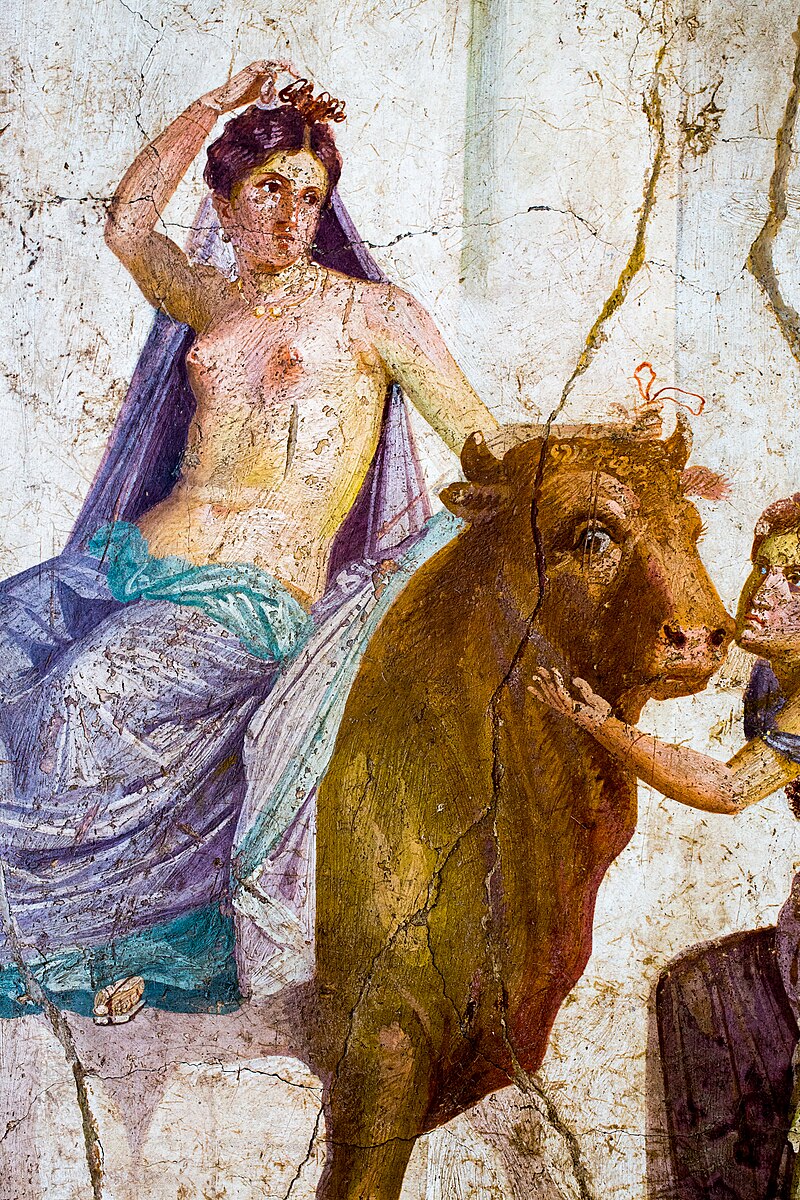
Europa
Phoenician character in Greek mythology, daughter of Agenor

Helios
In ancient Greek religion and mythology, Helios (; ; Homeric Greek: ) is the god who personifies the Sun. His name is also Latinized as Helius, and he is often given the epithets Hyperion ("the one above") and Phaethon ("the shining"). Helios is often depicted in art with a radiant crown and driving a horse-drawn chariot through the sky. He was a guardian of oaths and also the god of sight. Though Helios was a relatively minor deity in Classical Greece, his worship grew more prominent in late antiquity thanks to his identification with several major solar divinities of the Roman period, partic

Cupid
In classical mythology, Cupid ( , meaning "passionate desire") is the god of desire, erotic love, attraction and affection. He is often portrayed as the son of the love goddess Venus and the god of war Mars. He is also known as Amor (Latin: '''', "love"). His Greek counterpart is Eros.
Although Eros is generally portrayed as a slender winged youth in Classical Greek art, during the Hellenistic period, he was increasingly portrayed as a chubby boy. During this time, his iconography acquired the bow and arrow that represent his source of power: a person, or even a deity, who is shot by Cupid's a

Themis
In Greek mythology and religion, Themis (; ) is the goddess and personification of justice, divine order, law, and custom. She is one of the twelve Titan children of Gaia and Uranus, and the second wife of Zeus. She is associated with oracles and prophecies, including the Oracle of Delphi.

Medea
In Greek mythology, Medea (; ; ) is the daughter of King Aeëtes of Colchis. Medea is known in most stories as a sorceress, an accomplished pharmakís, a worker in pharmakeía (medicinal magic), and is often depicted as a high priestess of the goddess Hecate. She is a mythical granddaughter of the sun god Helios and a niece of Circe, an enchantress goddess. Her mother may have been Idyia.

Jason
thumb|upright=1.25|Jason, between the jaws of the dragon which guards the Golden Fleece, is saved by [[Athena. The fleece hangs from a tree behind them. Attic kylix, 480–470 BC, attributed to Douris.]]

Andromeda
Ethiopian princess in Greek mythology

Icarus

Eos
In ancient Greek mythology and religion, Eos (; Ionic and Homeric Greek Ēṓs, Attic Héōs, "dawn", or ; Aeolic Aúōs, Doric Āṓs) is the goddess and personification of the dawn, who rose each morning from her home at the edge of the river Oceanus to deliver light and disperse the night. In Greek tradition and poetry, she is characterized as a goddess with a great sexual appetite, who took numerous human lovers for her own satisfaction and bore them several children. Like her Roman counterpart Aurora and Rigvedic Ushas, Eos continues the name of an earlier Indo-European dawn goddess, Hausos. Eos, o

Ganymede
son of Tros in Greek mythology

Daedalus
In Greek mythology, Daedalus (, ; Greek: Δαίδαλος; Latin: Daedalus; Etruscan: Taitale) was a skillful architect and craftsman, seen as a symbol of wisdom, knowledge and power. He is the father of Icarus, the uncle of Perdix, and possibly also the father of Iapyx. Among his most famous creations are the wooden cow for Pasiphaë, the Labyrinth for King Minos of Crete which imprisoned the Minotaur, and wings that he and his son Icarus used to attempt to escape Crete. It was during this escape that Icarus did not listen to his father's warnings and flew too close to the Sun; the wax holding his win

Cassandra
In Greek mythology, Cassandra, also spelled Kassandra or Casandra, (; , , or referred to as Alexandra; ) was a Trojan priestess dedicated to the god Apollo and fated by him to utter true prophecies, but never be believed. Cassandra lived through the Trojan War and survived the sack of the city, but was murdered by Clytemnestra and Aegisthus when Agamemnon brought her to Mycenae as a pallake.

Hecate
Hecate ( ; ) is a goddess in ancient Greek religion and mythology, most often shown holding a pair of torches, a key, or snakes, or accompanied by dogs, and in later periods depicted as three-formed or triple-bodied. She is variously associated with crossroads, night, light, magic, witchcraft, and the Moon. Her earliest appearance in literature was in Hesiod's Theogony in the 8th century BCE as a goddess of great honour with domains in sky, earth, and sea. She had popular followings among the witches of Thessaly, and an important sanctuary among the Carians of Asia Minor in Lagina. The earlies

Adonis
In Greek mythology, Adonis (; , ) was the mortal lover of the goddesses Aphrodite and Persephone. He was considered to be the ideal of male beauty in classical antiquity.

Leto
In ancient Greek mythology and religion, Leto (; ) is a childhood goddess, the daughter of the Titans Coeus and Phoebe, the sister of Asteria, and the mother of Apollo and Artemis.

Mnemosyne
In Greek mythology, Mnemosyne (; ) was one of the Titans, who are the children of Uranus (Sky) and Gaia (Earth). She was the goddess of memory and the mother of the nine Muses by Zeus. The name Mnemosyne is derived from the Greek word mnēmē ('remembrance, memory').
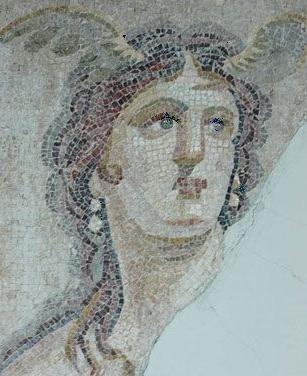
Tethys
ancient Greek mythological figure; mother of the river gods and the Oceanids

Hebe
ancient Greek goddess of youth

Circe
<!--
%20Lekythos%20with%20Charon%2C%20attributed%20to%20the%20Tymbos%20painter%2C%20ca%20500%20-%20450%20BC%2C%20Ashmolean%20Museum%2C%20Oxford%2C%20UK%20(22681344331).jpg)
Charon
thumb|right|Attic red-figure [[lekythos attributed to the Tymbos painter showing Charon welcoming a soul into his boat, c. 500–450 BC]]

Clio
thumb|349x349px|Print of Clio, made in the 16th–17th century. Preserved at the Ghent University Library.

Erinyes
thumb|upright=1.2|Clytemnestra tries to awaken the sleeping Erinyes. Detail from an [[Apulian red-figure bell-krater, 380–370 BC.]]

Hyperion
Titan in Greek mythology

Ajax the Great
son of Telamon in Greek mythology
.jpg)
Nemesis
In ancient Greek religion and myth, Nemesis (; ), also called Rhamnousia (or Rhamnusia; ), was the goddess who personified retribution for the sin of hubris: arrogance before the gods.

Midas
thumb|King Midas on a red-figure stamnos from Chiusi around 440 BC, British Museum

Iris
the personification of the rainbow in ancient Greek religion and mythology
%20(14569094819).jpg)
Chiron
In Greek mythology, Chiron, also Cheiron or Kheiron, (; or , , , or ) was held to be the superlative centaur amongst his brethren since he was called the "wisest and justest of all the centaurs".

Hercules
Hercules (, ) is the Roman equivalent of the Greek divine hero Heracles, son of Jupiter and the mortal Alcmena. In classical mythology, Hercules is famous for his strength and for his numerous far-ranging adventures.
.jpg)
Melpomene
thumb|Melpomene by Joseph Fagnani (1869)
Melpomene (; ) is the Muse of tragedy in Greek mythology. She is described as the daughter of Zeus and Mnemosyne (and therefore of power and memory) along with the other Muses, and she is often portrayed with a tragic theatrical mask.
Coeus
In Greek mythology, Coeus (; ), also called Koios or Polus, was one of the Titans, the children of Uranus (Sky) and Gaia (Earth).