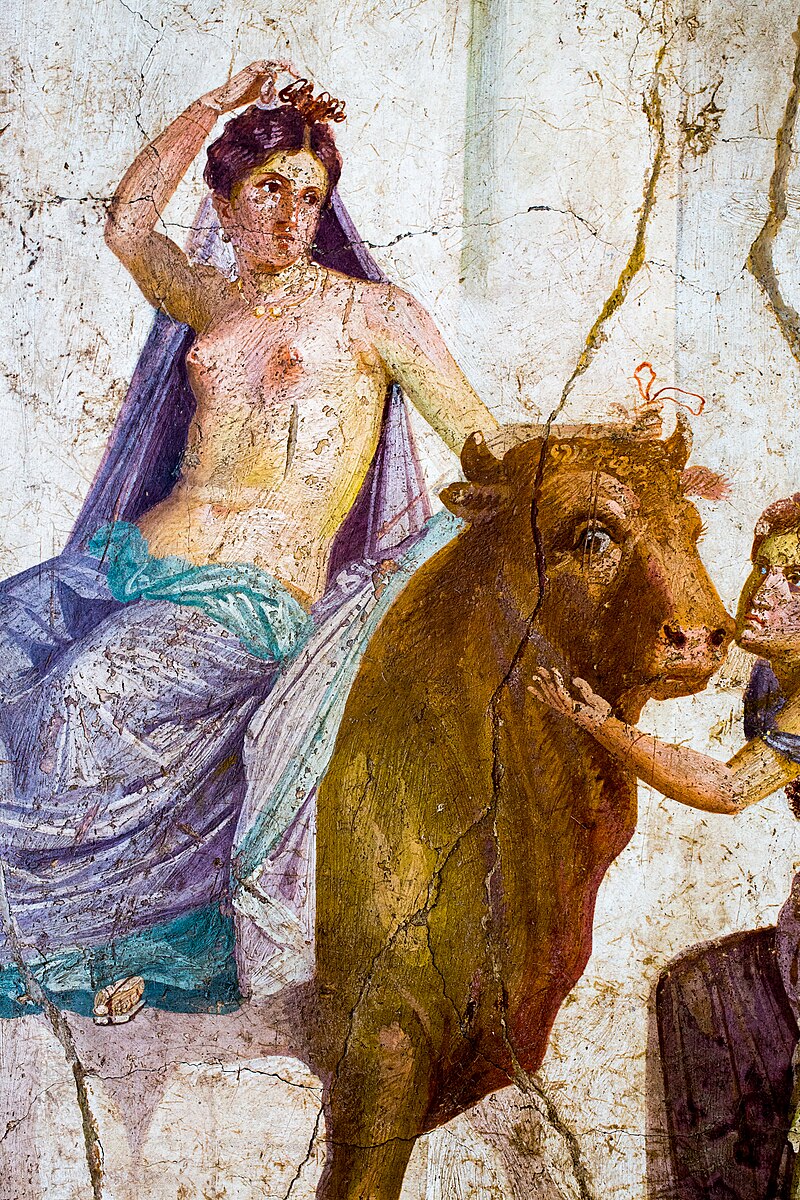
File:Wall_painting_-_Europa_and_the_bull_-_Pompeii_(IX_5_18-21)_-_Napoli_MAN_111475_-_02.jpg · Wikimedia Commons · See Wikimedia Commons
Europa
Sign in to saveAlso known as Europe, Evropa
Phoenician character in Greek mythology, daughter of Agenor
Europa was a figure in Greek mythology, a Phoenician princess and daughter of Agenor who became significant in ancient stories. Her name was later used for the European continent, making her an important figure in how the ancient Greeks understood and named the geography and peoples around them.
AI-generated from the Wikipedia summary — may contain errors.
Wikidata facts
Show 7 more facts
- worshipped by
- Ancient Greek religion
- Commons category
- Europa (mythology)
- wears
- garland
- described by source
- New International Encyclopedia
- unmarried partner
- Zeus
- on focus list of Wikimedia project
- Wikipedia:Vital articles/Level/4
- domain of saint or deity
- Europe
Sources (3)
via Wikidata · CC0
~16 min read
Encyclopedic overview
In Greek mythology, Europa (/jʊəˈroʊpə, jə-/; Ancient Greek: Εὐρώπη, romanized: Eurṓpē; Attic Greek pronunciation: [eu̯.rɔ̌ː.pɛː]) was a Phoenician princess said to have been abducted by Zeus in the form of a bull. She was the mother of the Cretan king Minos.
An early reference to Europa is in a fragment of the Hesiodic Catalogue of Women, discovered at Oxyrhynchus. The earliest vase-painting securely identifiable as Europa dates from the mid-7th century BC.
Excerpted from Wikipedia’s “Europa” article, available under the CC BY-SA 4.0 licence.
Gallery (12)
Available in 77 languages
- Español
- Français
- Deutsch
- 中文
- 日本語
- Русский
- Português
- Italiano
- العربية
- Afrikaans
- Albanian
- Albanian
- Armenian
- Azerbaijani
- Bahasa Indonesia
- Bangla
- Bashkir
- Basque
Show 58 more
- Bosnian
- Breton
- Bulgarian
- Catalan
- Chuvash
- Corsican
- Croatian
- Czech
- Danish
- Egyptian Arabic
- Esperanto
- Estonian
- Finnish
- Galician
- Georgian
- Greek
- Hebrew
- Hungarian
- hyw
- Icelandic
- Interlingua
- Kurdish
- Latin
- Latvian
- Lithuanian
- Lombard
- Luxembourgish
- Macedonian
- Malagasy
- Malay
- Malayalam
- Nederlands
- Norwegian
- Norwegian Nynorsk
- Occitan
- Polski
- Punjabi
- Romanian
- Sardinian
- Serbian
- Serbian (Latin)
- simple
- Slovak
- Slovenian
- Svenska
- Swahili
- Tatar
- Tiếng Việt
- Türkçe
- Ukrainian
- Urdu
- Waray
- Welsh
- Wu Chinese
- zh_yue
- فارسی
- ไทย
- 한국어
via Wikidata sitelinks · CC0