Category
page 1Military tactics

decentralization
thumb|A diagram comparing how commands are given and executed in a centralized organization and a decentralized organization
Decentralization or decentralisation is the process by which the activities of an organization, particularly those related to planning and decision-making, are distributed or delegated away from a central, authoritative location or group and given to smaller factions within it.

sabotage
Sabotage is a deliberate action aimed at weakening a polity, government, effort, or organization through subversion, obstruction, demoralization, destabilization, division, disruption, or destruction. One who engages in sabotage is a saboteur. Saboteurs typically try to conceal their identities because of the consequences of their actions and to avoid invoking legal and organizational requirements for addressing sabotage.

military tactics
science and art of organizing a military force and techniques
offensive
type of military operation

ambush
thumb|right|upright=1.3|French royalist rebels preparing an ambush during the War in the Vendée (The Ambush by [[Évariste Carpentier, 1889)]]
thumb|General Edward Braddock|Braddock's troops ambushed and decimated by the French and Indians in 1755
thumb|Depiction of a Weenen massacre|Zulu attack on a [[Boer camp in February 1838]]
thumb|1842 retreat from Kabul|Massacre of Elphinstone's army during the [[First Anglo-Afghan War in 1842]]
thumb|Ambush of Polish Partisan (military)|partisans against Russian forces during the [[January Uprising, 1863]]
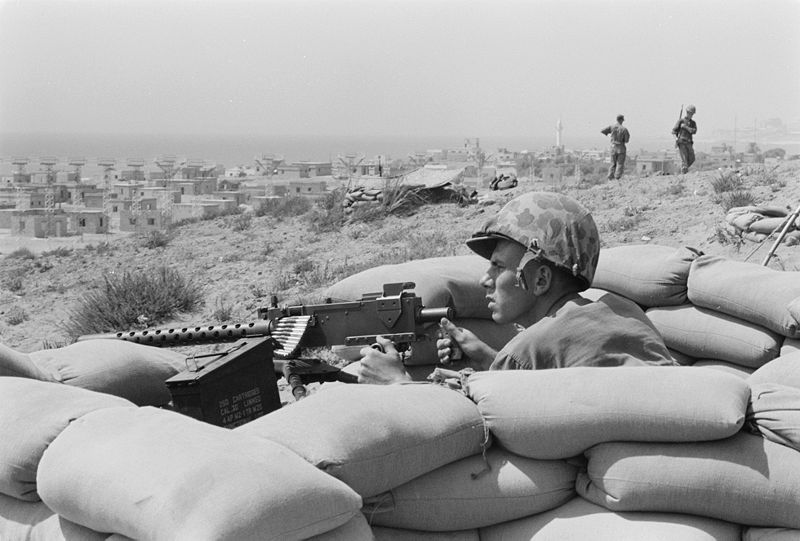
military trench
type of earthwork constructed in a military context
vanguard
The vanguard (sometimes abbreviated to van and also called the advance guard) is the leading part of an advancing military formation. It has a number of functions, including seeking out the enemy and securing ground in advance of the main force.

rear guard
thumb|A United States Marine Corps|United States Marine providing rear security to his unit during a simulated [[patrol in 2009]]
A rearguard or rear security is a part of a military force that protects it from attack from the rear, either during an advance or withdrawal. The term can also be used to describe forces protecting lines, such as communication lines, behind an army. Even more generally, a rearguard action may refer idiomatically to an attempt at preventing something though it is likely too late to be prevented; this idiomatic meaning may apply in either a military or non-military c

counterattack
thumb|Closing the Falaise pocket|Falaise-Argentan Pocket and the Mortain counterattack 6–17 August 1944
thumb|Map of the Battle of Cambrai (1917)|Battle of Cambrai – German counter-offensive
A counterattack is a tactic employed in response to an attack, with the term originating in "war games". The general objective is to negate or thwart the advantage gained by the enemy during attack, while the specific objectives typically seek to regain lost ground or destroy the attacking enemy (this may take the form of an opposing sports team or military units).

tercio
A tercio (, Spanish for '[a] third') was a military administrative unit of the Spanish Army during the reign of the Catholic Monarchs of Spain and Habsburg Spain in the early modern period. They were the elite military units of the Spanish monarchy and essential pieces of the powerful land forces of the Spanish Empire, sometimes also fighting along with the navy. These forces were among the most dominant in the European battlefields for more than a century and a half.
charge
military tactic involving a rapid frontal advance towards the enemy
barrage
artillery tactic
Hannibal Directive
military protocol of the Israeli Defense Forces
search and destroy
type of military counterinsurgency strategy, killing all enemies then quickly retreating
suppressive fire
fire that degrades the performance of an enemy force below the level needed to fulfill its mission
flanking maneuver
military tactic
tunnel warfare
warfare inside tunnels and other underground cavities

skirmisher
thumb|upright|Austrian pandur, , using a tree for cover while skirmishing
thumb|upright=1.25|As with most other modern foot soldiers, the US 6th Marine Regiment, on patrol near [[Marjah, 2010, routinely uses skirmish formation.]]
salient
battlefield front breakthrough progressing into enemy territory
combat search and rescue
military personnel recovery from battlefield and enemy occupied areas
show of force
open demonstration of military power intended to warn or to intimidate an opponent

obstacle
thumb|Obstacle to traffic caused by the Ferguson landslide in the state of [[California (USA)]]
An obstacle (also called a barrier, impediment, or stumbling block) is an object, thing, action or situation that causes an obstruction. A obstacle blocks or hinders our way forward. Different types of obstacles include physical, economic, biopsychosocial, cultural, political, technological and military.
tunnel rat
American, Australian, New Zealander, and South Vietnamese soldiers who performed underground search and destroy missions during the Vietnam War
leapfrogging
military strategy, also called island hopping
zone defense
defensive strategy in sports
combat support
military arms responsible for fire support and other assistance to combat units
counter-offensive
REDIRECT Counterattack
.jpg)
military patrolling
right|thumb|Irish Army Ranger Wing operators during patrol in [[Chad, May 2008.]]
Patrolling is a military tactic. Small groups or individual units are deployed from a larger formation to achieve a specific objective and then return. The tactic of patrolling may be applied to ground troops, armored units, naval units, and combat aircraft. The duration of a patrol will vary from a few hours to several weeks depending on the nature of the objective and the type of units involved.
clandestine cell
method for organizing a group of people, such as resistance fighters, spies, mercenaries, organized crime members, or violent extremists, to make it harder for police, military or other hostile groups to catch them
shock tactic
rapid offensive maneuver
volley fire
military tactic
ski warfare
use of ski-equipped soldiers in war

Envelopment
Envelopment is the military tactic of seizing objectives in the enemy's rear with the goal of destroying specific enemy forces and denying them the ability to withdraw. Rather than attacking an enemy head-on, as in a frontal assault, an envelopment seeks to exploit the enemy's flanks, attacking them from multiple directions and avoiding where their defenses are strongest. A successful envelopment lessens the number of casualties suffered by the attacker while inducing a psychological shock on the defender and improving the chances to destroy them. An envelopment will consist of one or more env
pocket
military forces isolated from their logistical base
list of military tactics
Wikimedia list article
security checkpoint
checkpoint erected to monitor and control the movement of people and materials
feigned retreat
military tactic
cavalry tactics
military tactics involving horses or other animals
Winning hearts and minds
idea of persuading enemies instead of defeating them by force
landing zone
area where aircraft can land; especially for vertical landings
last stand
situation in which a military unit holds against overwhelming odds
fire and movement
basic modern military low-level unit tactic used to maneuver on the battlefield in the presence of the enemy, especially when under fire
first island chain
first chain of major archipelagos out from the East Asian continental mainland coast
combat mission
Kill zone
area subject to an ambush in a battle
Strategic Hamlet Program
Rural Vietnamese anti-communist strategy
random checkpoint
temporary military or police roadblock set up in a semi-random location, e.g. to search for contraband or fugitives, or to indentify intoxicated drivers
slighting
thumb|Corfe Castle in [[Dorset was slighted in 1646 during the English Civil War. Parliament slighted or proposed to slight more than 100 buildings, including castles, town walls, abbeys, and houses.|alt=The shattered remains of a stone building, with two walls of a tower standing higher above the ruins.]]
Slighting is the deliberate damage of high-status buildings to reduce their value as military, administrative, or social structures. This destruction of property is sometimes extended to the contents of buildings and the surrounding landscape. It is a phenomenon with complex motivations and
hammer and anvil
military tactic
defeat in detail
military tactic
saturation attack
military tactic of overwhelming the defending side
Battle of annihilation
military strategy seeking total destruction of an enemy's military capacity
battlefield illumination
technology that improves visibility for military forces operating in difficult light conditions
Target fixation
attentional phenomenon
interdiction
Interdiction is interception of an object prior to its arrival at the location where it is to be used in military, espionage, and law enforcement.
infantry tactics
combination of military concepts and methods used by infantry to achieve tactical objectives during combat
deflection
technique used for effectively propelling a projectile at a moving target
Mobile Defense
fusillade
A fusillade is the simultaneous and continuous firing of a group of firearms on command. It stems from the French word fusil, meaning firearm, and fusiller meaning to shoot.