Category
page 1Millipede orders

Julida
thumb|Unidentified Parajulidae.
Julida is an order of millipedes. Members are mostly small and cylindrical, typically ranging from in length. Eyes may be present or absent, and in mature males of many species, the first pair of legs is modified into hook-like structures. Additionally, both pairs of legs on the 7th body segment of males are modified into gonopods.
.jpg)
Polydesmida
Polydesmida (from the Greek poly "many" and desmos "bond") is the largest order of millipedes, with more than 5,000 species, including all the millipedes reported to produce hydrogen cyanide (HCN). This order is also the most diverse of the millipede orders in terms of morphology. Millipedes in this order are found in all regions of the world other than Antarctica.

Spirobolida
Spirobolida is an order of "round-backed" millipedes containing approximately 500 species in 12 families. Its members are distinguished by the presence of a "pronounced suture that runs "vertically down the front of the head". Most of the species live in the tropics, and many are brightly coloured. Mature males have two pairs of modified legs, the gonopods, consisting of the eighth and ninth leg pairs: the posterior gonopods are used in sperm-transfer while the anterior gonopods are fused into a single plate-like structure.
thumb|Front and rear views of the anterior (A, B) and posterior left (

Polyxenida
thumb|Segmentation of Polyxenida millipedes. From top to bottom:Lophoturus madecassusOther [[Lophoproctidae and PolyxenidaeCondexenus biramipalpus and Phryssonotus brevicapensisOther Phryssonotus ]]

Chordeumatida
Chordeumatida (from the Greek word for "sausage") is a large order of millipedes containing more than 1,100 species. Also known as sausage millipedes, they are found nearly worldwide. Chordeumatida is the largest order in the superorder Nematophora, a group also known as spinning millipedes because their telsons feature spinnerets used to build nests of silk. These millipedes produce this silk to create chambers in which to molt or to lay their eggs.

Spirostreptida
Spirostreptida is an order of long, cylindrical millipedes. There are approximately 1000 described species, making Spirostreptida the third largest order of millipedes after Polydesmida and Chordeumatida.

Polyzoniida
__NOTOC__
Polyzoniida is an order of millipedes in the subterclass Colobognatha. This order contains three families and more than 70 described species. The species in this order are also known as camphor millipedes, because ozopore secretions in this order frequently have a strong camphor-like smell. Poison frogs in South America and Madagascar evidently obtain some of their poison from these millipedes.

Pill millipede
Glomerida is an order of pill-millipedes found primarily in the Northern Hemisphere. Also known as northern pill millipedes, they superficially resemble pill-bugs or woodlice, and can enroll into a protective ball. Adults in this order usually have twelve body segments (including the anal shield); adult females have 17 pairs of legs, and adult males have 19 leg pairs (including enlarged rear legs involved in mating). The order includes about 30 genera and at least 280 species, including Glomeris marginata, the common European pill-millipede. The order contains members in Europe, South-east Asi

Siphonophorida
Siphonophorida (Greek for "tube bearer") is an order of millipedes containing two families and over 100 species.
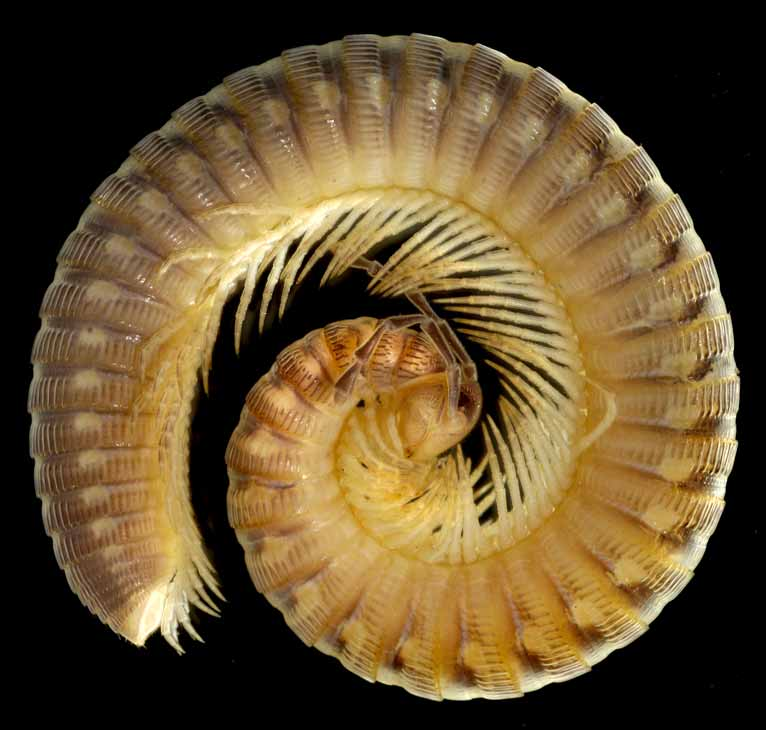
Callipodida
Callipodida is an order of millipedes containing around 130 species, many characterized by crests or ridges.

Platydesmida
Platydesmida (Greek for platy "flat" and desmos "bond") is an order of millipedes containing two families and over 60 species. Some species practice paternal care, in which males guard the eggs.

Sphaerotheriida
Sphaerotheriida is an order of millipedes in the infraclass Pentazonia, sometimes known as giant pill millipedes. They inhabit Southern Africa, Madagascar, South and Southeast Asia, Australia and New Zealand. Like the Northern Hemisphere pill millipedes of the order Glomerida, these millipedes can roll into a ball when disturbed. When they are rolled-up, most sphaerotheriidans reach a maximum size of a cherry or golf ball, but some species from Madagascar can even reach the size of an orange (an example of island gigantism; illustration - ). When rolled-up, predators are unable to unravel gian
Glomeridesmida
Glomeridesmida is an order of millipedes in the infraclass Pentazonia containing two families (Glomeridesmidae and Termitodesmidae) and at least 35 described species. Glomeridesmida is the only living order of the superorder Limacomorpha. Glomeridesmidans are also known as slug millipedes.
Siphonocryptida
Siphonocryptida is an order of millipedes, comprising the sole family Siphonocryptidae. With only seven described species, the Siphonocryptida is the second smallest millipede order, surpassed only by Siphoniulida, with two species.