Category
page 1Mineralogy concepts
hygroscopy
Hygroscopy is the phenomenon of attracting and holding water molecules via either absorption or adsorption from the surrounding environment, which is usually at normal or room temperature. If water molecules become suspended among the substance's molecules, adsorbing substances can become physically changed, e.g. changing in volume, boiling point, viscosity or some other physical characteristic or property of the substance. For example, a finely dispersed hygroscopic powder, such as a salt, may become clumpy over time due to collection of moisture from the surrounding environment.
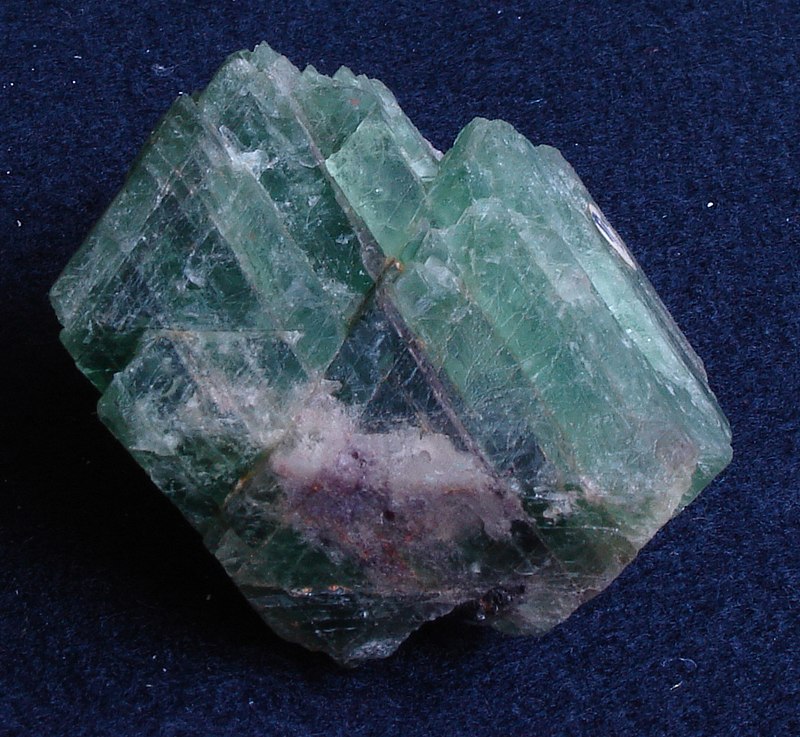
cleavage
tendency of crystalline materials to split along definite crystallographic structural planes
crystal habit
mineralogical term for the visible shape of a mineral
.svg)
dislocation
thumb|upright=1.5|Dislocations of edge (left) and screw (right) type.
In materials science, a dislocation is a linear crystallographic defect or irregularity within a crystal structure that contains an abrupt change in the arrangement of atoms. The movement of dislocations allows atoms to slide over each other at low stress levels and is known as glide or slip. The crystalline order is restored on either side of a glide dislocation but the atoms on one side have moved by one position. The crystalline order is not fully restored with a partial dislocation. A dislocation defines the boundary bet

maficity
thumbnail|Basalt
Mafic is a term used in geology to describe silicate minerals, magmas, and igneous rocks that are rich in magnesium and iron, while being relatively low in silica content. Most mafic minerals are dark in color, and common rock-forming mafic minerals include olivine, pyroxene, amphibole, and biotite. Common mafic rocks include basalt, diabase and gabbro. Mafic rocks often also contain calcium-rich varieties of plagioclase feldspar. Mafic materials can also be described as ferromagnesian.

felsicity
In geology, felsic is a modifier describing igneous rocks that are relatively rich in elements that form feldspar and quartz. It is contrasted with mafic rocks, which are richer in magnesium and iron. Felsic refers to silicate minerals, magma, and rocks which are enriched in the lighter elements such as silicon, oxygen, aluminium, sodium, and potassium. Molten felsic magma and lava is more viscous than molten mafic magma and lava. Felsic magmas and lavas have lower temperatures of melting and solidification than mafic magmas and lavas.
grain boundary
concept in materials science: the interface between two grains, or crystallites, in a polycrystalline material
isomorphism
having crystal structures of the same symmetry
interstitial defect
point defect in a crystal
Burgers vector
vector characterising a dislocation in a crystal lattice

permineralization
Permineralization is a process of fossilization of bones and tissues in which mineral deposits form internal casts of organisms. Carried by water, these minerals fill the spaces within organic tissue. Because of the nature of the casts, permineralization is particularly useful in studies of the internal structures of organisms, usually of plants.
conchoidal fracture
way that brittle materials break or fracture when they do not follow any natural planes of separation

microcrystalline
thumb|Microcrystalline copper(I) oxide
thumb|Silver microcrystals imaged by an electron microscope
Planar deformation features
microscopic features of silicate grains
extinction
term used in optical mineralogy and petrology
undulose extinction
geological term