Category
page 1Mississippian first appearances

moss
Mosses are small, non-vascular flowerless plants in the taxonomic division Bryophyta (, ) sensu stricto. Bryophyta (sensu lato, Schimp. 1879) may also refer to the parent group bryophytes, which comprise liverworts, mosses, and hornworts. Mosses typically form dense green clumps or mats, often in damp or shady locations. The individual plants are usually composed of simple leaves that are generally only one cell thick, attached to a stem that may be branched or unbranched and has only a limited role in conducting water and nutrients. Although some species have conducting tissues, these are gen

Scaphopoda
class of elephant tusk shell molluscs

Temnospondyli
Temnospondyli (from Greek τέμνειν, temnein 'to cut' and σπόνδυλος, spondylos 'vertebra') or temnospondyls is a diverse ancient order of small to giant tetrapods—often considered primitive amphibians—that flourished worldwide during the Carboniferous, Permian and Triassic periods, with fossils being found on every continent. A few species continued into the Jurassic and Early Cretaceous periods, but all had gone extinct by the Late Cretaceous. During about 210 million years of evolutionary history, they adapted to a wide range of habitats, including freshwater, terrestrial, and even coastal mar

Cumacea
Cumacea is an order of small marine crustaceans of the superorder Peracarida, occasionally called hooded shrimp or comma shrimp. Their unique appearance and uniform body plan makes them easy to distinguish from other crustaceans. They live in soft-bottoms such as mud and sand, mostly in the marine environment. There are more than 1,500 species of cumaceans formally described. The species diversity of Cumacea increases with depth.

Arthropleura
Arthropleura, from Ancient Greek ἄρθρον (árthron), meaning "joint", and πλευρά (pleurá), meaning "rib", is an extinct genus of massive myriapod that lived in modern-day Europe and North America around 344 to 292 million years ago, from the Viséan stage of the lower Carboniferous period to the Sakmarian stage of the lower Permian period. It was a millipede, and was capable of reaching at least in length, possibly up to over , making it the largest known land arthropod of all time. Arthropleura is known from body fossils as well as trace fossils, particularly giant trackways up to wide, and pote
Lepospondyli
Lepospondyli is a diverse grouping of early tetrapods. With the exception of one late-surviving lepospondyl from the Late Permian of Morocco (Diplocaulus minimus), lepospondyls lived from the Visean stage of the Early Carboniferous to the Early Permian and were geographically restricted to what is now Europe and North America. Five major groups of lepospondyls are known: Adelospondyli; Aïstopoda; Lysorophia; Microsauria; and Nectridea. Lepospondyls have a diverse range of body forms and include species with newt-like, eel- or snake-like, and lizard-like forms. Various species were aquatic, sem

Anthracosauria
Anthracosauria is a paraphyletic order of extinct reptile-like amphibians (in the broad sense) that flourished during the Carboniferous and early Permian periods, although precisely which species are included depends on one's definition of the taxon. "Anthracosauria" is sometimes used to refer to all tetrapods more closely related to amniotes such as reptiles, mammals, and birds, than to lissamphibians such as frogs and salamanders. An equivalent term to this definition would be Reptiliomorpha. Anthracosauria has also been used to refer to a smaller group of large, crocodilian-like aquatic tet
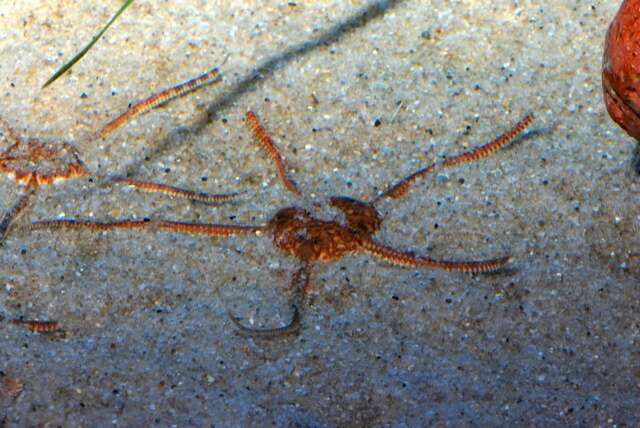
Ophiuridae
Ophiuridae are a large family of brittle stars of the suborder Ophiurina.
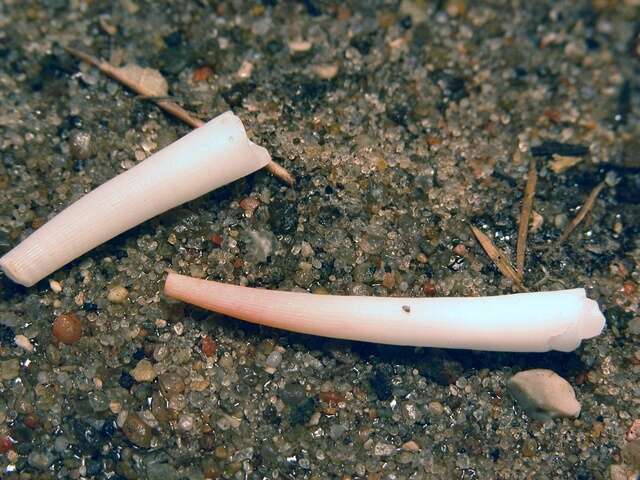
Dentaliida
Dentaliida is one of the two orders of scaphopod mollusks, commonly known as elephant's tusk shells. The order Dentaliida contains most of the larger scaphopods, and is distinguished from the other order (the Gadilidae) by the shape of its shell (the dentaliid shell tapers uniformly from anterior to posterior; the gadilid one has an anterior shell opening slightly smaller than the shell's widest point), the shape of the foot (the dentaliid foot is boat-shaped with a central trough; the gadilid foot is star-shaped), and the arrangement of some of their internal organs.
Odonatoptera
The Odonatoptera are a superorder (sometimes treated as an order) of ancient winged insects, placed in the probably paraphyletic group Palaeoptera. The dragonflies and damselflies (which are placed in the subgroup Odonata) are the only living members of this group, which was far more diverse in the late Paleozoic and contained gigantic species, including the griffinflies (colloquially called "giant dragonflies", although they were not dragonflies in the strict sense) of the order Meganisoptera (formerly Protodonata). The oldest members of Odonatoptera are known from the latest part of the Serp

Petalodontiformes
200px|thumb|left|Teeth of Petalodus|Petalodus ohioensis
Petalodontiformes ("thin-plate teeth") is an extinct order of marine cartilaginous fish related to modern day chimaera found in what is now the United States of America and Europe.

Eugeneodontiformes
right|thumb|Helicoprion bessonovi, teeth at the front of the lower jaw (reversed for more natural position)
225px|thumb|Restoration of Romerodus ([[Caseodontidae)]]

Embolomeri
Embolomeri is an order of tetrapods or stem-tetrapods, possibly members of Reptiliomorpha. Embolomeres first evolved in the Early Carboniferous (Mississippian) Period and were the largest and most successful predatory tetrapods of the Late Carboniferous (Pennsylvanian) Period. They were specialized semiaquatic predators with long bodies for eel-like undulatory swimming. Embolomeres are characterized by their vertebral centra, which are formed by two cylindrical segments, the pleurocentrum at the rear and intercentrum at the front. These segments are equal in size. Most other tetrapods have ple

Baphetidae
Baphetidae is an extinct family of stem-tetrapods. Baphetids were large labyrinthodont predators of the Late Carboniferous period (Namurian through Westphalian) of Europe. Fragmentary remains from the Early Carboniferous of Canada have been tentatively assigned to the group. The phylogenetic relationships of baphetids is uncertain; while many studies have placed the group as a close relative of Amniota, other analyses have found Baphetidae to be a more basal clade of early stem tetrapods. Baphetids were among the first of the Carboniferous fossil tetrapods to be found and were originally descr
Spelaeogriphacea
Spelaeogriphacea is an order of crustaceans that grow to no more than . Little is known about the ecology of the order.

Whatcheeriidae
Whatcheeriidae is an extinct family of stem-tetrapods which lived in the Mississippian sub-period, a subdivision of the Carboniferous period. It contains the genera Pederpes, Whatcheeria, and possibly Ossinodus. Fossils of a possible whatcheeriid have been found from the Red Hill locality of Pennsylvania. If these remains are from a whatcheeriid, they extend the range of the family into the Late Devonian and suggest that advanced tetrapods may have lived alongside primitive tetrapod ancestors like Hynerpeton and Densignathus. They also imply that a very long ghost lineage of whatcheeriids live

Adelospondyli
Adelospondyli is an order of elongated, presumably aquatic, Carboniferous amphibians (sensu lato). They have a robust skull roofed with solid bone, and orbits located towards the front of the skull. The limbs were almost certainly absent, although some historical sources reported them to be present. Despite the likely absence of limbs, adelospondyls retained a large part of the bony shoulder girdle. Adelospondyls have been assigned to a variety of groups in the past. They have traditionally been seen as members of the subclass Lepospondyli, related to other unusual early tetrapods such as "mic

Xenacanthiformes
Xenacanthiformes (or Xenacanthida) is an order or superorder of extinct shark-like chondrichthyans (cartilaginous fish) known from the Carboniferous to the Late Triassic. They were native to freshwater, marginal marine, and shallow marine habitats. Some xenacanths may have grown to lengths of . Most xenacanths died out at the end of the Permian in the End-Permian Mass Extinction, with only a few forms surviving into the Triassic.
Agassizodontidae
Helicoprionidae (sometimes referred to as Agassizodontidae) is an extinct family of holocephalans within the order Eugeneodontida. Members of the Helicoprionidae possessed a "whorl" of tooth crowns connected by a single root along the midline of the lower jaw. While historically considered elasmobranchs related sharks and rays, the closest living relatives of the Helicoprionidae and all other eugeneodonts are now thought to be the ratfishes. The anatomy of the tooth-whorls vary between taxa, with some possessing highly specialized, coiling spirals (such as those of the namesake genus Helicopri
Enantiopoda
REDIRECT Tesnusocarididae
Edestidae
The Edestidae are a poorly known, extinct family of shark-like eugeneodontid holocephalid cartilaginous fish.
Tesnusocarididae
Tesnusocarididae is an extinct family of remipedes and the sole member of the order Enantiopoda. It contains two genera, the type genus Tesnusocaris, and Cryptocaris, both known from the Carboniferous, with Tesnusocaris known from the Lower Pennsylvanian Tesnus Formation and Cryptocaris from the Middle Pennsylvanian Mazon Creek fossil beds.
Toxoprion
Toxoprion (Ancient Greek for "bow saw") is an extinct genus of eugeneodont holocephalans whose fossils are found in marine strata from the Early Carboniferous until the Late Permian near Eureka, Nevada.
Rhachitomi
Rhachitomi is a group of temnospondyl amphibians that includes all temnospondyls except edopoids and dendrerpetontids. It was established as a clade name by German paleontologist Rainer R. Schoch in 2013, although the name had first been established in 1919 by British paleontologist D. M. S. Watson to encompass an evolutionary grade of temnospondyls leading to the group Stereospondyli. American paleontologist Alfred Romer used the term in a similar sense, grouping most Permian and Triassic temnospondyls under Rhachitomi. A similar name that appeared earlier in the scientific literature is Rach
Petalodontidae
Petalodontidae is an extinct family of marine cartilaginous fish related to the modern-day chimaeras, found in what is now the United States of America and Europe. With a very few exceptions, they are known entirely from teeth. All fossils range from the Carboniferous to the Permian, where they are presumed to have died out during the Permian/Triassic extinction event.
Eutemnospondyli
Eutemnospondyli (meaning "true Temnospondyli") is a clade of temnospondyl amphibians that includes most temnospondyls except edopoids. Eutemnospondyli was named by German paleontologist Rainer R. Schoch in 2013. He defined it as a stem-based taxon including all temnospondyls more closely related to Stereospondyli than to Edopoidea. In his phylogenetic analysis, Eutemnospondyli included dendrerpetontids and a clade he referred to as Rhachitomi. Rhachitomi is defined to include four major and well-supported clades of temnospondyls: Dvinosauria, Eryopidae, Stereospondyli and a clade formed by Zat
Aeschronectida
Aeschronectida is an extinct order of mantis shrimp-like crustaceans which lived in the Mississippian subperiod in what is now Montana. They exclusively lived in the Carboniferous, or the age of amphibians. They have been found mostly in the U.S. and in the British Isles, in 1979 species were found in the Madera Formation in New Mexico. Aeschronectida was first identified appearing in Continental Europe in around 2014. While sharing similar characteristics to Stomatopoda, they lack certain physical characteristics of that taxon. The first species of Aeschronectida is accredited to Frederick R.