Category
page 1Mite families

Ixodidae
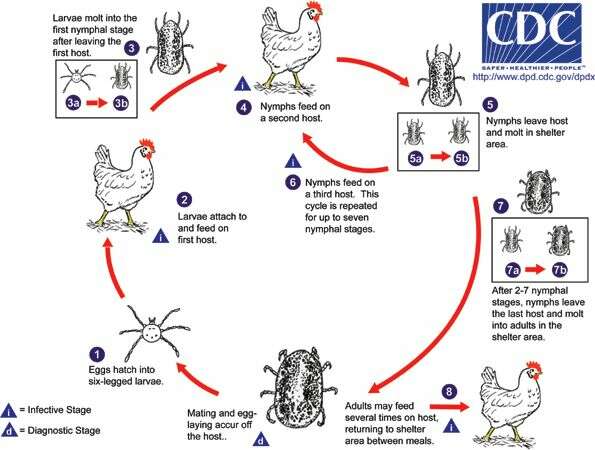
The Ixodidae are the family of hard ticks or scale ticks, one of the three families of ticks, consisting of 750 species, . They are known as 'hard ticks' because they have a scutum or hard shield, which the other major family of ticks, the 'soft ticks' (Argasidae), lack. They are ectoparasites of a wide range of host species, and some are vectors of pathogens that can cause human disease.
Argasidae
The Argasidae are the family of soft ticks, one of the three families of extant ticks. The family contains 220 species, although the composition of the genera is less certain, and more study is needed before the taxonomy is resolved. The Argasidae are very common in South Asia, along with around 100 other species of ticks from other lineages, making South Asia the region with the highest biodiversity of ticks worldwide. Soft ticks are resistant to desiccation and can live for several years in arid conditions.

Trombiculidae
Trombiculidae (), commonly referred to in North America as chiggers and in Britain as harvest mites, and also known as berry bugs, bush-mites, red bugs or scrub-itch mites, are a family of mites. Chiggers are often confused with jiggers, a type of flea. In their larval stage several species of Trombiculidae bite animal hosts to feed on their skin. To do so they embed their mouthparts into the skin, causing irritation. Humans can be hosts.

Eriophyidae
thumb|Rust mite, Aceria anthocoptes
thumb|Eriophyes cerasicrumena, galls on cherry
thumb|Aceria fraxini, galls

Trombidiidae
Trombidiidae, also known as red velvet mites, true velvet mites, or rain bugs, are small arachnids (eight-legged arthropods) found in plant litter and are known for their bright red color.

Tarsonemidae
Tarsonemidae is a family of mites, also called thread-footed mites or white mites.

Dermanyssidae
Dermanyssidae is a family of mites in the order Mesostigmata.

Acaridae
thumb|Tyrophagus putrescentiae
thumb|Rhizoglyphus echinopus
thumb|Sancassania sp.
The Acaridae are a family of mites in order Sarcoptiformes.
Phytoseiidae
The Phytoseiidae are a family of predatory mites which feed on thrips and other mite species. They are often used as a biological control agent for managing mite pests. Because of their usefulness as biological control agents, interest in Phytoseiidae has steadily increased over the past century. Public awareness of the biological control potential of invertebrates has been growing, though mainly in the US and Europe. In 1950, there were 34 known species. Today, there are 2,731 documented species organized in 90 genera and three subfamilies.
thumb|thumbtime=6|A Phytoseiidae|predatory mite inve

Sarcoptidae
The Sarcoptidae family of mites contains the genus Sarcoptes. Sarcoptic mange is caused by burrowing mites within this genus.
Tenuipalpidae
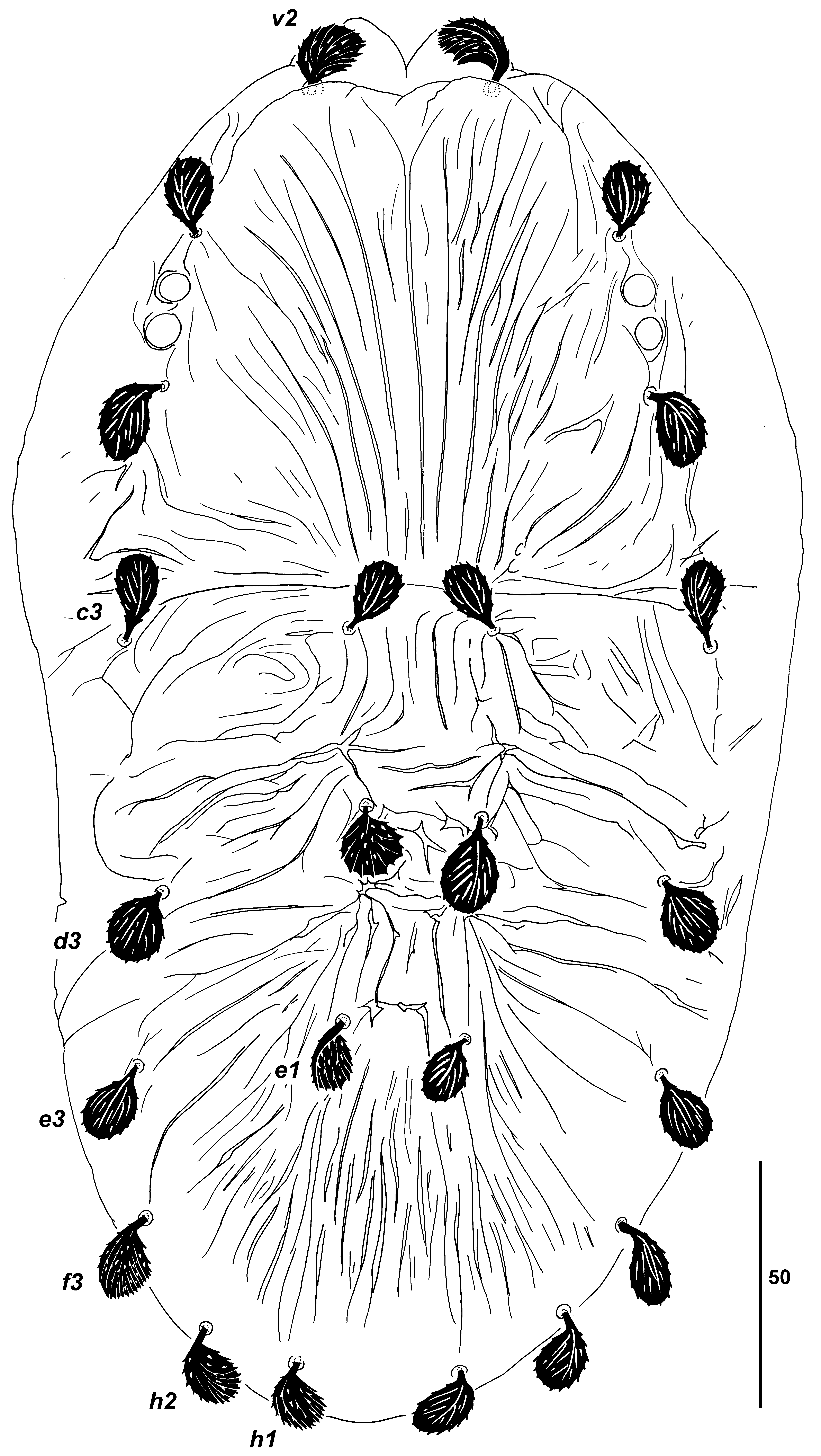
Tenuipalpidae, also called flat mites or false spider mites, are a family of mites, closely related to the Tetranychidae. They are reddish and slow-moving and normally feed near the midrib or veins on the underside of leaves. Several species, among them Raoiella indica, are important crop pests. Other common species include Acaricis urigersoni and the Brevipalpus species B. phoenicis, B. californicus, B. obovatus, and B. lewisi.

Parasitidae
Parasitidae is a family of predatory mites in the order Mesostigmata that has worldwide distribution. They are the only family in the superfamily Parasitoidea. Relatively large for mites, their color is often yellowish to dark brown. The family as a whole preys on a wide variety of microarthropods and nematodes, with individual species usually having a narrower range of prey. The family contains two subfamilies, 29 genera, and around 400 species.

Demodecidae
Demodecidae is a family of parasitic and commensal mites, living on various species of mammals. Each species of mite is usually only found on a single mammal species, whereas a mammal species can have several different species of demodecid mites living on it. Many species of mites are restricted to very limited areas of their body, e.g. the Meibomian glands, the ear canal, the tongue etc.
The family was formerly named Demodicidae.

Macronyssidae
The Macronyssidae are a family of parasitic mites in the order Mesostigmata.
Cheyletidae
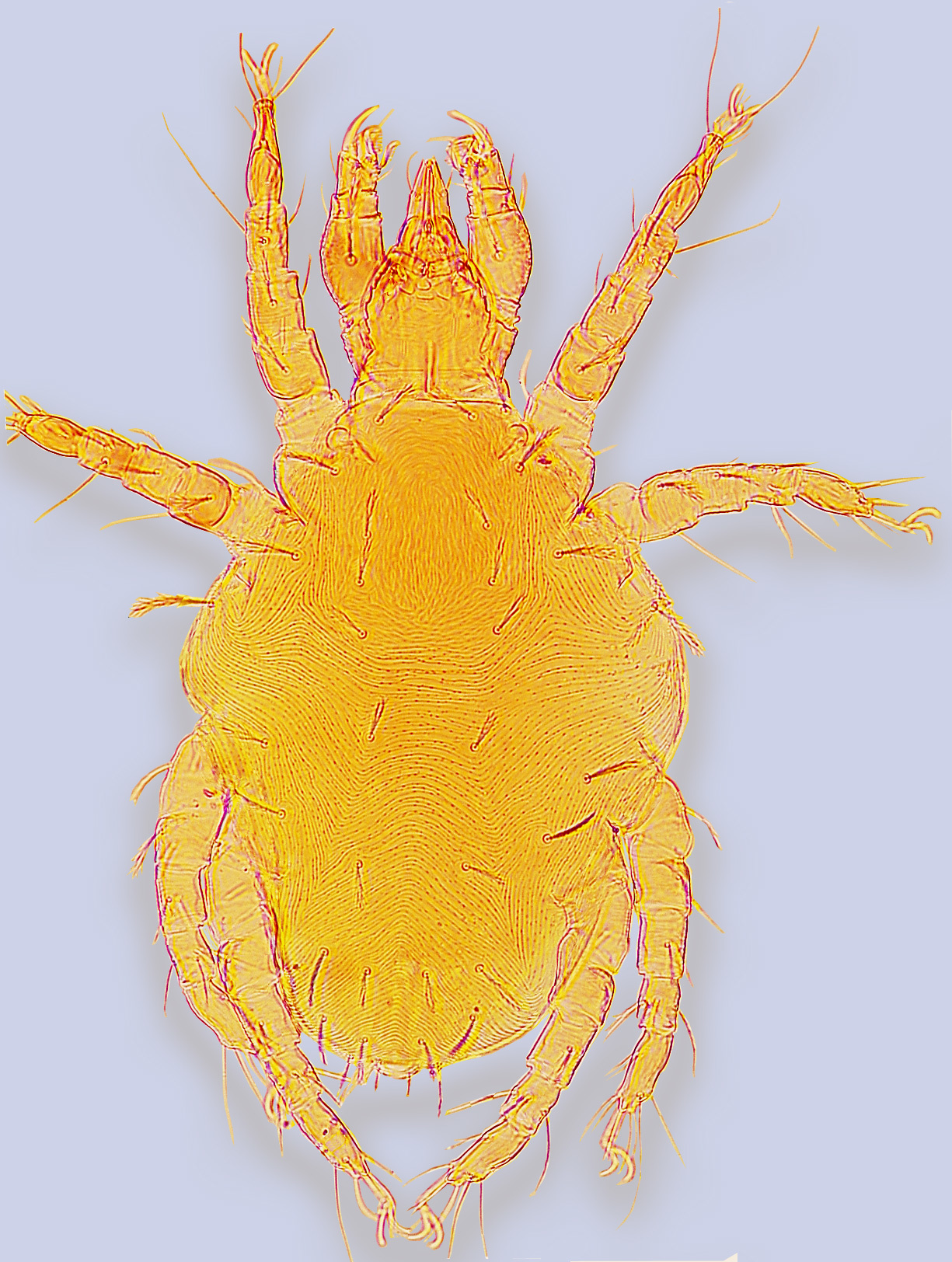
Cheyletidae is a family of mites in the order Trombidiformes. Some Cheyletiella spp. are parasites of mammals, causing cheyletiellosis or "walking dandruff". Others are free-ranging predators which can be found in soil, forest litter, animal nests, and house dust, under tree bark, and on foliage. Cheyletids may occur in corpses, where they feed on other mites and on nematodes.

Uropodidae
Uropodidae (from Ancient Greek οὐρά (ourá), meaning "tail", and πούς (poús), meaning "foot") is a family of mites in the order Mesostigmata.
Halacaridae
Halacaridae is a family of meiobenthic mites found in marine, brackish, and freshwater habitats around the world. It includes more than 1100 described species belonging to 64 genera It is the largest marine radiation of arachnids.
Psoroptidae
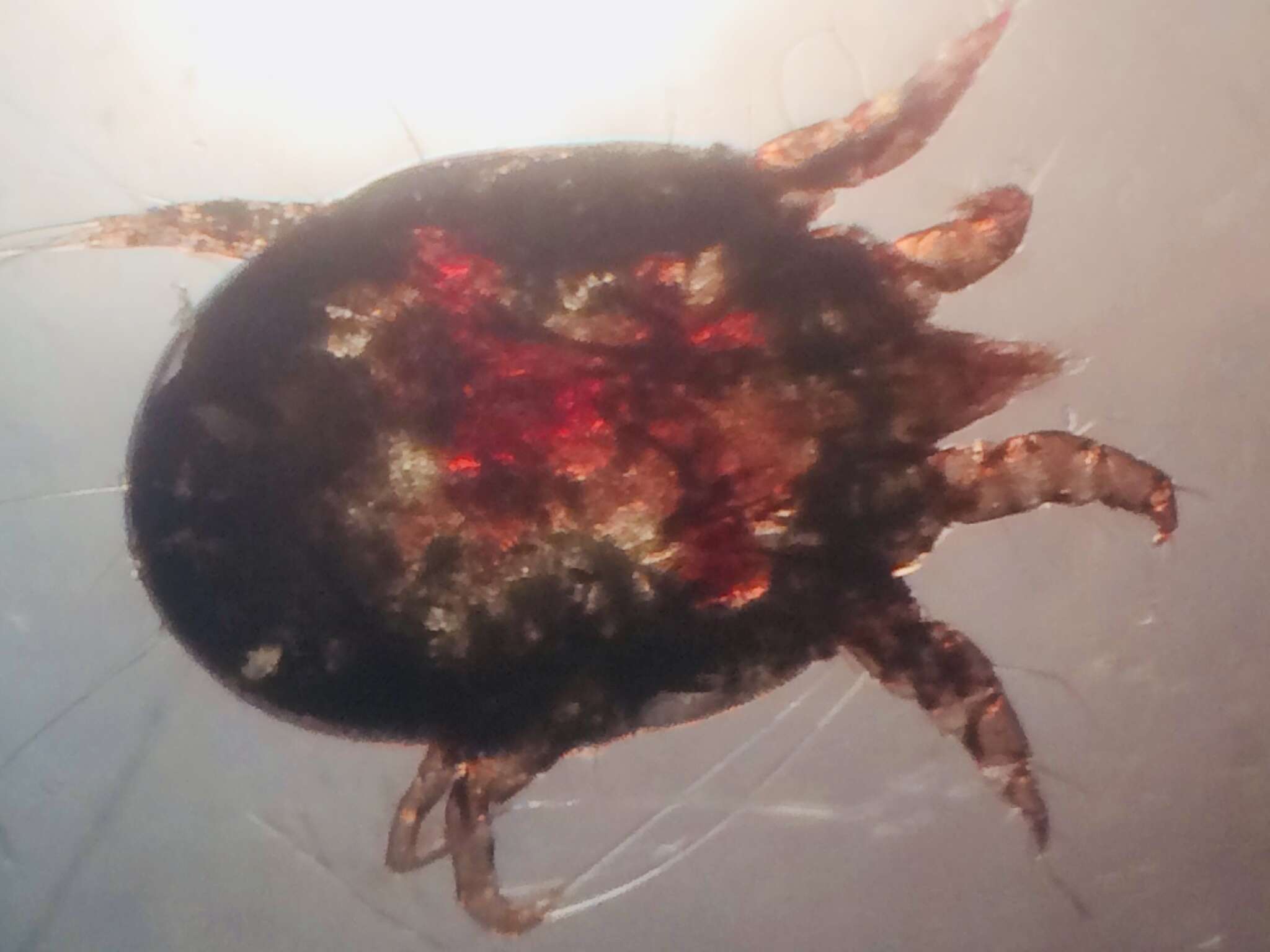
Psoroptidae is a family of parasitic mites, which are long and live on the surface of the skin, rather than burrowing into it. These mites affect various species, including cats, dogs, rabbits, cattle, sheep, and horses, causing skin inflammation, scabs, crusting, and hair loss.

Erythraeidae
Erythraeidae is a family of mites belonging to the Trombidiformes. Larval forms of these mites are parasitic on various other arthropods, for example harvestmen, but the adults are free-living predators. These oval mites are rather large, usually reddish-coloured and densely hairy. The legs, especially the first and fourth pairs, are long and adapted for running. They have either one or two pairs of eyes and can be distinguished from related families microscopically by the presence of a single claw on the tibia of the palp.

Ologamasidae
thumb | right
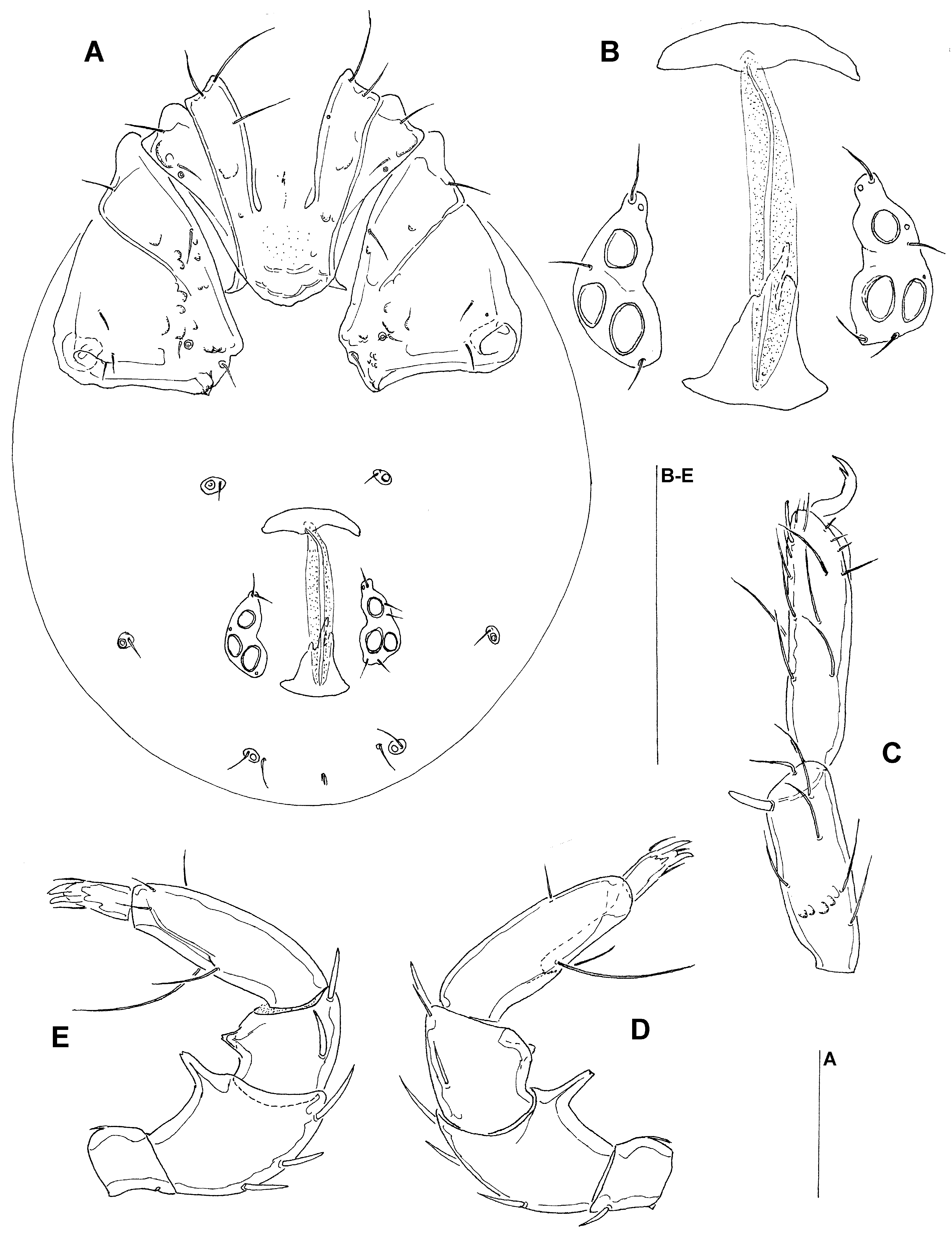
Ologamasidae is a family of mites in the order Mesostigmata. There are more than 40 genera and 470 described species in Ologamasidae.
Hygrobatidae
Hygrobatidae is a family of prostigs in the order Trombidiformes. There are about 78 genera and far more than 100 described species in Hygrobatidae.

Pyroglyphidae
Pyroglyphidae is a family of non-parasitic mites. It includes the house dust mites that live in human dwellings, many species that live in the burrows and nests of other animals, and some pests of dried products stored in humid conditions.

Damaeidae
Damaeidae is a family of mites. Alternative names for the family include Belbidae, and Belbodamaeidae or Hungarobelbidae. They had been previously considered to be distinct families.

Glycyphagidae
Glycyphagidae is a family of mites in the order Astigmata. There are more than 25 genera and 100 described species in Glycyphagidae.
Crotoniidae
Crotoniidae are a family of mites of the Holosomata group that may be the first animal lineage to have abandoned sexual reproduction and then re-evolved it. This is a spectacular case of atavism, and later convergent evolution.

Listrophoridae
Listrophoridae is a family of mites in the suborder Psoroptidia of the order Sarcoptiformes. The family contains small, long mites specialized for grasping the hairs of mammals. North American genera include:
Aplodontochirus
Chirodiscoides
Dentocarpus
Geomylichus
Leporacarus
Listrophorus
Lutracarus
Lynxacarus
Olabidocarpus
Olistrophorus
Prolistrophorus
Quasilistrophorus
Asiochirus is one Asian genus. Unidentified listrophorids have been found on the marsh rice rat (Oryzomys palustris) in Florida and Georgia.
Cunaxidae
Cunaxidae is a family of predatory mites in the order Trombidiformes. There are at least 20 genera and 390 described species in Cunaxidae.

Macrochelidae
Macrochelidae is a family of mites in the order Mesostigmata.
Ameroseiidae
The family Ameroseiidae is one of the three families of mites under the superfamily Ascoidea. There are about 12 genera and more than 130 described species in Ameroseiidae. The family has a worldwide distribution.

Oppiidae
Oppiidae is a family of mites belonging to the order Sarcoptiformes.
Rhodacaridae
Rhodacaridae is a family of mites in the order Mesostigmata.
Brachychthoniidae
Brachychthoniidae is a family of oribatids in the order Oribatida. There are about 11 genera and at least 150 described species in Brachychthoniidae.
Arrenuridae
Arrenuridae is a family of prostigs in the order Trombidiformes. There are at least 3 genera and 110 described species in Arrenuridae.
Ascidae
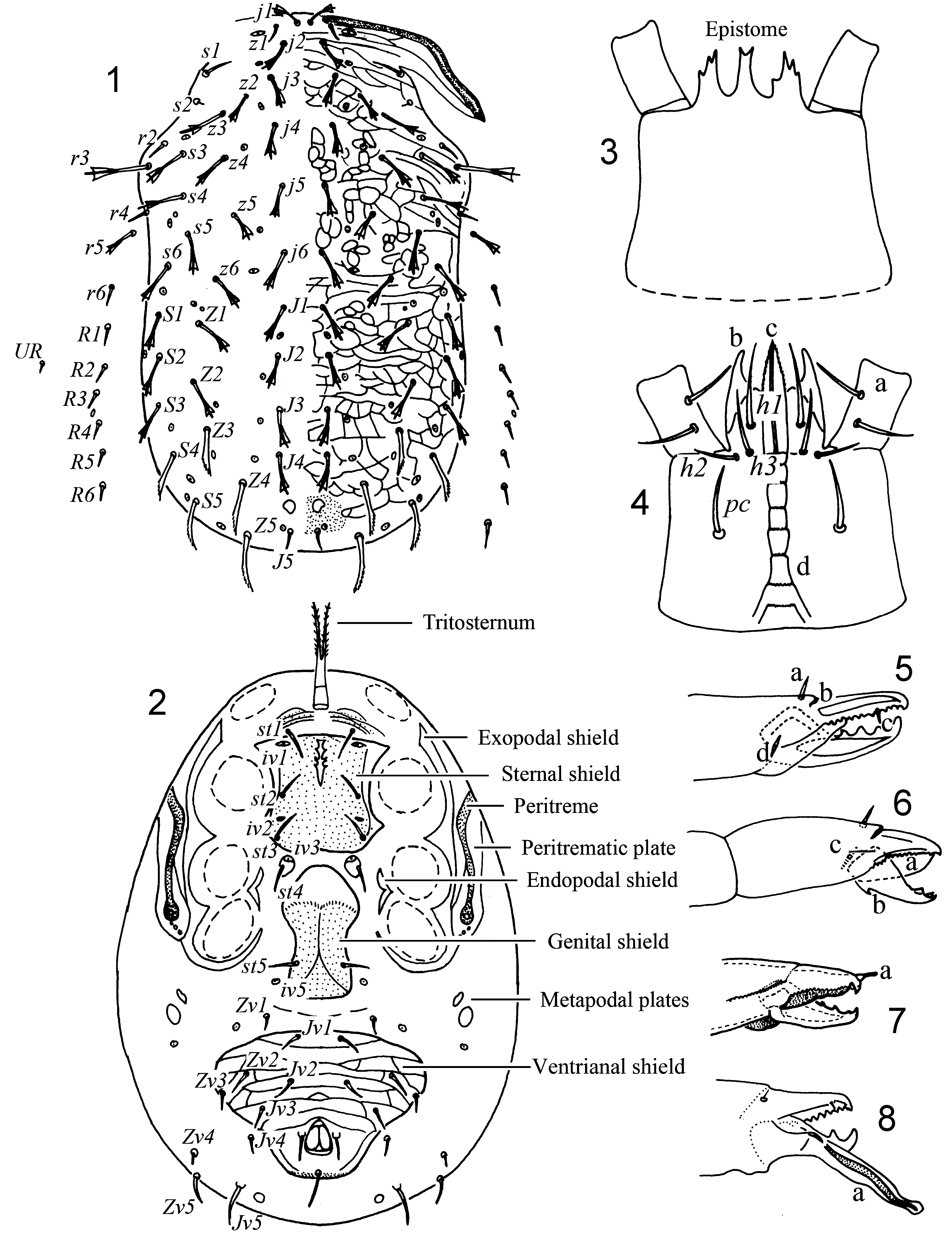
Ascidae is a family of mites in the order Mesostigmata.

Digamasellidae
Digamasellidae is a family of mites in the order Mesostigmata.
Eviphididae
Eviphididae is a family of mites in the order Mesostigmata.
Lohmanniidae
Lohmanniidae is a family of oribatids in the order Oribatida. There are at least 20 genera and 180 described species in Lohmanniidae.

Zerconidae
Zerconidae is a family of mites in the order Mesostigmata.
Hermanniellidae
Hermanniellidae is a family of oribatids in the order Oribatida. There are about 9 genera and at least 50 described species in Hermanniellidae.
Hypochthoniidae
thumb | right | Illustration of Hypochthonius rufulus
Hypochthoniidae is a family of oribatids in the order Oribatida. There are at least 4 genera and 20 described species in Hypochthoniidae.

Bdellidae
Bdellidae is a family of snout mites in the order Trombidiformes. There are about 11 genera and at least 260 described species in Bdellidae.
Veigaiidae
Veigaiidae is a family of mites belonging to the superorder Parasitiformes. However they are not parasitic but free-living and predatory and are found in soil and decaying organic matter. Some species are specialists of rocky shorelines. Members of this family can be distinguished by a hyaline appendage on the tarsus of the pedipalp.

Galumnidae
Galumnidae is a family of mites and ticks in the order Sarcoptiformes. There are at least 30 genera and 410 described species in Galumnidae.

Achipteriidae
Achipteriidae is a family of mites in the order Sarcoptiformes. There are about 9 genera and at least 80 described species in Achipteriidae.
Quadroppiidae
Quadroppiidae is a family of mites belonging to the order Sarcoptiformes.

Spinturnicidae
Spinturnicidae is a family of mites in the order Mesostigmata. The mites are highly specialized parasites of wing or tail membrane or bats. Some species infest eyelids and eye canthi. The species of Spinturnicidae are found in bat habitats throughout the world, living all stages of life on bats.
Histiostomatidae
Histiostomatidae is a family of mites in the clade Astigmata.
Carabodidae
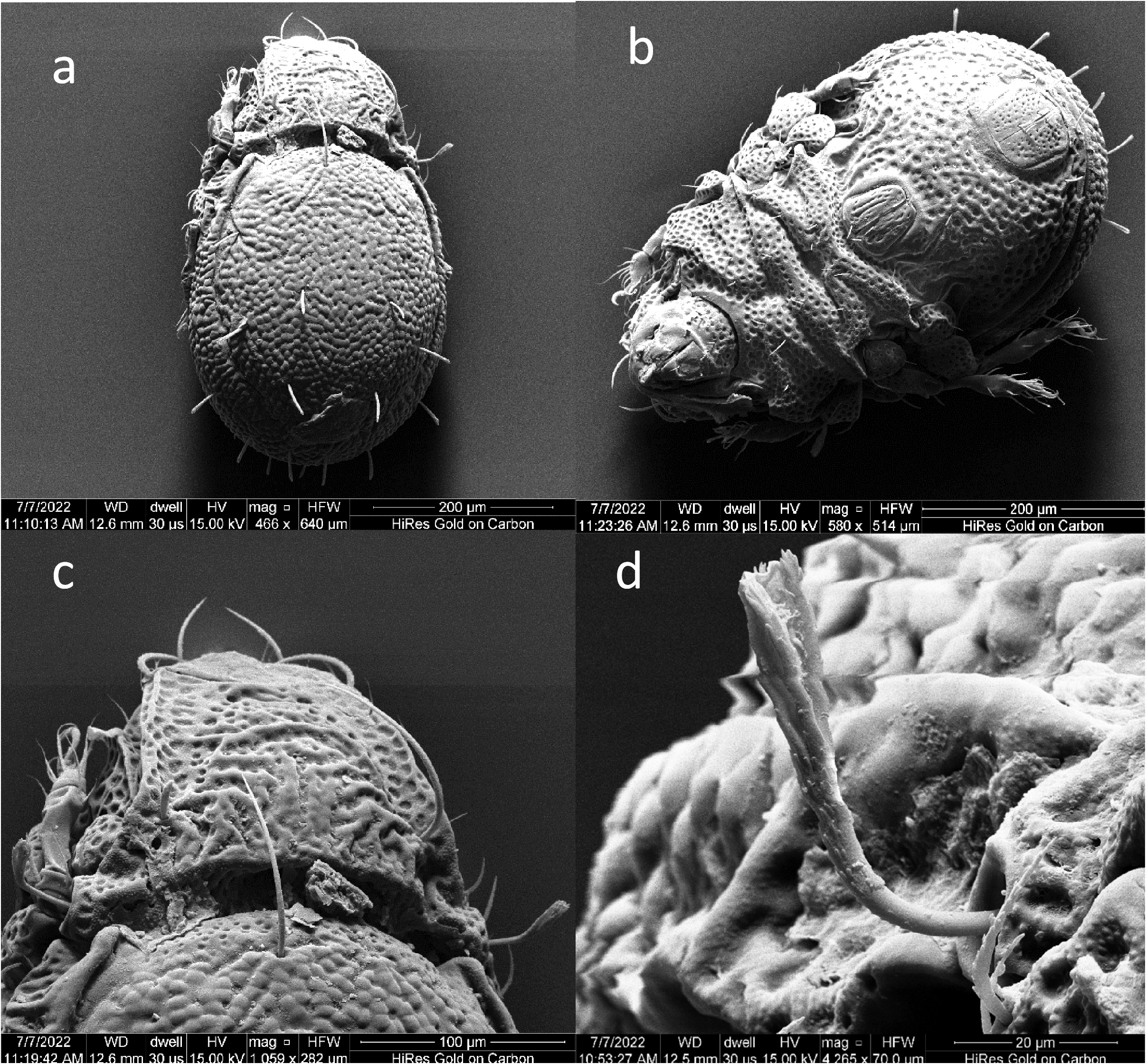
Carabodidae is a family of oribatids in the order Oribatida. There are at least 20 genera and 300 described species in Carabodidae.

Phthiracaridae
Phthiracaridae is a family of oribatid mites in the order Oribatida. There are about 7 genera and at least 710 described species in Phthiracaridae.
Phenopelopidae
Phenopelopidae is a family of oribatid mites in the order Sarcoptiformes. As of 2018, there were 4 genera and 106 species known in this family.
Epicriidae
Epicriidae is a family of mites in the order Mesostigmata.
Scheloribatidae
Scheloribatidae is a family of mites and ticks in the order Sarcoptiformes. There are at least 20 genera and 320 described species in Scheloribatidae.

Euphthiracaridae
Euphthiracaridae is a family of mites in the order Oribatida.

Parholaspididae
Parholaspididae is a family of mites in the order Mesostigmata. There are 14 known genera in the family, with a distribution across the entire world. Species are found in a variety of habitats, including leaf litter, logs, moss, caves, mammal nests, and as early colonizers from habitat disturbance.

Stigmaeidae
Stigmaeidae is a family of prostigmatan mites in the order Trombidiformes. At over 600 species, it is the largest family in superfamily Raphignathoidea. It has a worldwide distribution.

Tydeidae
Tydeidae is a family of acariform mites. As of 2016, it contained over 300 species in three subfamilies, though more species have been discovered since then.

Nothridae
Nothridae is a family of oribatids in the order Oribatida. There are at least 3 genera and 70 described species in the family Nothridae.

Phytoptidae
Phytoptidae is a family of mites belonging to the order Trombidiformes.
Mochlozetidae
Mochlozetidae is a family of mites and ticks in the order Sarcoptiformes. There are about 12 genera and at least 50 described species in Mochlozetidae.

Penthalodidae
Penthalodidae is a family of mites within the order Trombidiformes. Members in this family have been found in all continents, including Antarctica with members of Stereotydeus.