Category
page 1Models of computation
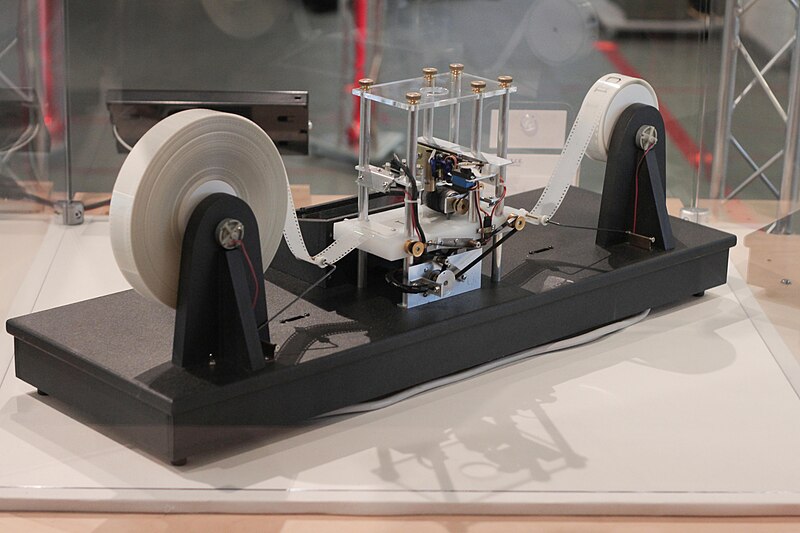
Turing machine
abstract computation model; mathematical model of computation that defines an abstract machine which manipulates symbols on a strip of tape according to a table of rules

quantum computing
study of a model of computation

lambda calculus
formal system in mathematical logic
pushdown automaton
type of automaton
Petri net
family of modelling languages for distributed systems
DNA computing
computing using molecular biology hardware
state diagram
diagram used in computer engineering and computer science
optical computer
computer that uses photons or light particles
abstract machine
theoretical model of a computer hardware or software system used in automata theory
Mealy machine
finite-state machine whose output values are determined both by its current state and the current inputs
model of computation
mathematical model describing how an output of a function is computed given an input
agent-based model
type of computational models
denotational semantics
approach of formalizing the meanings of programming languages by constructing mathematical objects (called denotations) that describe the meanings of expressions from the languages
persistence
computer system state that outlives the process that created it
linear bounded automaton
Turing machine, in which computation is restricted to the portion of the tape containing the input
probabilistic Turing machine
non-deterministic Turing machine which chooses between the available transitions at each point according to some probability distribution
stream processing
programming paradigm which gives some degree of parallel processing
state
set of instantaneous values of all variables to which a system or computer program has access
quantum circuit
model of quantum computing
register machine
generic class of abstract machines
state space
the set of values that a process can take in a dynamical system
structured program theorem
theorem that a class of control flow graphs can compute any computable function if it combines subprograms only through sequence, selection, and iteration
stack machine
type of computer
biocomputers
systems of biologically derived molecules that perform computational processes
state transition system
abstract machine used in the study of computation
reversible computing
model of computing
Zeno machine
hypothetical computational model
Binomial options pricing model
numerical method for the valuation of financial options

Markov algorithm
string rewriting system that uses grammar-like rules to operate on strings of symbols

parallel random-access machine
abstract computer for designing parallel algorithms

FRACTRAN
FRACTRAN is a Turing-complete esoteric programming language invented by the mathematician John Conway. A FRACTRAN program is an ordered list of positive fractions together with an initial positive integer input n. The program is run by updating the integer n as follows:
for the first fraction f in the list for which nf is an integer, replace n by nf
repeat this rule until no fraction in the list produces an integer when multiplied by n, then halt.
dataflow
In computing, dataflow is a broad concept, which has various meanings depending on the application and context. In the context of software architecture, data flow relates to stream processing or reactive programming.

one-instruction set computer
abstract machine that uses only one instruction
Alternating Turing machine
abstract computation model

Turmite
A 2-state 2-color turmite on a square grid. Starting from an empty grid, after 8342 steps the turmite (a red pixel) has exhibited both chaotic and regular movement phases.|thumb|250x250px
nested stack automaton
topological quantum computer
hypothetical fault-tolerant quantum computer based on topological condensed matter
deterministic pushdown automaton
Abstract machine in computer science
discrete system
system with a countable number of states
computational model
mathematical model of a complex system, e.g. weather
Cache-oblivious algorithm
i/O-efficient algorithm regardless of cache size
SECD machine
virtual and Abstract Machine target for functional programming language compiler
abstract state machine
state machine operating on states that are arbitrary data structures
Post–Turing machine
abstract calculator
tag system
deterministic computational model
one-way quantum computer
quantum computer that first prepares an entangled resource state and then performs single qubit measurements on it
P′′
P′′ (P double prime) is a primitive computer programming language created by Corrado Böhm in 1964 to describe a family of Turing machines. It provided one of the earliest formulations of the single-entry single-exit principle central to structured programming.
quantum volume
metric for a quantum computer's capabilities and error rates
decision tree model
model of computational complexity
behavior tree
control method
out-of-core algorithm
algorithm to process data that is too large to fit into a computer's main memory at one time, optimized to efficiently fetch and access data stored in slow bulk memory (e.g. hard drives, tape drives, remote network)
embedded pushdown automaton
Turing machine equivalents
hypothetical computing devices
billiard-ball computer
idealized model of a reversible mechanical computer