Category
page 1Mongol states
Mongolia
Mongolia is a landlocked country in the East Asia region. It is bordered by Russia to the north and China to the south, and covers an area of , making it the 18th-largest country in the world and the second largest landlocked country after Kazakhstan, as well as the largest landlocked country that does not border an inland sea. With a population of 3.5 million, Mongolia is the world's most sparsely populated sovereign state, excluding partially unrecognized Western Sahara. The country constitutes a significant portion of the Mongolian Plateau, and its natural environment is characterized

Mongol Empire
13th- and 14th-century empire originating in Mongolia

Yuan dynasty
Mongol-led imperial dynasty of China (1271–1368)
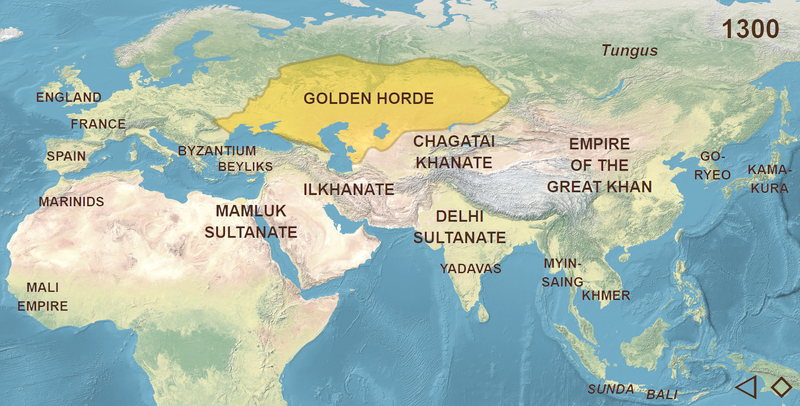
Golden Horde
medieval state in Eurasia

Timurid Empire
Central Asian Persianate Turco-Mongol empire (1370–1507)

Ilkhanate
The Ilkhanate or Il-khanate was a Mongol khanate founded in the southwestern territories of the Mongol Empire. It was ruled by the Il-Khans or Ilkhanids (), and known to the Mongols as Hülegü Ulus (). The Ilkhanid realm was officially known as the Land of Iran (Irānzamin) or simply Iran. It was established after Hülegü, the son of Tolui and grandson of Genghis Khan, inherited the West Asian and Central Asian part of the Mongol Empire after his brother Möngke Khan died in 1259.
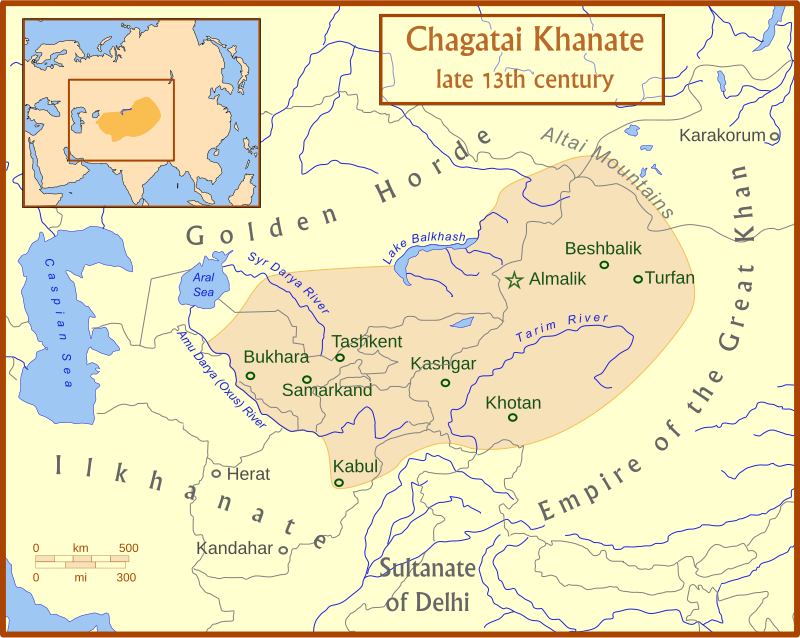
Chagatai Khanate
1226–1347 Turkicized Mongol khanate in Central Asia
Mongolian People's Republic
1924–1992 communist republic in East Asia

Liao dynasty
Khitan imperial dynasty in East Asia (916-1125), controlling northern and northeastern China, Mongolia, Russian Far East and North Korea

Dzungar Khanate
Oirat Mongolian Khanate based in Dzungaria from 1634–1758, referred as the Last great Nomadic empire

Tartary
thumb|300px| Cary's Map of independent Tartary (in yellow) and Chinese Tartary (in violet), in 1808.
Tartary (Latin: Tartaria; ; ; ) or Tatary () was a blanket term used in Western European literature and cartography for a vast part of Asia bounded by the Caspian Sea, the Ural Mountains, the Pacific Ocean, and the northern borders of China, India, and Persia, at a time when this region was largely unknown to European geographers.

Xianbei
The Xianbei (Mongolian:Сүнбэ; ; ) were an ancient nomadic people in northern East Asia who developed a distinct cultural and political identity by the 1st century BC. They inhabited regions spanning parts of present-day northeastern China, Inner Mongolia, and the eastern Eurasian steppe. Several Xianbei groups formed ruling regimes, with early political center around present-day Datong in Shanxi. The Xianbei were likely not of a single ethnicity, but rather a multilingual, multi-ethnic confederation consisting of mainly Proto-Mongols (who spoke either pre-Proto-Mongolic, or Para-Mongolic langu
Jalayirid Sultanate
Shia Muslim Turco-Mongol Sultanate
Bogd Khanate of Mongolia
khanate ruled by bogd khan on Outer Mongolia from 1911 to 1919 and 1921 to 1924

Keraites
The Keraites (also Kerait, Kereit, Khereid, Kazakh: керейт; Kyrgyz: керей; Mongolian: , Хэрэйд; Nogai: Кереит; Uzbek: Kerait; Chinese: 克烈, Persian: کرایت) were one of the five dominant Turco-Mongol tribal confederations (khanates) in the Altai-Sayan region during the 12th century. They had converted to the Church of the East in the early 11th century and are one of the possible sources of the European Prester John legend.
Northern Yuan dynasty
former empire in East Asia
Former Yan
Chinese Sixteen Kingdoms dynastic state (337–370)
Blue Horde
Mongol horde of the 13th-14th centuries, controlling the western territories of the Golden Horde
Khamag Mongol
Mongolic tribal confederation (khanlig) on the Mongolian Plateau in the 12th century
Kalmyk Khanate
historic state
Four Oirats
Confederation of Oirat tribes of Western Mongolia
Khoshut Khanate
Tibetan kingdom from 1642-1717

Xueyantuo
The Xueyantuo or Sir Tardush were an ancient Turkic tribe from the Tiele confederation and a khaganate in Northeast Asia who were at one point vassals of the Göktürks, later aligning with the Tang dynasty against the Eastern Turkic Khaganate.
Tatar confederation
major nomad confederation in the Mongolian Plateau (12th century)
State of Buryat-Mongolia
1917–1921 state in East Asia
Kara Del
Qamil or Kara Del was a kingdom that existed in Kumul or Hami, in present-day Xinjiang. It was founded by the Yuan prince Gunashiri, a descendant of Chagatai Khan, in the late 14th century (c. 1389), and ruled by the Chagatayids thereafter until 1463. From 1380s, it began to pay tribute to the Ming dynasty. From 1406, it was governed by Ming under the "Hami Guard" (); however, sometimes it was still under the influence of the Northern Yuan, and the ruler was called the Obedient King () under the Jimi system. It was destroyed in 1513 as a result of the wars between the Ming dynasty and the Oira
list of Mongol states
Wikimedia list article
Sutayids
The Sutayids () were a Mongol dynasty descended from Ilkhan Ghazan's commander Emir Sutay. Like other post-Ilkhanate Mongol dynasties, such as the Jalayirids and Chupanids, they were related to the Borjigin dynasty through marriage. Emir Sutay was a son-in-law of Hulagu Khan's son Möngke Temür. Their main area of activity ranged from Jazira in the south to Erzurum in the north.