Category
page 1Monotypic Basidiomycota genera

Polyozellus multiplex
Polyozellus is a fungal genus in the family Thelephoraceae, a grouping of mushrooms known collectively as the leathery earthfans. Previously considered a monotypic genus, it now contains the Polyozellus multiplex species complex. The genus name is derived from the Greek poly meaning many, and oz, meaning branch. It is commonly known as the blue chanterelle, the clustered blue chanterelle, bluefan, or, in Alaska, the black chanterelle. The distinctive fruit body of this species comprises blue- to purple-colored clusters of vase- or spoon-shaped caps with veiny wrinkles on the undersurface that
Wallemia
REDIRECT Wallemiomycetes
Phaeolepiota
Phaeolepiota is a genus of fungi in the family Squamanitaceae. The genus is monotypic, containing the single species Phaeolepiota aurea. Commonly known as Alaskan gold, Alaska gold, golden bootleg or golden cap, P. aurea is an agaric (gilled mushroom) found throughout North America and Eurasia – often in groups and next to nettles.
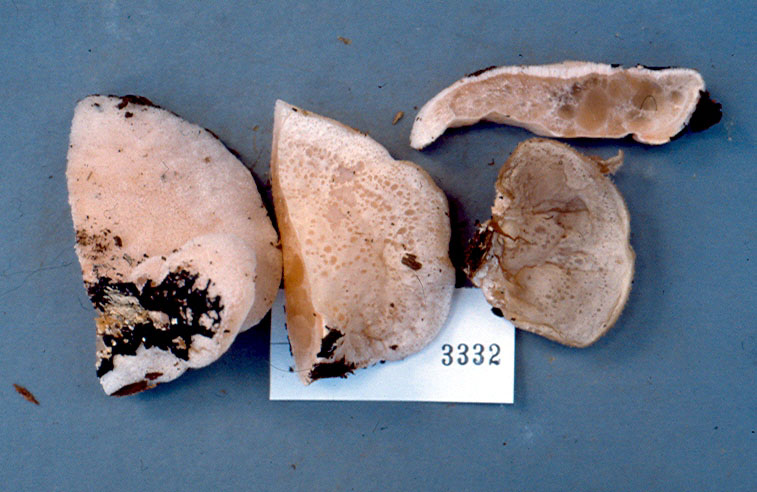
Gloeostereum incarnatum
Gloeostereum is a genus of fungi in the family Cyphellaceae. This is a monotypic genus, containing the single species Gloeostereum incarnatum, an edible mushroom native to China. In Chinese culture, it is called ''yú'ěr'' (榆 耳; literally "elm ear"). It is sometimes included in a vegetarian dish called Buddha's delight.

Phleogena
Phleogena is a fungal genus in the Phleogenaceae family. The genus is monotypic, containing the single species Phleogena faginea and is found mostly widespread in northern temperate areas, but is occasionally found in southern areas.
Mycaureola dilseae
Mycaureola is a genus of fungi in the family Physalacriaceae of mushrooms. Circumscribed in 1922 by French mycologists René Maire and Émile Chemin, the genus is monotypic, containing the single species Mycaureola dilseae. The fungus is a parasite of the red algal species Dilsea carnosa, on which it causes circular necrotic lesions.
Phellopilus
Phellopilus is a fungal genus in the family Hymenochaetaceae. Circumscribed in 2001, the genus is monotypic, containing the single widespread species Phellopilus nigrolimitatus.
Serpulomyces
Serpulomyces is a genus of fungi in the family Amylocorticiaceae. The genus is monotypic, containing the single species Serpulomyces borealis, found in Europe. Serpulomyces was described by Ivan Zmitrovich in 2002.

Irpicodon
Irpicodon is a genus of fungi in the family Amylocorticiaceae. The genus is monotypic, containing the single species Irpicodon pendulus, found in Europe.
Dacryoscyphus
Dacryoscyphus is a genus of anamorphic fungi in the Dacrymycetales order. The genus is monotypic, containing the single species Dacryoscyphus chrysochilus, found in China. The genus and species were formally described in 2005.
Guepinia
Guepinia is a genus of fungus in the Auriculariales order. It is a monotypic genus, containing the single species Guepinia helvelloides, commonly known as the apricot jelly or salmon salad. The fungus produces salmon-pink, ear-shaped, gelatinous fruit bodies that grow solitarily or in small tufted groups on soil, usually associated with buried rotting wood. The fruit bodies are up to tall and up to wide; the stalks are not well-differentiated from the cap. It has a white spore deposit, and the oblong to ellipsoid spores measure 9–11 by 5–6 micrometers.
Heliocybe
Heliocybe is an agaric genus closely allied to Neolentinus and the bracket fungus, Gloeophyllum, all of which cause brown rot of wood. Heliocybe sulcata is the type and sole species.
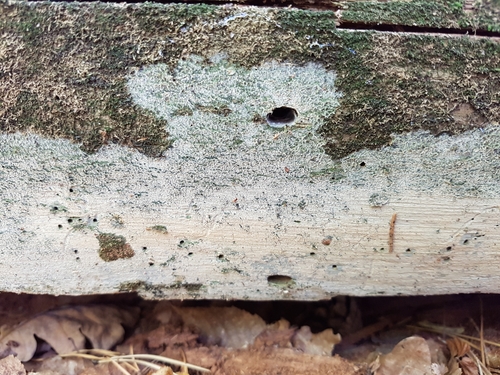
Skvortzovia
Skvortzovia is a fungal genus of unknown placement in the class Agaricomycetes. It is a monotypic genus, containing the single species Skvortzovia furfurella, found in the United States. This crust fungus was originally described by Italian mycologist Giacomo Bresadola in 1925 as Odontia furfurella. Vera Lúcia Bononi and Kurt Hjortstam circumscribed Skvortzovia in Mycotaxon vol.28 on page 12 in 1987 to contain the species.
Cerinosterus
Cerinosterus is a genus of anamorphic fungi in the order Dacrymycetales. The genus is monotypic, containing the single species Cerinosterus luteoalbus. The species and genus was formally described in 1987. Cerinosterus is similar in morphology to Sporothrix; common features include hyphal septa with dolipores and imperforate parenthesomes.
Aphroditeola
Aphroditeola is an agaric fungal monotypic genus that produces pink cantharelloid fruit bodies on coniferous forest floors. The lamellae are forked and typically the fruit bodies have a fragrant odor described as candy-like, cinnamon-like or pink bubble gum-like. It contains the one species Aphroditeola olida, which is commonly known as the pink bubblegum mushroom.
Apioperdon
Apioperdon pyriforme, commonly known as the pear-shaped puffball or stump puffball, is a species of fungus. It is often called Lycoperdon pyriforme, but was transferred to Apioperdon in 2017. It is the only species in the genus.
Burgella
Burgella is a genus of fungi in the family Clavulinaceae. The genus is monotypic, containing the single species Burgella flavoparmeliae, described in 2007.
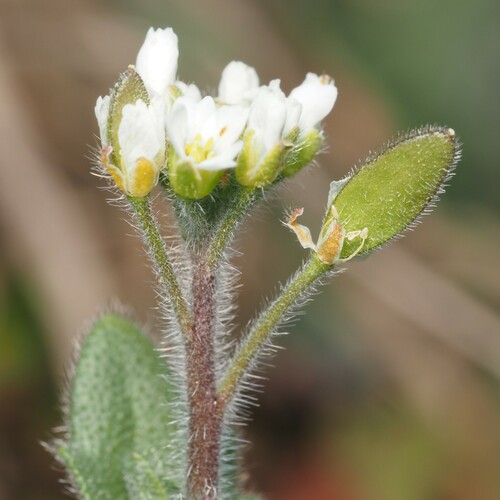
Platycarpa
Platycarpa is a genus of fungus in the order Platygloeales, containing the single species Platycarpa polypodii. The species forms effused basidiocarps (fruit bodies) on ferns, on which it is parasitic.
Basidiopycnis
Basidiopycnis is a fungal genus in the family Hoehnelomycetaceae. The genus is monotypic, containing the single species Basidiopycnis hyalina. The species forms minute pycnidial basidiocarps (fruit bodies) in bark beetle tunnels. Teleomorphs produce auricularioid (laterally septate) basidia, whilst anamorphs produce asexual conidia. Basidiopycnis hyalina was described from Germany and is also known from Italy and Switzerland. Anamorphic fruit bodies collected in Canada were given the name Basidiopycnides albertensis, but are currently considered conspecific with the European species.
Guyanagaster
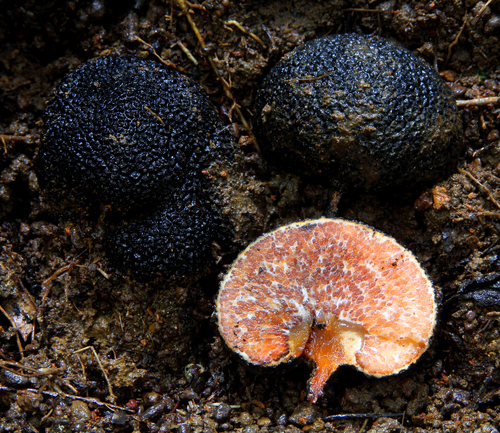
Guyanagaster is a genus of fungi in the family Physalacriaceae. The genus contains two wood-decaying sequestrate species Guyanagaster necrorhizus and Guyanagaster lucianii. The species, found in the neotropical rainforests of the Guiana Shield, was first described scientifically in 2010.
Faerberia
Faerberia is a fungal genus in the family Polyporaceae. It is a monotypic genus, containing the single species Faerberia carbonaria, which is commonly known as the firesite funnel due to its habitat of burned soil.
Ceraceopsis
Ceraceopsis is a fungal genus in the class Agaricomycetes. It has not yet been placed in any order or family. A monotypic genus, it contains the single corticioid species Ceraceopsis verruculosa, found growing on dead deciduous wood in Venezuela. The type collection was made in June 1997, in Yutajé (Amazonas State).
Ceraceopsis was circumscribed by mycologists Kurt Hjortstam and Leif Ryvarden in 2007.
Licrostroma
Licrostroma is a genus of fungi in the family Corticiaceae. The genus is monotypic, containing the single species Licrostroma subgiganteum found in North America and Japan. It is an anamorphic form of Michenera.
Phallogaster
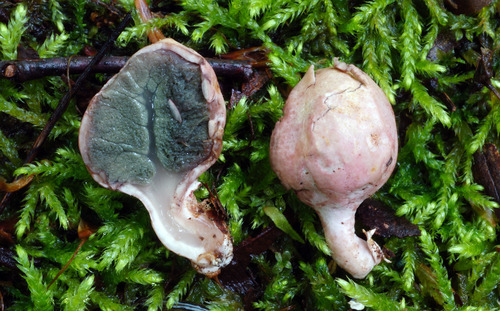
Phallogaster is a fungal genus in the family Phallogastraceae. The genus is monotypic, containing the single secotioid species Phallogaster saccatus, commonly known as the club-shaped stinkhorn or the stink poke.
Brauniella
Brauniella is an agaric fungal genus in the family Strophariaceae. The only species in the genus is Brauniella alba, a species first described as Braunia alba by Brazilian mycologist Johannes Rick in 1934. Braunia is an illegitimate homonym of an earlier name, so Rolf Singer circumscribed Brauniella to contain the fungus in 1955.
Phlyctibasidium
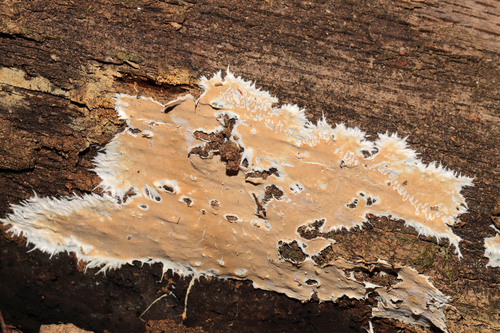
Phlyctibasidium is a fungal genus of uncertain taxonomic placement in the Agaricomycetes. This is a monotypic genus, containing the single corticioid species Phlyctibasidium polyporoideum.
Illosporiopsis
Illosporiopsis is a genus of fungi with one species, Illosporiopsis christiansenii, a fungus which parasitizes lichen. Illosporiopsis was described after DNA evidence showed that species previously ascribed to Hobsonia were unrelated.

Goossensia
As established by Cossmann in 1885, Goossensia is a mollusc genus in family Carditidae. As invalidly described by Ragonot in 1891, it refers to the snout moth genus Macna.
Hydnocristella
Hydnocristella is a fungal genus in the Lentariaceae family. The genus is monotypic, containing the single species Hydnocristella himantia, found in North America. The species was originally named Hydnum himantia by Lewis David von Schweinitz in 1822, and underwent several generic transfers before being made the type species of Hydnocristella in 1971.
Scutelliformis
Scutelliformis is a genus of rust fungi in the family Phragmidiaceae. The genus is monotypic, containing the single species Scutelliformis bicornus.
Bogbodia
Bogbodia is a bog-inhabiting agaric fungal genus that colonizes peat and Sphagnum and produces tan-colored fruit bodies. The only species in the genus is Bogbodia uda. Characteristically it forms chrysocystidia and rather large, finely roughened, violaceous basidiospores each with a poorly defined germ pore. The genus differs from Hypholoma which has smaller, smooth basidiospores and typically have cespitose fruit bodies and decay wood. Phylogenetically, Bogbodia is distinct from Hypholoma, Pholiota, and Leratiomyces.
Butlerelfia
Butlerelfia is a fungal genus in the family Atheliaceae. The genus is monotypic, containing the single corticioid species Butlerelfia eustacei, recorded from Europe and Canada. The species causes fisheye rot of refrigerated apples. The binomial honors H. J. Eustace and L. F. Butler, who first described the species under the name Corticium centrifugum.
Limnoperdon
Limnoperdon is a fungal genus in the monotypic family Limnoperdaceae. The genus is also monotypic, as it contains a single species, the aquatic fungus Limnoperdon incarnatum. The species, described as new to science in 1976, produces fruit bodies that lack specialized structures such as a stem, cap and gills common in mushrooms. Rather, the fruit bodies—described as aquatic or floating puffballs—are small balls (0.5–1 mm diameter) of loosely interwoven hyphae. The balls float on the surface of the water above submerged twigs. Experimental observations on the development of the fruit body,