Category
page 1Montehermosan

Caenolestidae
family of mammals

Thylacosmilus
Thylacosmilus is an extinct genus of saber-toothed metatherian mammals that inhabited South America from the Late Miocene to Pliocene epochs. Though Thylacosmilus looks similar to the "saber-toothed cats", it was not a felid, like the well-known American Smilodon, but a sparassodont, a group closely related to marsupials, and only superficially resembled other saber-toothed mammals due to convergent evolution, with the aforementioned Thylacosmilus being one of the last known sparassodonts. A 2005 study found that the bite forces of Thylacosmilus and Smilodon were low, which indicates that the

Macrauchenia
Macrauchenia ("long llama", based on the now-invalid llama genus, Auchenia, from Greek "big neck") is an extinct genus of large ungulate native to South America from the Pliocene or Middle Pleistocene to the end of the Late Pleistocene. It was one of the last surviving members of the extinct order Litopterna, a group of South American native ungulates distinct from the two orders which contain all living ungulates which had been present in South America since the early Cenozoic, over 60 million years ago, prior to the arrival of living ungulates in South America around 2.5 million years ago as

Toxodon
Toxodon (from Ancient Greek τόξον (tóxon), meaning "bow", and ὀδούς (odoús), meaning "tooth", in reference to the curvature of the teeth) is an extinct genus of large ungulate native to South America from the Pliocene to the end of the Late Pleistocene. Toxodon is a member of Notoungulata, an order of extinct South American native ungulates distinct from the two living ungulate orders that had been indigenous to the continent for over 60 million years since the early Cenozoic, prior to the arrival of living ungulates into South America around 2.5 million years ago during the Great American Int
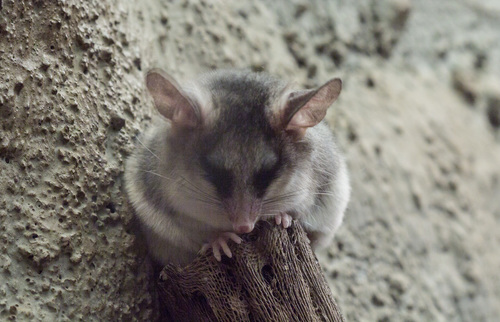
Thylamys
Thylamys is a genus of opossums in the family Didelphidae. The premaxillae are rounded rather than pointed. The females lack a pouch. The females' nipples are arranged in two symmetrical rows on the abdomen. All species but T. macrurus store fat in their tails, although this is not necessarily true for all species in the genus. Fossils belonging to the genus date back to the Miocene, with the oldest specimens being found in the Cerro Azul Formation of Argentina and the Honda Group of Colombia. Genetic studies indicate that the genus may have originated around 14 million years ago.

Purussaurus
Purussaurus is a genus of extinct giant caimans that lived in the Americas during the Miocene epoch, from the Friasian to the Huayquerian in the SALMA classification. It is known from skull material found in the Brazilian and Peruvian Amazon, Argentina, Colombian Villavieja Formation, Panamanian Culebra Formation, Urumaco, and Socorro Formations of northern Venezuela.

Stupendemys
Stupendemys is an extinct genus of freshwater side-necked turtle, belonging to the family Podocnemididae. It is the largest freshwater turtle known to have existed, with a carapace over 2 meters long. Its fossils have been found in northern South America, in rocks dating from the Middle Miocene to the very start of the Pliocene, about 13 to 5 million years ago. Male specimens are known to have possessed bony horns growing from the front edges of the shell and the discovery of the fossil of a young adult shows that the carapace of these turtles flattens with age. A fossil skull described in 202

Eremotherium
Eremotherium (from Greek for "steppe" or "desert" "beast": ἔρημος "steppe or desert" and θηρίον "beast") is an extinct genus of giant ground sloth in the family Megatheriidae. Eremotherium lived in southern North America, Central America, and northern South America. It was one of the largest sloths, with a body size comparable to elephants, weighing around and measuring about long, slightly larger than its close relative Megatherium.

Thalassocnus
Thalassocnus is an extinct genus of semiaquatic ground sloths from the Miocene and Pliocene of the Pacific South American coast. It is monotypic within the subfamily Thalassocninae. The five species—T. antiquus, T. natans, T. littoralis, T. carolomartini, and T. yuacensis—represent a chronospecies, a population gradually adapting to marine life in one direct lineage. They are the only known aquatic sloths, but they may have also been adapted to a terrestrial lifestyle. They have been found in the Pisco Formation of Peru, the Tafna Formation of Argentina, and the Bahía Inglesa, Coquimbo, and Ho

Pelagornis
Pelagornis is an extinct genus of prehistoric pseudotooth birds, a group of extinct seabirds. Species span from the Oligocene to the Early Pleistocene. Members of Pelagornis represent among the largest pseudotooth birds, with one species, P. sandersi, having the widest wingspan of any bird known.

Cuvieronius
Cuvieronius is an extinct New World genus of gomphothere which ranged from southern North America to northwestern South America during the Pleistocene epoch. Reaching a shoulder height of and a body mass of , it was comparable in size to an Asian elephant. Cuvieronius inhabited subtropical and tropical latitudes in environments ranging from grasslands to tropical rainforest. Among the last gomphotheres along with the South American Notiomastodon, it became extinct as part of the end Pleistocene-extinction event, approximately 12-11,000 years ago, along with most other large mammals in the Amer

Acrophoca
Acrophoca longirostris, also known as the swan-necked seal, is an extinct genus of Late Miocene pinniped. It was thought to have been the ancestor of the modern leopard seal; however, it is now thought to be a species of monk seal.
Carcharodon hubbelli
species of fossil shark

Psilopterus
Psilopterus (Greek for "bare wing") is an extinct genus of phorusrhacid ("terror bird") from the Middle Oligocene to possibly the Late Pleistocene of Argentina and Uruguay. Compared to other phorusrhacids, members of the genus are both relatively gracile and diminutive, and include the smallest known species of terror bird: with the head raised P. bachmanni was in height and weighed about , while the largest members of the genus were only about . The birds resemble the modern cariama (Cariama cristata), except with a heavier build and considerably smaller wings. Fossil finds in Uruguay indicat
Argyrolagus
Argyrolagus is an extinct genus of South American metatherian, belonging to the order Polydolopimorpha from the Early Pliocene Monte Hermoso Formation, Patagonia, Argentina.

Devincenzia
Devincenzia is an extinct genus of giant flightless predatory birds in the family Phorusrhacidae or "terror birds" that lived during the Early Miocene (Deseadan) Fray Bentos Formation of Uruguay, Late Miocene (Huayquerian) Ituzaingó Formation, Early Pliocene (Montehermosan) of Argentina, and possibly the Early Pleistocene Raigón Formation of Uruguay. The type species D. pozzi was formerly known as Onactornis pozzi. The largest possible specimen weighed up to , making it one of the largest phorusrhacids and carnivorous birds known.
Procariama
Procariama is an extinct monotypic genus of phorusrhacid, which lived from the Late Miocene to the Late Pliocene (11-2 million years ago) of Argentina. Fossils of the animal have been found in six places, in the Cerro Azul and Andalhuala Formations. More specifically in the Andagalá department and in the north of the Belén department of the Catamarca province, with a single location in the La Pampa province. The type and only species, Procariama simplex, is the largest member of the subfamily Psilopterinae.
Lestodon
Lestodon is an extinct genus of giant ground sloth native to South America during the Pleistocene epoch. Its fossil remains have primarily been found in the Pampas and adjacent regions. The largest member of the family Mylodontidae, It is estimated to have weighed . It was a herbivore and primarily fed on the grasses and low-growing plants.
Mesembriornis
Mesembriornis is a genus of intermediate-sized phorusrhacids that grew up to in height. They represent a well-distinct lineage of terror birds, differing from the massive large groups and the smaller Psilopterinae. In general proportions, they most resembled the Patagornithinae which flourished somewhat earlier, mainly to the south of the range of Mesembriornis. Fossils of the terror bird have been found in Montehermosan deposits of the Monte Hermoso Formation, as well as the Andalgala Formation and Chapadmalal Formation in Argentina.
Trigodon gaudryi
Trigodon is an extinct genus of the family Toxodontidae, a large-bodied notoungulate which inhabited South America during the Late Miocene to Early Pliocene (Mayoan to Montehermosan in the SALMA classification), living from 11.61 to 4.0 Ma which existed for approximately . The type species is T. gaudryi. It bore a superficial resemblance to a rhinoceros, in that it had a horn on its forehead, and was one of a few horned notoungulates, including Adinotherium and Leontinia.
Cyonasua
Cyonasua (meaning "dog-coati" in Greek) is an extinct genus of procyonid from the Late Miocene to Middle Pleistocene of South America. Fossils of Cyonasua have been found in Argentina (Ituzaingó, Epecuén, Huayquerías, Monte Hermoso, Chapadmalal, Maimará, Ensenada, La Playa, Chiquimil, Andalhuala, and Cerro Azul Formations), Bolivia (Tariquía Formation), Uruguay (Camacho Formation), and Venezuela (San Gregorio Formation). The oldest well-dated fossils of Cyonasua are approximately 7.3 million years old. Most fossils of Cyonasua are late Miocene to early late Pliocene (Huayquerian to Chapadmalal
Neotamandua
Neotamandua is an extinct genus of anteaters that lived in the Miocene to Pliocene in South America.
Crocodylus falconensis
extinct species of corocilde from northern South America during the Pliocene
Aulophyseter
Aulophyseter is an extinct genus of sperm whales from the subfamily Physeterinae that existed during the Miocene.
Piscogavialis
Piscogavialis is an extinct genus of gryposuchine gavialid crocodylian. Two species have been described, the type species P. jugaliperforatus and P. laberintoensis. Fossils of Piscogavialis have been found from the Mio-Pliocene Pisco Formation of the Sacaco Basin in southern Peru in 1998, where it coexisted with the much smaller gavialid Sacacosuchus.
Catonyx
Catonyx is an extinct genus of ground sloth of the family Scelidotheriidae, endemic to South America during the Pliocene and Pleistocene epochs. It lived from 2.5 Ma to about 10,000 years ago, existing for approximately . The most recent date obtained is about 9600 B.P.
Palaeomyrmidon
Palaeomyrmidon is an extinct genus of anteater. Its closest living relative is the silky anteater (Cyclopes didactylus). Although the silky anteater is arboreal, Palaeomyrmidon lived on the ground. Palaeomyrmidon is known from a fossil skull that was found in the Andalhualá Formation of Argentina.
Ikanogavialis
Ikanogavialis is an extinct genus of gavialid crocodilian. Fossils have been found in the Urumaco Formation in Urumaco, Venezuela and the Solimões Formation of Brazil. The strata from which remains are found are late Miocene in age, rather than Pliocene as was once thought. A possible member of this genus survived into the Late Holocene on Muyua or Woodlark Island in Papua New Guinea.
Charactosuchus
Charactosuchus is an extinct genus of crocodilian. It was assigned to the family Crocodylidae in 1988. Specimens have been found in Colombia, Brazil, Jamaica, and possibly Florida and South Carolina. It was gharial-like in appearance with its long narrow snout but bore no relation to them, being more closely related to modern crocodiles than to gharials.
Diplasiotherium
Diplasiotherium is an extinct genus of litoptern belonging to the family Proterotheriidae, that lived between the late Miocene and the early Pliocene (in the SALMAs Huayquerian and Montehermosan). The fossils of this animal have been found in Argentina, in the Monte Hermoso Formation.
Opisthodactylus
Opisthodactylus is an extinct genus of rheiform bird from the Early to Middle Miocene Santa Cruz and Chichinales Formations and the Late Miocene (Montehermosan) Andalhuala Formation of Argentina. Three species are described: the type species, O. patagonicus, O. kirchneri and O. horacioperezi. The species O. kirchneri was described in 2017 by Noriega et al. Fossils of O. horacioperezi were found together with fossils of Patagorhacos terrificus.
Promacrauchenia
Promacrauchenia is an extinct genus of macraucheniids that lived during the Late Miocene to Late Pliocene epochs of what is now Argentina and Bolivia. It belongs to the subfamily Macraucheniinae, which also includes Huayqueriana, Macrauchenia, and Xenorhinotherium. Fossils of this genus have been found in the Ituzaingó, Andalhuala, and Cerro Azul Formations of Argentina.
Boreostemma
alt=Reconstruction of the glyptodont Boreostemma venezolensis. Artwork created with rapidograph and colored markers. Author: Edwin Chávez. |thumb|Paleoart of Boreostemma venezolensis. Created by Edwin Chávez "Disfrasaurio".
Boreostemma is an extinct genus of glyptodonts from northern South America. Fossils assigned to the genus were first described as belonging to Asterostemma from southern South America, but have been placed in the new genus Boreostemma by Carlini et al. in 2008. The type species is B. pliocena. Fossils of Boreostemma have been found in the Honda Group of Colombia, in Peru an
Hoffstetterius
Hoffstetterius is an extinct genus of toxodontid notoungulate mammal, belonging to the subfamily Toxodontinae whose remains were discovered in the Middle to Late Miocene (Mayoan to Montehermosan) Mauri Formation in the La Paz Department in Bolivia. The only described species is the type Hoffstetterius imperator.
Globidentosuchus
Globidentosuchus is an extinct genus of basal caimanine crocodylian known from the late Middle to Late Miocene of the Middle and the Upper Members of the Urumaco Formation at Urumaco, Venezuela. Its skull was very short and robust, with large units of spherical teeth used to break the shells of molluscs as part of its durophagus diet. It is thought to be one of the most basal Caimanines, even sharing some traits with alligatorids.
Eleutherocercus
Eleutherocercus was a genus of glyptodonts that lived during the Late Miocene and Early Pliocene in South America. Fossils of the genus have been found in the Huayquerian Ituzaingó Formation (E. paranensis) and the Montehermosan Monte Hermoso Formation (E. antiquus) in Argentina.
Macroeuphractus
Macroeuphractus is a genus of extinct armadillos from the Late Miocene to Late Pliocene of South America. The genus is noted for its large size, with Macroeuphractus outesi being the largest non-pampathere or glyptodont armadillo discovered, as well as its specializations for carnivory, unique among all xenarthrans.