Category
page 1Multi-dimensional geometry
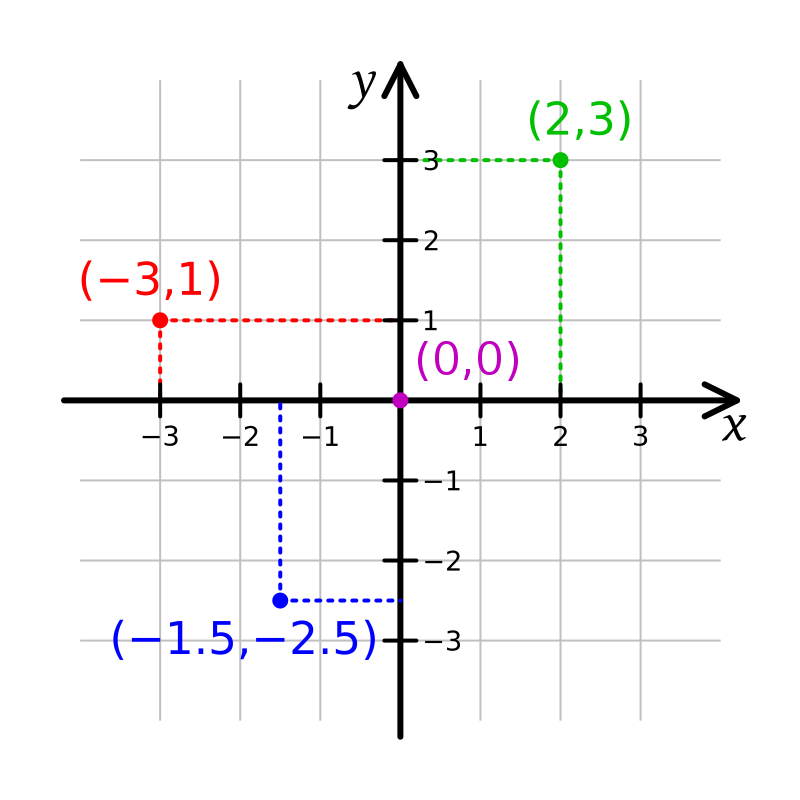
plane
flat, infinite two-dimensional surface
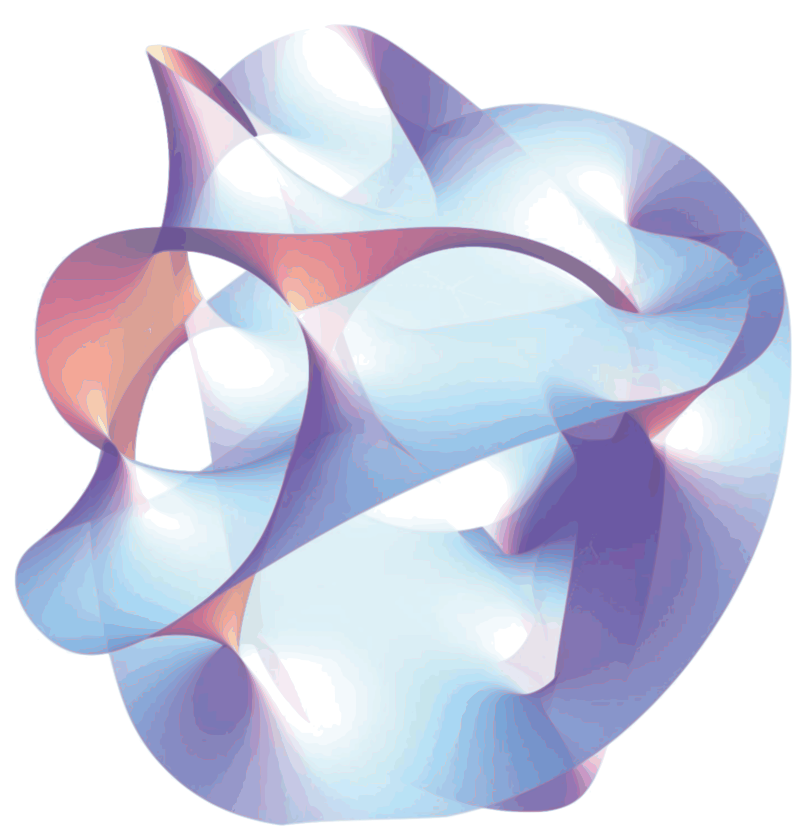
string theory
physical theory of quantized one-dimensional objects with conformal symmetry, which can describe gravitation, gauge theory and other phenomena
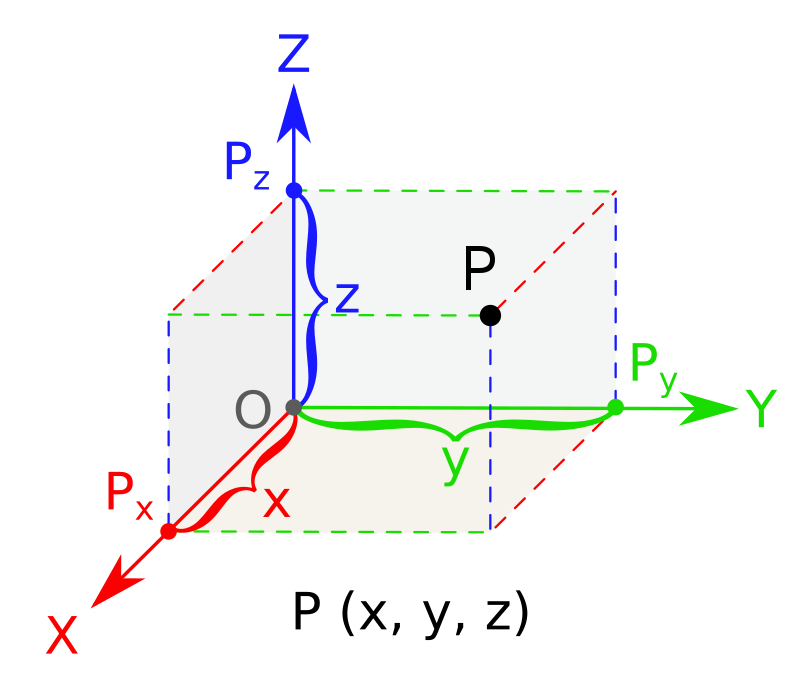
three-dimensional space
geometric model in which a point is specified by three parameters

Platonic solid
convex regular polyhedra with the same number of faces at each vertex

two-dimensional space
geometric model of the planar projection of the physical universe

edge
line segment joining two adjacent vertices in a polygon or polytope
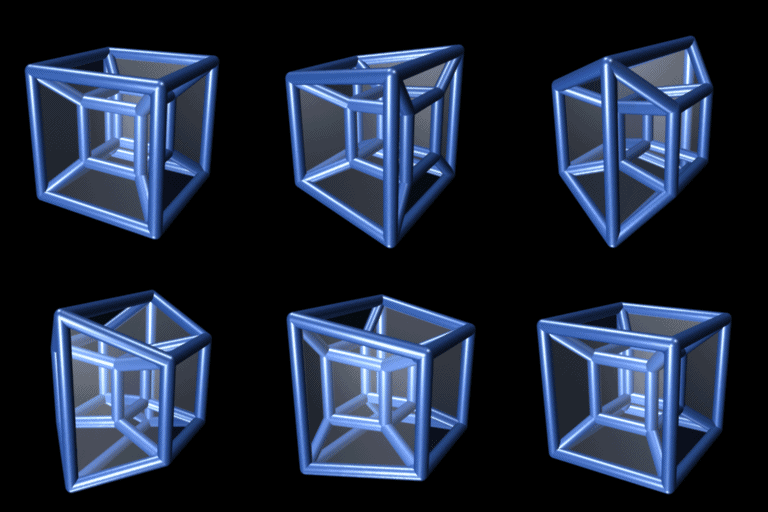
four-dimensional space
geometric space with four dimensions

simplex
alt=From left to right: a point (marked 0), a line (marked 1), a triangle (marked 2), and a tetrahedron (marked 3).|thumb|The four simplexes that can be fully represented in 3D space.

hyperplane
thumb|Two intersecting planes: Two-dimensional planes are the hyperplanes in three-dimensional space.
hypersurface
In geometry, a hypersurface is a generalization of the concepts of hyperplane, plane curve, and surface. A hypersurface is a manifold or an algebraic variety of dimension , which is embedded in an ambient space of dimension , generally a Euclidean space, an affine space or a projective space.
Hypersurfaces share, with surfaces in a three-dimensional space, the property of being defined by a single implicit equation, at least locally (near every point), and sometimes globally.

n-sphere
thumb|2-sphere wireframe as an orthogonal projection
right|thumb|Just as a stereographic projection can project a sphere's surface to a plane, it can also project a -sphere into -space. This image shows three coordinate directions projected to -space:
parallels (red), meridians (blue), and hypermeridians (green).
Due to the conformal property of the stereographic projection, the curves intersect each other orthogonally (in the yellow points) as in 4D.
All of the curves are circles: the curves that intersect have an infinite radius (= straight line).

cross-polytope
{| class="wikitable floatright"
|+ Cross-polytopes of dimension 2 to 5
|-
|style="text-align: center;"|120px|A 2-dimensional cross-polytope
|style="text-align: center;"|120px|A 3-dimensional cross-polytope
|-
|style="text-align: center;"|2 dimensionssquare
|style="text-align: center;"|3 dimensionsoctahedron
|-
|style="text-align: center;"|120px|A 4-dimensional cross-polytope
|style="text-align: center;"|120px|A 5-dimensional cross-polytope
|-
|style="text-align: center;"|4 dimensions16-cell
|style="text-align: center;"|5 dimensions5-orthoplex
|}
Poincaré disk model
model of hyperbolic geometry
five-dimensional space
mathematic space with five dimensions
parallel coordinates
chart displaying multivariate data with values represented on parallel axes

hyperrectangle
thumb|Projections of k-cells onto the plane (from k\in\{1,\dots{},6\}). Only the edges of the higher-dimensional cells are shown.
In geometry, a hyperrectangle (also called a box, hyperbox, k-cell or orthotope), is the generalization of a rectangle (a plane figure) and the rectangular cuboid (a solid figure) to higher dimensions. A necessary and sufficient condition is that it is congruent to the Cartesian product of finite intervals. This means that a k-dimensional rectangular solid has each of its edges equal to one of the closed intervals used in the definition. Every k-cell is compact.
5D Chess With Multiverse Time Travel
2020 chess variant video game
volume of an n-ball
generalizing the notion of 3-dimensional volume to regions of points in n-dimensional Euclidean space with distance to a center less than a constant
hyperboloid model
model of n-dimensional hyperbolic geometry

list of regular polytopes
Wikimedia list article
demihypercube
thumb|Alternation (geometry)|Alternation of the yields one of two , as in this illustration of the two [[tetrahedra that arise as the of the .]]
In geometry, demihypercubes (also called n-demicubes, n-hemicubes, and half measure polytopes) are a class of n-polytopes constructed from alternation of an n-hypercube, labeled as hγn for being half of the hypercube family, γn. Half of the vertices are deleted and new facets are formed. The 2n facets become 2n '(n − 1)-demicubes', and 2n '(n − 1)-simplex' facets are formed in place of the deleted vertices.
seven-dimensional space
space with seven dimensions

convex body
term in mathematics