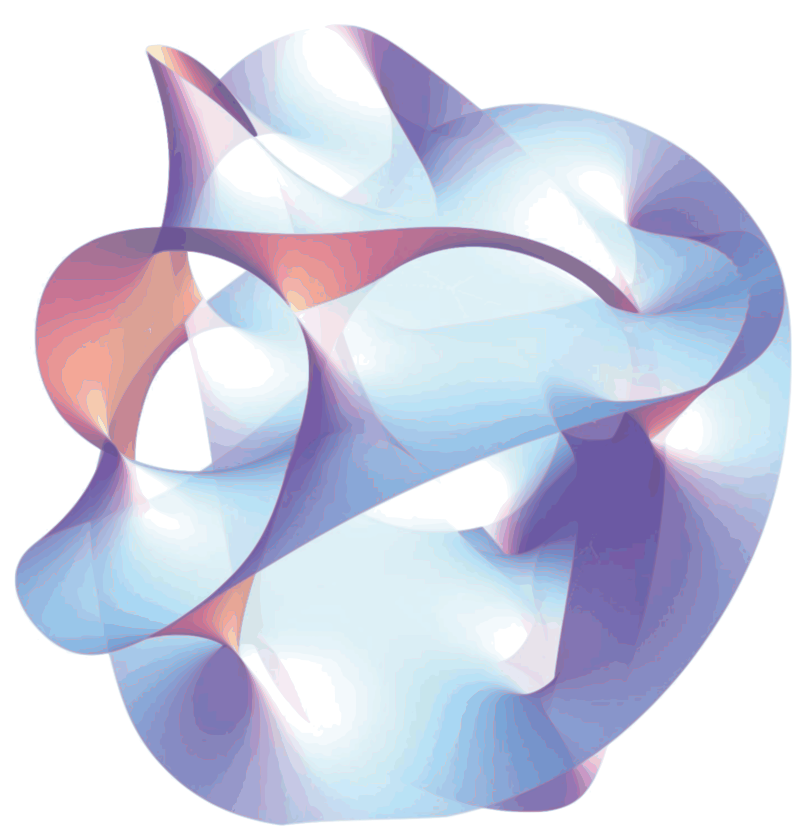
File:Calabi_yau_formatted.svg · Wikimedia Commons · See Wikimedia Commons
string theory
Sign in to savephysical theory of quantized one-dimensional objects with conformal symmetry, which can describe gravitation, gauge theory and other phenomena
String theory proposes that the fundamental building blocks of the universe are tiny vibrating strings rather than point particles, and these strings have a special symmetry property that allows them to mathematically describe gravity, electromagnetic forces, and other forces simultaneously. This matters because it offers a potential path toward unifying all the forces of nature into a single coherent framework.
AI-generated from the Wikipedia summary — may contain errors.
Wikidata facts
- Instance of
- branch of physics
- Subclass of
- scientific theory
- Image
- Apfel partikel.jpg
Show 6 more facts
- Commons category
- String theory
- topic's main category
- Category:String theory
- studied by
- theoretical physics
- topic has template
- Template:String theory
- on focus list of Wikimedia project
- Wikipedia:Vital articles/Level/4
- Stack Exchange tag
- math.stackexchange.com/tags/string-theory
via Wikidata · CC0
~40 min read
Encyclopedic overview
In physics, string theory is a theoretical framework in which the point-like particles of particle physics are replaced by one-dimensional objects called strings. String theory describes how these strings move through space and interact with each other by vibrations. On distance scales larger than the string scale, a string acts like a particle, with its mass, charge, and other properties determined by the vibrational state of the string. In string theory, one of the many vibrational states of the string corresponds to the graviton, a quantum mechanical particle that carries the gravitational force. Thus, string theory is a theory of quantum gravity.
String theory is a broad and varied subject that attempts to address a number of deep questions of fundamental physics. String theory has contributed a number of advances to mathematical physics, which have been applied to a variety of problems in black hole physics, early universe cosmology, nuclear physics, and condensed matter physics, and it has stimulated a number of major developments in pure mathematics. Because string theory potentially provides a unified description of gravity and particle physics, it is a candidate for a theory of everything, a self-contained mathematical model that describes all fundamental forces and forms of matter. Despite much work on these problems, it is not known to what extent string theory describes the real world or how much freedom the theory allows in the choice of its details.
Excerpted from Wikipedia’s “string theory” article, available under the CC BY-SA 4.0 licence.
Gallery (12)
Available in 76 languages
- Español
- Français
- Deutsch
- 中文
- 日本語
- Русский
- Português
- Italiano
- العربية
- हिन्दी
- Afrikaans
- Albanian
- Armenian
- Asturian
- Azerbaijani
- Bahasa Indonesia
- Bangla
- Basque
Show 57 more
- Belarusian
- Bosnian
- Bulgarian
- Catalan
- Chuvash
- Croatian
- Czech
- Danish
- Esperanto
- Estonian
- Finnish
- Galician
- Georgian
- Greek
- Haitian Creole
- Hebrew
- Hungarian
- Ido
- Interlingua
- Kabyle
- Kazakh
- kbp
- Kongo
- Latin
- Latvian
- Lithuanian
- Macedonian
- Malay
- Malayalam
- Nederlands
- Norwegian
- Norwegian Nynorsk
- Occitan
- Polski
- Punjabi
- Romanian
- Serbian
- Serbian (Latin)
- simple
- Sindhi
- Slovak
- Standard Moroccan Tamazight
- Svenska
- Swahili
- Tamil
- Tatar
- Tiếng Việt
- Türkçe
- Ukrainian
- Urdu
- Waray
- Western Panjabi
- Wu Chinese
- zh_yue
- فارسی
- ไทย
- 한국어
via Wikidata sitelinks · CC0