Category
page 1Musical terminology

composer
thumb|upright=1.3|Portrait of Nikolai Rimsky-Korsakov composing at his desk, by [[Valentin Serov, 1898]]

rhythm
Rhythm (from Greek , rhythmos, "any regular recurring motion, symmetry") generally means a "movement marked by the regulated succession of strong and weak elements, or of opposite or different conditions". This general meaning of regular recurrence or pattern in time can apply to a wide variety of cyclical natural phenomena having a periodicity or frequency of anything from microseconds to several seconds (as with the riff in a rock music song); to several minutes or hours, or, at the most extreme, even over many years.

soprano
A soprano () is a type of classical singing voice and has the highest vocal range of all voice types. The soprano's vocal range (using scientific pitch notation) is from approximately middle C (C4) = 261 Hz to A5 in choral music, or to soprano C (C6) or higher in operatic music. In four-part chorale style harmony, the soprano takes the highest part, which often encompasses the melody. The soprano voice type is generally divided into the coloratura, soubrette, lyric, spinto, and dramatic soprano.

chamber music
form of classical music composed for a small group of instruments

tenor
The tenor is a type of male singing voice whose vocal range lies between the countertenor and baritone voice types. It is the highest male chest-voice type. Composers typically write music for the tenor in the range from the second B below middle C, to the G above middle C (i.e. B2 to G4) in choral music – and from the second B-flat below middle C, to the C above middle C (B2 to C5) in operatic music – but the range can extend at either end. Subtypes of the tenor include the leggero tenor, lyric tenor, spinto tenor, dramatic tenor, heldentenor and tenor buffo (also known as the ).

bass
type of classical male singing voice

baritone
A baritone is a type of classical male singing voice whose vocal range lies between the bass and the tenor voice-types. It is the most common male voice. The term originates from the Greek (), meaning "low sounding". Composers typically write music for this voice in the range from the second F below middle C to the F above middle C (i.e. F2–F4) in choral music, and from the second G below middle C to the G above middle C (G2 to G4) in operatic music, but the range can extend at either end. Subtypes of baritone include the baryton-Martin baritone (light baritone), lyric baritone, Kavalierbarito
.jpg)
tempo
In musical terminology, tempo (Italian for 'time'; plural 'tempos', or from the Italian plural), measured in beats per minute, is the speed or pace of a given composition, and is often also an indication of the composition's character or atmosphere. In classical music, tempo is typically indicated with an instruction at the start of a piece (often using conventional Italian terms) and, if a specific metrical pace is desired, is usually measured in beats per minute (bpm or BPM). In modern classical compositions, a "metronome mark" in beats per minute, indicating only measured speed and not any

a cappella
group or solo singing without instrumental sound

contralto
A contralto () is a classical female singing voice whose vocal range is the lowest of their voice types.

refrain
thumb|Musical notation for the chorus of "Jingle Bells"
overture
Overture (from French ouverture, "opening") is a music instrumental introduction to a ballet, opera, or oratorio in the 17th century. During the early Romantic era, composers such as Beethoven and Mendelssohn composed overtures which were independent, self-existing, instrumental, programmatic works that foreshadowed genres such as the symphonic poem. These were "at first undoubtedly intended to be played at the head of a programme".
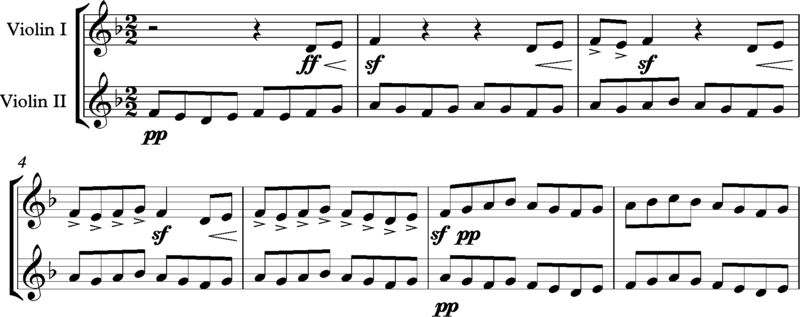
dynamics
aspect of musical expression related to sound intensity and its variation

raga
alt=|thumb|Melakarta ragas of Carnatic music. While ragas in Hindustani music are divided into thaats, ragas in Carnatic music are divided into melakartas.
A raga ( ; , ; ) is a melodic framework for improvisation in Indian classical music akin to a melodic mode. It is central to classical Indian music. Each raga consists of an array of melodic structures with musical motifs; and, from the perspective of the Indian tradition, the resulting music has the ability to "colour the mind" as it engages the emotions of the audience.

duet
thumb|The Duet (1628), by Hendrick ter Brugghen
A duet (Italian: duo or duetto) is a musical composition for two performers in which the performers have equal importance to the piece, often a composition involving two singers or two pianists. It differs from a harmony, as the performers take turns performing a solo section rather than performing simultaneously. A piece performed by two pianists performing together on the same piano is a "piano duet" or "piano four hands". A piece for two pianists performing together on separate pianos is a "piano duo".
harmonic analysis
study of superpositions in mathematics

barcarolle
A barcarolle ( ; from French, also barcarole; originally, Italian barcarola or barcaruola, from 'boat') is a traditional folk song sung by Venetian gondoliers, or a piece of music composed in that style. In classical music, two of the most famous barcarolles are Jacques Offenbach's "Belle nuit, ô nuit d'amour", from his opera The Tales of Hoffmann; and Frédéric Chopin's Barcarolle in F-sharp major for solo piano.

syncopated rhythm
In music, syncopation is a variety of rhythms played together to make a piece of music, making part or all of a tune or piece of music off-beat. More simply, syncopation is "a disturbance or interruption of the regular flow of rhythm": a "placement of rhythmic stresses or accents where they wouldn't normally occur". It is the correlation of at least two sets of time intervals.

virtuoso
A virtuoso (from Italian virtuoso, or ; Late Latin virtuosus; Latin virtus; 'virtue', 'excellence' or 'skill') is an individual who possesses outstanding talent and technical ability in a particular art or field such as fine arts, music, singing, playing a musical instrument, or composition.

countertenor
A countertenor (also contra tenor) is a type of classical male singing voice whose vocal range is equivalent to that of the female contralto or mezzo-soprano voice types, generally extending from around E3 to D5 or E5, although a sopranist (a specific kind of countertenor) may match the soprano's range of around C4 to C6. Countertenors often have tenor or baritone chest voices, but sing in falsetto or head voice much more often than they do in their chest voice.
divertimento
(; from the Italian divertire "to amuse") is a musical genre, with most of its examples from the 18th century. The mood of the divertimento is most often lighthearted (as a result of being played at social functions) and it is generally composed for a small ensemble. The term is used to describe a wide variety of secular (non-religious) instrumental works for soloist or chamber ensemble. It is usually a kind of music entertainment, although it could also be applied to a more serious genre. After 1780, the term generally designated works that were informal or light.
close
In Western musical theory, a cadence () is the end of a phrase in which the melody or harmony creates a sense of full or partial resolution, especially in music of the 16th century onwards. A harmonic cadence is a progression of two or more chords that concludes a phrase, section, or piece of music. A rhythmic cadence is a characteristic rhythmic pattern that indicates the end of a phrase. A cadence can be labeled "weak" or "strong" depending on the impression of finality it gives.
coda
musical passage that leads on to the conclusion
programme music
type of art music that attempts to musically render an extra-musical narrative
opus
number assigned to a composition to indicate its chronological order in the composer's production
impresario
An impresario (from Italian ) is a person who organizes and often finances concerts, plays, or operas, performing a role in stage arts that is similar to that of a film or television producer.
fanfare
A fanfare (or fanfarade or flourish) is a short musical flourish which is typically played by trumpets (including fanfare trumpets), French horns or other brass instruments, often accompanied by percussion. It is a "brief improvised introduction to an instrumental performance". A fanfare has also been defined in The Golden Encyclopedia of Music as "a musical announcement played on brass instruments before the arrival of an important person", such as heralding the entrance of a monarch (the term honors music for such announcements does not have the specific connotations of instrument or style t
eighth-note
musical figure that is equivalent to 1/8 of the value of a whole note

Minnesang
thumb|Walther von der Vogelweide ([[Codex Manesse, ca. 1300)]]
supergroup
band whose members were successful in prior acts

ostinato
In music, an ostinato (; , compare English obstinate) is a motif or phrase that persistently repeats in the same musical voice, frequently in the same pitch.
glossary of music terminology
Wikimedia glossary list article
phrase
unit of musical meter that has a complete musical sense of its own, built from figures, motifs, and cells, and combining to form melodies, periods and larger sections
3-note chord
type of three-note chord in music and music theory
ornament
musical flourishes that are not necessary to carry the overall line of the melody (or harmony), but serve instead to decorate or 'ornament' that line
%20of%20'Der%20Freisch%C3%BCtz'%20-%20NGO4p1116.jpg)
scoring
thumb|right|300px|A hand-written Sheet music|musical score for Act 2 of the [[opera Der Freischütz by Carl Maria von Weber, written in the 1820s. The score contains all the parts for the singers and the accompaniment parts and melodies for the orchestra.]]
Orchestration is the study or practice of writing music for an orchestra (or, more loosely, for any musical ensemble, such as a concert band) or of adapting music composed for another medium for an orchestra. Also called "instrumentation", orchestration is the assignment of different instruments to play the different parts (e.g., melody, bas

melisma
thumb|400px|Syllabic and melismatic text setting: "Christ the Lord Is Risen Today|Jesus Christ Is Ris'n Today" (Methodist Hymn Book, 1933, No. 204).
one-hit wonder
any entity that achieves mainstream popularity, often for only one piece of work, and becomes known among the general public solely for that momentary success
audio signal
representation of sound, typically as an electrical voltage
musical hit
musical composition that achieved popularity or hit the charts
backing vocalist
singer who provides vocal harmony with the lead vocalist or other backing vocalists
chord progression
succession formed by the repetition of a melodic or harmonic motif at a higher or lower degree
incidental music
musical composition for a play, television program, radio program, video game, or some other presentation form that is not primarily musical
lip sync
matching a speaking or singing person's lip movements to an audio recording

conducting
Conducting is the art of directing a musical performance, such as an orchestral or choral concert. It has been defined as "the art of directing the simultaneous performance of several players or singers by the use of gesture." The primary duties of the conductor are to interpret the score in a way that reflects the specific indications in that score, set the tempo, ensure correct entries by ensemble members, and "shape" the phrasing where appropriate. Conductors communicate with their musicians primarily through hand gestures, usually with the aid of a baton, and may use other gestures or sign

descant
90px|thumb|Soprano clef
figured bass
musical notation in which numerals/accidentals show chords to be played in relation to the bass note, used in Baroque music

alto
The musical term alto, meaning "high" in Italian (from Latin: altus), historically refers to the contrapuntal part higher than the tenor and its associated vocal range. In four-part voice leading alto is the second-highest part, sung in choruses by either low women's or high men's voices. In vocal classification these are usually called contralto and male alto or countertenor.

playlist
thumb|A playlist in an Audio player (software)|audio player
A playlist is a list of video or audio files that can be played back on a media player, either sequentially or in a shuffled order. In its most general form, an audio playlist is simply a list of songs that can be played once or in a loop. The term has several specialized meanings in the realms of television broadcasting, radio broadcasting and personal computers.
altered chord
chord with notes of a different key than the corresponding one, with chromatic alterations
ad libitum
Latin expression for "at one's pleasure"

tutti
thumb|The tutti piston seen over the organ pedalboard
Tutti is an Italian word literally meaning all or together and is used as a musical term, for the whole orchestra as opposed to the soloist. It is applied similarly to choral music, where the whole section or choir is called to sing. Music examination boards may instruct candidates to "play in tuttis", indicating that the candidate should play both the solo and the tutti sections.
earworm
An earworm or brainworm, also described as sticky music or stuck song syndrome, is a catchy or memorable piece of music or saying that continuously occupies a person's mind even after it is no longer being played or spoken about. Involuntary Musical Imagery (INMI) is most common after earworms, but INMI as a label is not solely restricted to earworms; musical hallucinations also fall into this category, although they are not the same thing. Earworms are considered to be a common type of involuntary cognition. Some of the phrases often used to describe earworms include "musical imagery repetiti
Wall of Sound
music production effect
hemiola
In music, hemiola (also hemiolia) is the ratio 3:2. The equivalent Latin term is sesquialtera. In rhythm, hemiola refers to three beats of equal value in the time normally occupied by two beats. In pitch, hemiola refers to the interval of a perfect fifth.
power trio
three-piece rock music group, usually with guitar, bass and drums
artist and repertoire
profession inside a record label
bridge
contrasting section of music

embouchure
thumb|The embouchure of a trumpeter
Embouchure () or lipping is the use of the lips, facial muscles, tongue, and teeth in playing a wind instrument. This includes shaping the lips to the mouthpiece of a woodwind or brass instrument. The word is of French origin and is related to the root '''', 'mouth'. Proper embouchure allows an instrumentalist to play an instrument at its full range with a full, clear tone and without strain or damage to their muscles.
lead vocalist
member of a band who sings the main solo vocal portions of a song