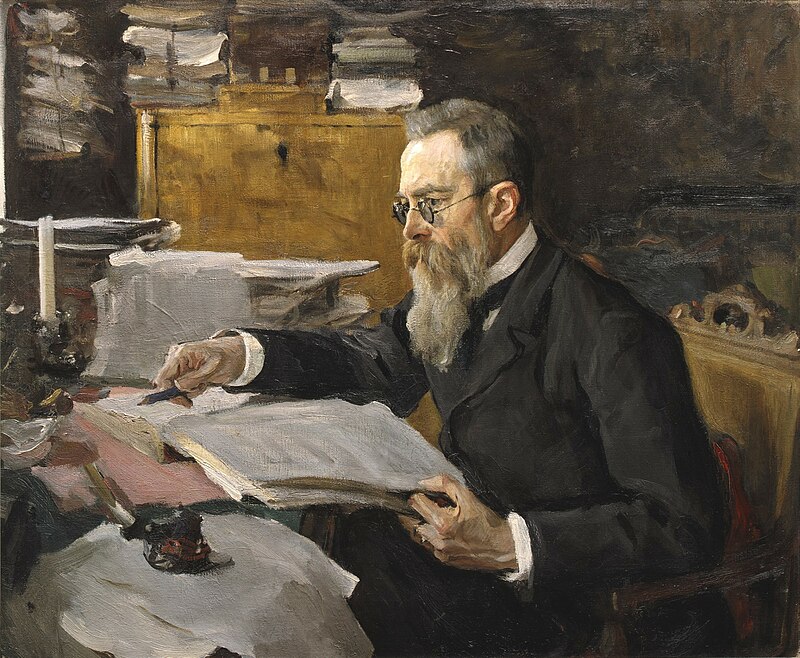
File:Walentin_Alexandrowitsch_Serow_004.jpg · Wikimedia Commons · See Wikimedia Commons
composer
Sign in to saveAlso known as music composer, music by, composed by, music composed by
thumb|upright=1.3|Portrait of Nikolai Rimsky-Korsakov composing at his desk, by [[Valentin Serov, 1898]]
A composer is a person who creates musical works by writing down notes and instructions that musicians perform. Composers matter because they are the creative force behind the music we hear—from classical symphonies to modern film scores—shaping cultural expression and artistic tradition across generations.
AI-generated from the Wikipedia summary — may contain errors.
Wikidata facts
- Instance of
- occupation
- Subclass of
- author
- Image
- Beethoven.jpg
- Patron saint
- Saint Cecilia
- Field of occupation
- composed musical work
Show 9 more facts
- female form of label
- cumpusitrice
- topic's main category
- Category:Composers
- Commons category
- Composers
- ISCO-88 occupation class
- 2453
- category for eponymous categories
- Category:Wikipedia categories named after composers
- P8168
- Bad Girl
- ISCO-08 occupation class
- 2652
- male form of label
- cumpusitore
- topic has template
- Template:Infobox classical composer
Sources (8)
via Wikidata · CC0
~14 min read
Encyclopedic overview
15 sectionsContents
- Etymology and definition
- Role in the Western world
- Relationship with performers
- History of employment
- Role of women
- Modern training
- Undergraduate
- Masters
- Doctoral
- Other routes
- References
- Citations
- General and cited sources
- Further reading
- External links
thumb|upright=1.3|Portrait of Nikolai Rimsky-Korsakov composing at his desk, by [[Valentin Serov, 1898]]
A composer is a person who writes music. The term is especially used to indicate composers of Western classical music, or those who are composers by occupation. Many composers are, or were, also skilled performers of music.
Excerpted from Wikipedia’s “composer” article, available under the CC BY-SA 4.0 licence.
Gallery (6)
Available in 118 languages
- Español
- Français
- Deutsch
- 中文
- 日本語
- Русский
- Português
- Italiano
- العربية
- हिन्दी
- Adyghe
- Afrikaans
- Albanian
- Albanian
- Aragonese
- Armenian
- Arpitan
- Asturian
Show 99 more
- Awadhi
- azb
- Azerbaijani
- Bahasa Indonesia
- Bangla
- Basque
- Bavarian
- be_x_old
- Belarusian
- Bikol
- Bosnian
- Bulgarian
- Burmese
- Catalan
- Cebuano
- Central Kurdish
- Chuvash
- Cornish
- Croatian
- Czech
- Danish
- Egyptian Arabic
- Esperanto
- Estonian
- Fijian
- Filipino
- Finnish
- fiu_vro
- Friulian
- Galician
- Georgian
- Greek
- Hebrew
- Hungarian
- Icelandic
- Interlingua
- Javanese
- Kabyle
- Kara-Kalpak
- Kazakh
- Kyrgyz
- Latin
- Latvian
- Lingala
- Lithuanian
- Lojban
- Low German
- Luxembourgish
- Macedonian
- Malay
- Maltese
- Mari
- Mingrelian
- Mongolian
- nah
- Nederlands
- Northern Frisian
- Norwegian
- Norwegian Nynorsk
- Occitan
- olo
- Picard
- Polski
- Quechua
- Romanian
- rsk
- Rusyn
- Scots
- Scottish Gaelic
- Serbian
- Serbian (Latin)
- Sicilian
- simple
- Slovak
- Slovenian
- Somali
- Svenska
- Swahili
- Tajik
- Tamil
- Tatar
- Tiếng Việt
- Tsonga
- Türkçe
- Ukrainian
- Urdu
- Uzbek
- Walloon
- Waray
- Welsh
- Western Frisian
- Wu Chinese
- Yiddish
- zh_min_nan
- zh_yue
- Zulu
- فارسی
- ไทย
- 한국어
via Wikidata sitelinks · CC0