Category
page 1NASA satellites

Spitzer Space Telescope
decommissioned NASA infrared space observatory
Cosmic Background Explorer
NASA space observatory
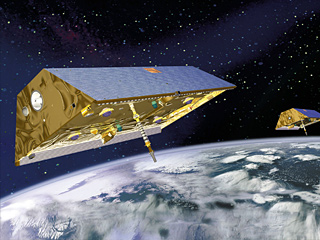
Gravity Recovery and Climate Experiment
joint mission of NASA and the German Aerospace Center
Aqua
NASA Earth observation satellite

CALIPSO
CALIPSO was a joint NASA (US) and CNES (France) environmental satellite, built in the Cannes Mandelieu Space Center, which was launched atop a Delta II rocket on April 28, 2006. Its name stands for Cloud-Aerosol Lidar and Infrared Pathfinder Satellite Observations. CALIPSO launched alongside CloudSat.
CloudSat
CloudSat is a Passivated NASA Earth observation satellite, which was launched on a Delta II rocket on April 28, 2006, and is awaiting disposal. It used radar to measure the altitude and properties of clouds, adding to the information on the relationship between clouds and climate to help resolve questions about global warming.
Orbiting Carbon Observatory
NASA climate satellite destroyed during a 2009 launch failure
Aura
NASA Earth observation satellite
Aeronomy of Ice in the Mesosphere
NASA satellite of the Explorer program
Tropical Rainfall Measuring Mission
joint space mission between NASA and JAXA
Soil Moisture Active Passive
NASA environmental monitoring satellite
ICESat
ICESat (Ice, Cloud, and land Elevation Satellite) was a NASA satellite mission for measuring ice sheet mass balance, cloud and aerosol heights, as well as land topography and vegetation characteristics. It operated as part of NASA's Earth Observing System (EOS). ICESat was launched 13 January 2003 on a Delta II launch vehicle from Vandenberg Air Force Base in California into a near-circular, near-polar orbit with an altitude of approximately . It operated for seven years before being retired in February 2010, after its scientific payload shut down and scientists were unable to restart it.

TOPEX/Poseidon
TOPEX/Poseidon was a joint satellite altimeter mission between NASA, the U.S. space agency; and CNES, the French space agency, to map ocean surface topography. Launched on August 10, 1992, it was the first major oceanographic research satellite after Seasat. TOPEX/Poseidon helped revolutionize oceanography by providing data previously impossible to obtain. Oceanographer Walter Munk described TOPEX/Poseidon as "the most successful ocean experiment of all time." A malfunction ended normal satellite operations in January 2006.
Solar Mesosphere Explorer
NASA satellite of the Explorer program
Solar Radiation and Climate Experiment
NASA space observatory
Glory
NASA Earth observation satellite, lost in a launch failure

QuikSCAT
The NASA QuikSCAT (Quick Scatterometer) was an Earth observation satellite carrying the SeaWinds scatterometer. Its primary mission was to measure the surface wind speed and direction over the ice-free global oceans via its effect on water waves. Observations from QuikSCAT had a wide array of applications, and contributed to climatological studies, weather forecasting, meteorology, oceanographic research, marine safety, commercial fishing, tracking large icebergs, and studies of land and sea ice, among others. This SeaWinds scatterometer is referred to as the QuikSCAT scatterometer to distingu

Orbiting Carbon Observatory 2
NASA climate satellite
ACRIMSAT
The Active Cavity Radiometer Irradiance Monitor Satellite, or ACRIMSAT was a satellite carrying the ACRIM-3 (Active Cavity Radiometer Irradiance Monitor 3) instrument. It was one of the 21 observational components of NASA's Earth Observing System program. The instrument followed upon the ACRIM-1 and ACRIM-2 instruments that were launched on multi-instrument satellite platforms. ACRIMSAT was launched on 20 December 1999 from Vandenberg Air Force Base as the secondary payload on the Taurus launch vehicle that launched KOMPSAT. It was placed into a high inclination of 98.30°, at 720 km. Sun-

ICESat-2
ICESat-2 (Ice, Cloud, and land Elevation Satellite 2), part of NASA's Earth Observing System, is a satellite mission for measuring ice sheet elevation and sea ice thickness, as well as land topography, vegetation characteristics, and clouds. ICESat-2, a follow-on to the ICESat mission, was launched on 15 September 2018 onboard Delta II as the final flight from Vandenberg Air Force Base in California, into a near-circular, near-polar orbit with an altitude of approximately . It was designed to operate for three years and carry enough propellant for seven years. The satellite orbits Earth at a s
Pandora
NASA small satellite space telescope
Earth Radiation Budget Satellite
former American geophysical research satellite
TIMED
The TIMED (Thermosphere • Ionosphere • Mesosphere • Energetics and Dynamics) mission is dedicated to study the influences that energetics and dynamics of the Sun and humans have on the least explored and understood region of Earth's atmosphere – the Mesosphere and Lower Thermosphere / Ionosphere (MLTI). The mission was launched from Vandenberg Air Force Base in California on 7 December 2001 aboard a Delta II rocket launch vehicle. The project is sponsored and managed by NASA, while the spacecraft was designed and assembled by the Applied Physics Laboratory at Johns Hopkins University. The miss
Student Nitric Oxide Explorer
NASA atmospheric research satellite
Demonstration for Autonomous Rendezvous Technology
former NASA spacecraft which tested autonomous navigation and rendezvous
Surface Water Ocean Topography
NASA and CNES water monitoring satellite
Biosatellite program
NASA satellite program
Space Technology 5
Experimental space technologies
GeneSat-1
GeneSat-1 is a NASA fully automated, CubeSat spaceflight system that provides life support for bacteria E. Coli K-12. The system was launched into orbit on 16 December 2006, from Wallops Flight Facility. GeneSat-1 began to transmit data on its first pass over the mission's California ground station.
DODGE
DODGE (Department of Defense Gravity Experiment) was a satellite whose primary purpose was to conduct experiments in gravity-gradient stabilization at near-geosynchronous altitudes. Its secondary objectives included measuring the Earth's magnetic field, and taking pictures of the entire Earth's disk in both black-and-white and color. It was launched atop a Titan IIIC rocket on July 1, 1967, and operated for over three years. DODGE carried ten knobbed booms oriented along three different axes, that could be independently extended and retracted by ground command.
Communications Technology Satellite
multinational communications satellite
AEROS
AEROS satellites were to study the aeronomy i. e. the science of the upper atmosphere and ionosphere, in particular the F region under the strong influence of solar extreme ultraviolet radiation. To this end the spectrum of this radiation was recorded aboard by one instrument (of type Hinteregger) on the one hand and a set of 4 other instruments measuring the most important neutral uand iononized parameters at the satellite's position on the other.
Inflatable Antenna Experiment
inflatable satellite experiment launched by STS-77
Plankton, Aerosol, Cloud, ocean Ecosystem
NASA Earth-observing satellite
Time-Resolved Observations of Precipitation structure and storm Intensity with a Constellation of Smallsats
NASA small satellite mission