
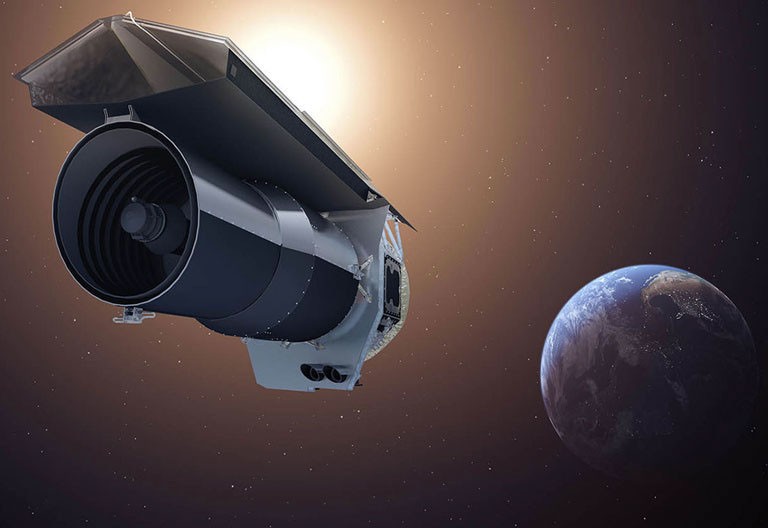
File:Spitzer_space_telescope.jpg · Wikimedia Commons · See Wikimedia Commons
Spitzer Space Telescope
Sign in to saveAlso known as SST, Space Infrared Telescope Facility, SIRTF
decommissioned NASA infrared space observatory
The Spitzer Space Telescope was a NASA observatory that orbited in space and observed the universe using infrared light, allowing it to see things that visible light telescopes cannot. It has now been decommissioned, meaning it is no longer in operation, but during its time in service it made important contributions to our understanding of space and celestial objects.
AI-generated from the Wikipedia summary — may contain errors.
Official website
Spitzer Space Telescope - NASA Science
Spitzer uses an ultra-sensitive infrared telescope to study asteroids, comets, planets and distant galaxies.
nasa.gov →Link to the official site · 36,502 chars · not written by Vinony
Wikidata facts
- Part of
- Great Observatories program
- Named after
- Lyman Spitzer
- Country of origin
- United States
- Follows
- Chandra X-ray Observatory
- Parent body
- Sun
- Diameter
- 2.1
- Mass
- 15.6
- Orbital period
- 373.12
- Manufacturer
- Goddard Space Flight Center
- Official website
- solarsystem.nasa.gov/missions/spitzer-space-telescope
- Image
- Spitzer space telescope.jpg
- Length
- 4.45
Show 18 more facts
- Commons category
- Spitzer Space Telescope
- UTC date of spacecraft launch
- 2003-08-25
- space launch vehicle
- Delta II
- topic's main category
- Category:Spitzer Space Telescope
- type of orbit
- heliocentric orbit
- focal length
- 10.2
- orbital eccentricity
- 0.011323
- periapsis
- 1.0028
- apoapsis
- 1.0258
- orbital inclination
- 1.1338
- service retirement
- 2020-01-30
- semi-major axis of an orbit
- 1.0143
- argument of periapsis
- 195.80
- mean anomaly
- 212.72
- service entry
- 2003-12-18
- aperture
- 0.85
- powered by
- photovoltaic system
- on focus list of Wikimedia project
- Wikipedia:Vital articles/Level/4
Sources (10)
via Wikidata · CC0
~32 min read
Encyclopedic overview
NASA Great Observatories
Infrared observations can see objects hidden in visible light, such as HUDF-JD2, shown. This shows how the Spitzer IRAC camera was able to see beyond the wavelengths of Hubble's instruments.
Excerpted from Wikipedia’s “Spitzer Space Telescope” article, available under the CC BY-SA 4.0 licence.
Gallery (13)
Available in 61 languages
- Español
- Français
- Deutsch
- 中文
- 日本語
- Русский
- Português
- Italiano
- العربية
- हिन्दी
- Afrikaans
- Asturian
- Azerbaijani
- Bahasa Indonesia
- Basque
- Bosnian
- Bulgarian
- Burmese
Show 42 more
- Catalan
- Central Kurdish
- Croatian
- Czech
- Danish
- Esperanto
- Estonian
- Finnish
- Galician
- Greek
- Haitian Creole
- Hebrew
- Hungarian
- Igbo
- Kurdish
- Latvian
- Lithuanian
- Luxembourgish
- Malay
- Malayalam
- Marathi
- Mongolian
- Nederlands
- Norwegian
- Norwegian Nynorsk
- Occitan
- Polski
- Punjabi
- Romanian
- Serbian
- Serbian (Latin)
- simple
- Slovak
- Svenska
- Tiếng Việt
- Türkçe
- Ukrainian
- Western Panjabi
- zh_yue
- فارسی
- ไทย
- 한국어
via Wikidata sitelinks · CC0