Category
page 1Natural materials

wood

soil
thumb|upright=1.25|Surface-water-Gley soil|gley developed in [[glacial till in Northern Ireland]]

mineral
thumb|upright=1.25|Crystals of serandite, [[natrolite, analcime, and aegirine from Mont Saint-Hilaire, Quebec, Canada]]

clay
Clay is a type of fine-grained natural soil material containing clay minerals (hydrous aluminium phyllosilicates, e.g. kaolinite, ). Most pure clay minerals are white or light-coloured, but natural clays show a variety of colours from impurities, such as a reddish or brownish colour from small amounts of iron oxide.

straw
thumb|Bundles of rice straw
thumb|Pile of stacked small rectangular straw bales sheltered under a clear tarpaulin
thumb|Straw lines and a Combine Harvester|combine harvester
Straw is an agricultural byproduct consisting of the dry stalks of cereal plants after the grain and chaff have been removed. It makes up about half of the yield by weight of cereal crops such as barley, oats, rice, rye and wheat. It has a number of different uses, including fuel, livestock bedding and fodder, thatching and basket making.

gravel
thumb|upright=1.35|Gravel (largest fragment in this photo is about )
.jpg)
pebble
thumb|upright=1.35|Close view of pebbles

crystalline schist
thumb|A schist showing characteristic scaly schistose texture caused by platy mica|micas
Schist ( ) is a medium-grained metamorphic rock generally derived from fine-grained sedimentary rock, like shale. It shows pronounced schistosity (named for the rock). This means that the rock is composed of mineral grains easily seen with a low-power hand lens, oriented in such a way that the rock is easily split into thin flakes or plates. This texture reflects a high content of platy minerals, such as mica, talc, chlorite, or graphite. These are often interleaved with more granular minerals, such as fel

slate
Slate is a fine-grained, foliated, homogeneous, metamorphic rock derived from an original shale-type sedimentary rock composed of clay or volcanic ash through low-grade, regional metamorphism. It is the finest-grained foliated metamorphic rock. Foliation may not correspond to the original sedimentary layering, but instead is in planes perpendicular to the direction of metamorphic compression.
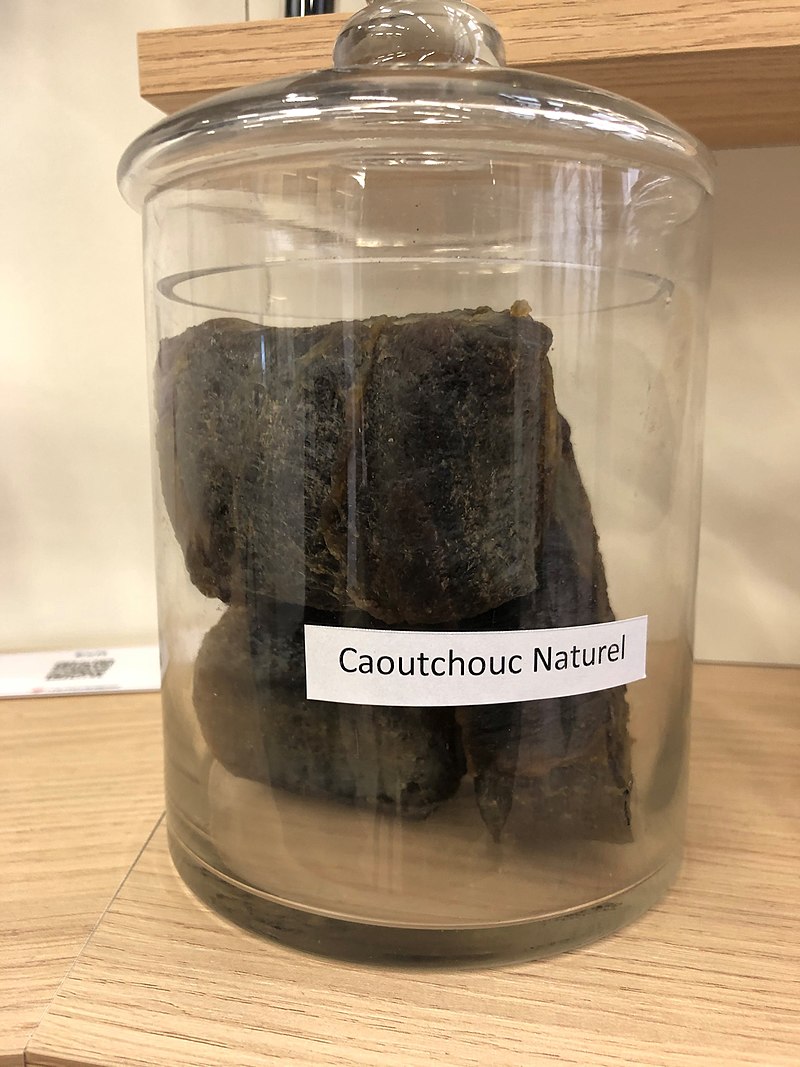
natural rubber
polymers of the organic compound isoprene, with minor impurities of other organic compounds; refined from latex harvested from rubber trees

boulder
thumb|This Balancing rock|balancing boulder, "[[Balanced Rock", stands in Garden of the Gods park in Colorado Springs, Colorado, United States.]]
thumb|Boulder in British Columbia, Canada
thumb|Kämmenkivi stone on the Pisa hill in Kuopio, Finland
thumb|Balanced granite boulders at Hyderabad, India
In geology, a boulder is a rock fragment with size greater than in diameter. Smaller pieces are called cobbles and pebbles. While a boulder may be small enough to move or roll manually, others are extremely massive. In common usage, a boulder is too large for a person to move. Smaller boulders are us
dry stone walling
mortarless masonry method

thatched roof
thumb|right|A thatched public house|pub (The Williams Arms) at [[Wrafton, North Devon, England]]
Thatching is the craft of building a roof with dry vegetation such as straw, water reed, sedge (Cladium mariscus), rushes, heather, or palm branches, layering the vegetation so as to shed water away from the inner roof. Since the bulk of the vegetation stays dry and is densely packed—trapping air—thatching also functions as insulation. It is a very old roofing method and has been used in both tropical and temperate climates. Thatch is still employed by builders in developing countries, usually with
expanded clay aggregate
substrate suitable for hydroculture applications
crushed stone
artificial gravel of angular shape, used as construction aggregate
rammed earth
technique for constructing foundations, floors, and walls by compacting a damp mixture of sub soil

cobblestone
thumb|Cobblestones on a road surface in Imola, Italy
thumb|upright|Sett (paving)|Sett-paving, such as this surface in [[Fulham, south-west London, is also often referred to as "cobblestones".]]

rubble
Rubble is broken stone, of irregular size, shape and texture; undressed especially as a filling-in. Rubble naturally found in the soil is known also as 'brash' (compare cornbrash). Where present, it becomes more noticeable when the land is ploughed or worked.
bast fibre
fibre obtained from the phloem tissues of many plants, used for textiles, rope, and paper
natural fiber
any fibre derived from natural sources such as plants, animals or minerals

Manilkara bidentata
species of plant
biogenic substance
substance produced by life processes; it may be either constituents, or secretions, of plants or animals
cob
natural building material made from subsoil, water, some kind of fibrous organic material (typically straw)
Armenian bole
natural mixture of hydrated silicate clays colored with red iron oxide
stone wall
masonry structural division
list of woods
Wikimedia list article

sorbent
thumb|300px|Cross-section of a gas mask filter, with sorbent material visible
A sorbent is an insoluble material that either absorbs or adsorbs liquids or gases. They are frequently used to remove pollutants and in the cleanup of chemical accidents and oil spills. Besides their uses in industry, sorbents are used in commercial products such as diapers and odor absorbents, and are researched for applications in environmental air analysis, particularly in the analysis of volatile organic compounds. The name sorbent is derived from sorption, which is itself a derivation from adsorption and absorp

compressed earth block
building material

withy
thumb|A pollarding|pollarded willow with a crop of withies ready for harvest
thumb|Cutting and stacking withies
thumb|upright|Drying withies
A withy or withe (also willow and osier) is a strong flexible willow stem, typically used in thatching, basketmaking, gardening and for constructing woven wattle hurdles. The term is also used to refer to any type of flexible rod of natural wood used in rural crafts such as hazel or ash created through coppicing or pollarding.
natural material
product or physical matter that arises without the use of technology
.jpg)
knapping
thumb|Flintknapping a stone tool
trass
Trass is the local name of a volcanic tuff occurring in the Eifel, where it is worked for hydraulic mortar. It is a grey or cream-coloured fragmental rock, largely composed of pumiceous dust, and may be regarded as a trachytic tuff. It much resembles the Italian pozzolana and is applied to like purposes. Mixed with lime and sand, or with Portland cement, it is extensively employed for hydraulic work, especially in the Netherlands; while the compact varieties have been used as a building material and as a fire-stone in ovens. Trass was formerly worked extensively in the Brohl valley and is now
Certified wood
Wood product from a responsibly managed forest
metal clay
craft material of metal particles and a plastic binder
heterogenite
Heterogenite is a natural tri-valent cobalt oxyhydroxide mineral. It is the most abundant oxidised cobalt mineral in the Katanga Copperbelt, a region in the Democratic Republic of the Congo. About 70% of known heterogenite is located in the DRC.
Biotic material
any material that originates from living organisms
ikranite
Ikranite is a member of the eudialyte group, named after the Shubinov Institute of Crystallography of the Russian Academy of Sciences. It is a cyclosilicate mineral that shows trigonal symmetry with the space group R3m, and is often seen with a pseudo-hexagonal habit. Ikranite appears as translucent and ranges in color from yellow to a brownish yellow. This mineral ranks a 5 on Mohs scale of mineral hardness, though it is considered brittle, exhibiting conchoidal fracture when broken.
grayite
Grayite, ThPO4·(H2O), is a thorium phosphate mineral of the Rabdophane group first discovered in 1957 by S.H.U. Bowie in Rhodesia. It is of moderate hardness occurring occasionally in aggregates of hexagonal crystals occasionally but more commonly in microgranular/cryptocrystalline masses. Due to its thorium content, grayite displays some radioactivity although it is only moderate and the mineral displays powder XRD peaks without any metamict-like effects. The color of grayite is most commonly observed as a light to dark reddish brown but has also been observed as lighter yellows with grayish
dorrite
Dorrite is a silicate mineral that is isostructural to the aenigmatite group. It is most chemically similar to the mineral rhönite [Ca2Mg5Ti(Al2Si4)O20], made distinct by a lack of titanium (Ti) and the presence of Fe3+. Dorrite is named for Dr. John (Jack) A. Dorr, a late professor at the University of Michigan that researched in outcrops where dorrite was found in 1982. This mineral is sub-metallic resembling colors of brownish-black, dark brown, to reddish brown.
takedaite
thumb | right
Takedaite is a borate mineral that was found in a mine in Fuka, Okayama Prefecture Japan during a mineralogical survey in the year 1994. During the survey, Kusachi and Henmi reported the occurrence of an unidentified anhydrous borate mineral closely associated with nifontovite, olshanskyite, and calcite. By the year 1994 two other minerals in the borate group M3B2O6 had been identified in nature Mg3B2O6 known as kotoite and Mn3B2O6 known as jimboite. Takedaite has the ideal chemical formula of Ca3B2O6. The mineral has been approved by the Commission on New Minerals and Mineral Na
nevadaite
Nevadaite is a rare phosphate mineral with a chemical formula of
{|
|Cu2Zn0.02V3+0.98Al1.15Al8P7.9O32F8.37(OH)1.63(H2O)21.65
|-
|}

Strategic material
important raw materials
allendeite
Allendeite, Sc4Zr3O12, is an oxide mineral. Allendeite was discovered in a small ultrarefractory inclusion within the Allende meteorite. This inclusion has been named ACM-1. It is one of several scandium rich minerals that have been found in meteorites. Allendeite is trigonal, with a calculated density of 4.84 g/cm3. The new mineral was found along with hexamolybdenum. These minerals, are believed to demonstrate conditions during the early stages of the Solar System, as is the case with many CV3 carbonaceous chondrites such as the Allende meteorite. It is named after the Allende meteorite
decomposed granite
smaller chunks or particles of granite, produced by weathering
scotlandite
Scotlandite is a sulfite mineral first discovered in a mine at Leadhills in South Lanarkshire, Scotland, an area known to mineralogists and geologists for its wide range of different mineral species found in the veins that lie deep in the mine shafts. This specific mineral is found in the Susanna vein of Leadhills, where the crystals are formed as chisel-shaped or bladed. Scotlandite was actually the first naturally occurring sulfite, which has the ideal chemical formula of PbSO3. The mineral has been approved by the Commission on New Minerals and Mineral Names, IMA, to be named scotlandite fo
dessauite-(Y)
Dessauite-(Y) is a mineral member of the crichtonite group with the formula . It is associated with derbylite, hematite, rutile, karelianite, siderite, and calcite. Founded in the Buca della Vena Mine, Tuscany, Italy, the mineral was called dessauite in honor of professor Gabor Dessau (1907–1983).
simmonsite
Simmonsite is a halide mineral, being a tertiary light metal fluoride, with formula Na2LiAlF6. It was first discovered in nature in Mineral County in the Gillis Range of Nevada, U.S.A. The mineral is found intergrown with cryolite, cryolithionite and trace elpasolite. The mineral has a monoclinic structure of P2 or P2/m. The ideal chemical formula for simmonsite is Na2LiAlF6. The mineral has a no visible cleavage, Mohs hardness of 2.53, a pale white color with a white streak and feels somewhat greasy. Simmonsite was named for the Professor of Mineralogy and Petrology at the University of New O