Category
page 1Natural philosophy

force
In physics, a force is an action that can cause an object to change its velocity or its shape, or to resist other forces, or to cause changes of pressure in a fluid. In mechanics, force makes ideas like 'pushing' or 'pulling' mathematically precise. Because the magnitude and direction of a force are both important, force is a vector quantity (force vector). The SI unit of force is the newton (N), and force is often represented by the symbol .

optics
thumb|A researcher working on an optical system|300x300px

alchemy
thumb|15th century depiction of an Ouroboros from the alchemical treatise '' (Zurich, Rheinau 172'').

Philosophiæ Naturalis Principia Mathematica
1687 work by Isaac Newton describing his laws of motion and gravitation

cosmogony
thumb|The Big Bang theory of modern cosmology postulates the universe evolved from a hot dense state.
Cosmogony, also spelled as cosmogeny, or cosmogenesis, is any model concerning the origin of the cosmos or the universe.

classical elements
group of constituent basic elements of matter (water, earth, fire, air and sometimes aether), used to explain nature patterns since ancient times
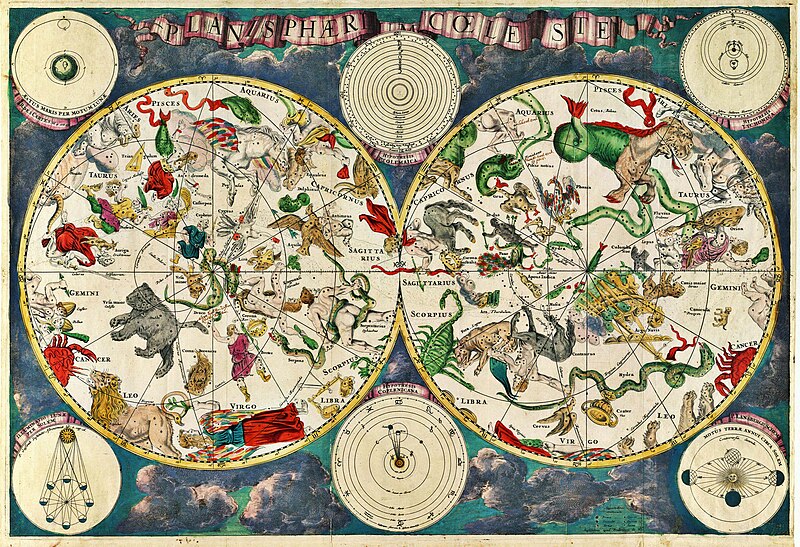
natural philosophy
ancient philosophical study of nature and physical universe that was dominant before the development of modern science. It is considered to be the precursor of natural science

hylozoism
thumb|upright=1.3|Sphera volgare, featuring the Sun, the [[Moon, the winds and the stars as living. Woodcut illustration from an edition of De sphaera mundi, Venice, 1537.]]
Philosophical Transactions
British scientific journal published by the Royal Society
great chain of being
concept associated with Aristotelian philosophy in which all forms of life on the planet exist in ranked order, from the most to the least important, in a "ladder of life"
philosophy of space and time
branch of philosophy relating to spatiality and temporality
corpuscular theory of light
theory

Principles of Philosophy
book by Descartes
theory of impetus
concept similar to inertia and momentum
organicism
Organicism is the philosophical position that states that the universe and its various parts (including human societies) ought to be considered alive and naturally ordered, much like a living organism. Vital to the position is the idea that organicistic elements are not dormant "things" per se but rather dynamic components in a comprehensive system that is, as a whole, everchanging. Organicism is related to but remains distinct from holism insofar as it prefigures holism; while the latter concept is applied more broadly to universal part-whole interconnections such as in anthropology and socio
vis viva
physical quantity, historically invented by G. Leibniz, equivalent to (in modern terminology) twice the kinetic energy
Philosophical Magazine
scientific journal established in 1798
School of Naturalists
school of Chinese philosophy, explaining the universe in terms of basic natural forces in nature (yin–yang, the five elements)
panta rhei
"all flows", aphorism of Plato or Heraclites
cosmic pluralism
belief in numerous life-bearing "worlds"

Naturphilosophie
thumb|Friedrich Wilhelm Joseph von Schelling (1775–1854), considered the primary figure of Naturphilosophie
"Naturphilosophie" (German for "nature-philosophy") is a term used in English-language philosophy to identify a current in the philosophical tradition of German idealism, as applied to the study of nature in the earlier 19th century. German speakers use the clearer term "Romantische Naturphilosophie", the philosophy of nature developed at the time of the founding of German Romanticism. It is particularly associated with the philosophical work of Friedrich Wilhelm Joseph Schelling and Geo
Natura non facit saltus
Latin axiom in natural philosophy

The World
book by René Descartes
mechanism
belief that natural wholes are composed of parts lacking any intrinsic relationship to each other
Mechanical explanations of gravitation
attempts to explain the action of gravity by aid of basic mechanical processe
participation
philosophical concept
Mean speed theorem
Theory of speed in physics
vitality
thumb|Springtime by Émile Vernon, an artistic depiction of seasonal vitality
Vitality (, , ) is the capacity to live, grow, or develop. Vitality is also the characteristic that distinguishes living from non-living things. To experience vitality is regarded as a basic psychological drive and, in philosophy, a component to the will to live. As such, people seek to maximize their vitality or their experience of vitality—that which corresponds to an enhanced physiological capacity and mental state.
Annals of Philosophy
scientific journal