Category
page 1Nature goddesses

Artemis
In ancient Greek religion and mythology, Artemis (; ) is the goddess of hunting, the wilderness, wild animals, transitions, nature, vegetation, childbirth, care of children, and chastity. She was often said to roam the forests and mountains, attended by an entourage of nymphs. The goddess Diana is her Roman equivalent.

Demeter
In ancient Greek religion and mythology, Demeter (; Attic: Dēmḗtēr ; Doric: Dāmā́tēr) is the Olympian goddess of the harvest and agriculture, presiding over crops, grains, food, and the fertility of the earth. Although Demeter is mostly known as a grain goddess, she also appeared as a goddess of health, birth, and marriage, and had connections to the Underworld. She is also called Deo ( Dēṓ).
.JPG)
Persephone
In ancient Greek mythology and religion, Persephone ( ; , classical pronunciation: ), also called Kore () or Cora, is the daughter of Zeus and Demeter. She became the queen of the underworld after her abduction by her uncle Hades, the king of the underworld, who later took her into marriage. The myth of her abduction, her sojourn in the underworld, and her cyclical return to the surface represents her functions as the embodiment of spring and the personification of vegetation, especially grain crops, which disappear into the earth when sown, remain hidden for a period, sprout from the earth, a

Gaia
In Greek mythology, Gaia (; , a poetic form of (''''), meaning 'land' or 'earth'), also spelled Gaea (), is the personification of Earth. She is the mother of Uranus (Sky), with whom she conceived the Titans (themselves parents of many of the Olympian gods), the Cyclopes, and the Giants, as well as of Pontus (Sea), from whose union she bore the primordial sea gods. Her equivalent in the Roman pantheon was Terra.

Diana
goddess of the hunt, the moon and birthing, equated with the Greek goddess Artemis
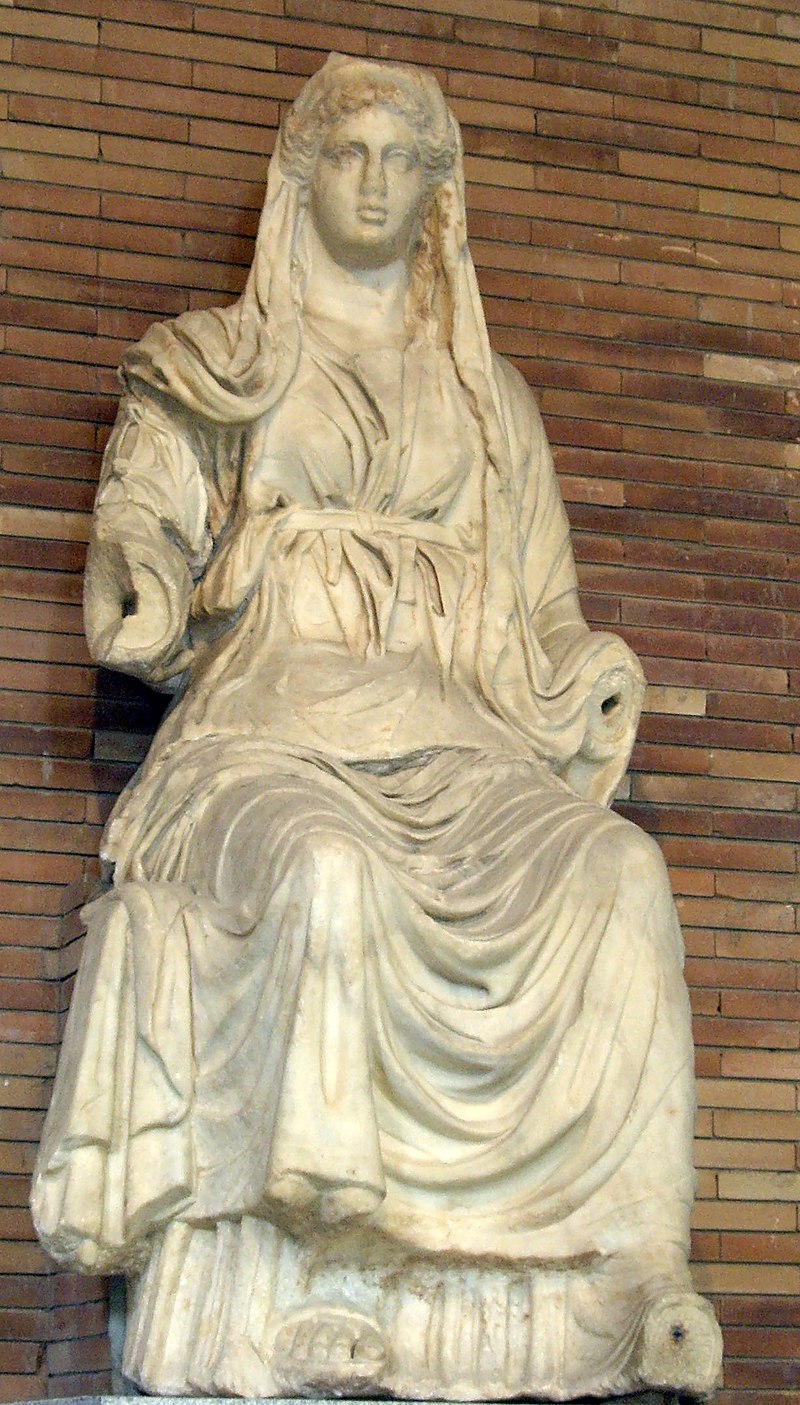
Ceres
Roman goddess of agriculture
.jpg)
Charites
thumb|300x300px|The Three Graces in a fresco at [[Pompeii, 1–50 AD]]

mother goddess
goddess who represents or is a personification of nature, motherhood, fertility, creation

Horae
thumb|upright=1.3|Dionysus leads the Horae. Dionysus carries his [[thyrsus, and the middle Hora hold ears of wheat. Neo-Attic Roman relief, c. 50–25 BC.]]
In Greek mythology, the Horae (), Horai () or Hours (, ) were the goddesses of the seasons and the natural portions of time.

Flora
goddess of prosperity in Roman mythology

Maia
In ancient Greek mythology, Maia (from ; or ), also spelled Maie, is one of the Pleiades and the mother of the messenger god Hermes by Zeus.
Terra
personification of the Earth in ancient Roman religion and mythology

Pachamama
Pachamama () or Mama Pacha () is the Andean deity representing space-time, revered by the peoples of the Andes. In Inca mythology and religion, she is a "mother goddess" type deity, representing the universal energy that connects everything. She is considered an omnipresent deity with creative power, capable of sustaining life in the cosmos. Her shrines are hallowed rocks, or the boles of legendary trees, and her artists envision her as a woman bearing harvests of potatoes or coca leaves. The four cosmological Quechua principlesWater, Earth, Sun, and Moonclaim Pachamama as their prime origin.

Xochiquetzal
thumb|Xochiquetzal, from the Codex Rios, 16th century.
In Aztec mythology, Xochiquetzal ( ), also called Ichpochtli ( , meaning "maiden"), was a goddess associated with fertility, beauty, and love, serving as a protector of young mothers and a patroness of pregnancy, childbirth, and the crafts practiced by women such as weaving and embroidery. In pre-Hispanic Maya culture, a similar figure is Goddess I.

Devana
Devana ( , ), Zevana (), less often Zievonia () is the goddess of wild nature, forests, hunting and the moon worshiped by the Western Slavs. In the sources, she was first mentioned in the 15th century by Jan Długosz, who compared her to the Roman goddess Diana. Dziewanna is also a Polish name for Verbascum, and the etymology of the word is unclear. After strong criticism from Aleksander Brückner, researchers rejected her authenticity, but nowadays it is accepted by an increasing number of researchers. Sometimes, in folk rituals, she performs together with Morana.
Kishar
In the Babylonian epic Enuma Elish, Kishar () is the daughter of Lahamu and Lahmu, the first children of Tiamat and Abzu. She is the female principle, sister and wife of Anshar, the male principle, and the mother of Anu. Kishar may represent the earth as a counterpart to Anshar, the sky, and can be seen as an earth mother goddess. Her name also means "Whole Earth".

Abnoba
thumb|right|The altar to Diana Abnoba at Badenweiler
Abnoba is a name with theological and geographical meanings: It is the name of a Gaulish goddess who was worshiped in the Black Forest and surrounding areas. It is also the name of a mountain or mountain range.
Feronia
italic goddess of wilderness and liberty
Matronae
deities of fertility in Celtic and Germanic mythologies under Roman rule

Mielikki
Mielikki () is the Finnish goddess of forests and the hunt. She is usually called (), though the epithet () also exists. As the mistress, she is seen as the wife of Tapio and the mother of Tuulikki, Tellervo and Nyyrikki.
.jpg)
Konohanasakuyahime
Konohanasakuya-hime is the kami of Mount Fuji and all volcanoes in Japanese mythology; she is also the 'blossom princess' and symbol of delicate earthly life. She is often considered an avatar of Japanese life, especially since her symbol is the cherry blossom (sakura).
Yavanna
REDIRECT Valar#Yavanna
Medeina
Medeina or Medeinė (from – "tree" or medė – "forest"), often treated as synonymous to Žvorūnė or Žvorūna (derived from žvėris – "beast"), is one of the main deities in the Lithuanian mythology, and is similar to Latvian Meža māte (Forest Mother). She is a ruler of forests, trees and animals. Her sacred animal is a hare.

Arduinna
thumb|Bronze statuette of the Celtic goddess Arduinna riding a wild boar.
In Gallo-Roman religion, Arduinna (also Arduina, Arduinnae or Arduinne) was the eponymous tutelary goddess of the Ardennes Forest and region, thought to be represented as a huntress riding a boar (primarily in the present-day regions of Belgium and Luxembourg). Her cult originated in the Ardennes region of present-day Belgium, Luxembourg, and France. She was identified with the Roman goddess Diana.

Nantosuelta
thumb|A depiction of Nantosuelta from Speyer, showing her distinctive sceptre and birds. The head of Sol can be seen in the tympanum.
In Celtic mythology, Nantosuelta is the goddess of nature, the earth, fire, and fertility.

Nemetona
right|300px|thumb|The Rhine at Altrip in the former territory of the [[Nemetes, where an inscription to Nemetona was found.]]
Nemetona, or 'she of the sacred grove', is a Celtic goddess with roots in northeastern Gaul. She is thought to have been the eponymous deity of the Germano-Celtic people known as the Nemetes; evidence of her veneration is found in their former territory along the Middle Rhine as well in the Altbachtal sanctuary in present-day Trier, Germany. She is also attested in Bath, England, where an altar to her was dedicated by a man of the Gallic Treveri people.
Aranyani
Aranyani () is the goddess of forests and the wild animals that dwell within them in Hinduism.
Cyllene
naiad from Greek mythology
Ameretat
'''''' () is the Avestan language name of the Zoroastrian divinity/divine concept of immortality. Amerdad is the Amesha Spenta of long life on earth and perpetuality in the hereafter.
Tailtiu
Tailtiu or Tailltiu (; modern spelling: Tailte) is the name of a presumed goddess from Irish mythology. The goddess's name is linked to Teltown (< OI Óenach Tailten) in Co. Meath, site of the Óenach Tailten. A legendary dindsenchas "lore of places" poem relates a myth connecting the presumed goddess Tailtiu with the site. However, linguistic analysis of the name reveals that Tailtiu as a place-name derives from a loan word of Brythonic origin represented by the Welsh telediw "well formed, beautiful." The mythological character of Tailtiu likely derives her name from the place-name.
María Lionza
Venezuelan female deity
Bonbibi
thumb|Statue of goddess Bonbibi
Bonbibi, is a legendary lady of the forest, dubbed as a guardian spirit of the forests and venerated by both the Hindu and the Muslim residents of the Sundarbans. She is called upon mostly by the honey-collectors and the woodcutters before entering the forest for protection against the attacks from the tigers. It is believed that the demon king, Dakkhin Rai (or Dakshin Rai; meaning Lord of the South), an arch-enemy of Bonbibi actually appears in the disguise of a tiger and attacks human beings.
Baj Bajania
spirit in Siberian folklore
Ningikuga
Ningikuga was a Mesopotamian goddess. Her name can be explained as nin-gi-kug-a(k), "lady of the pure reed".
Flidais
Flidas or Flidais (modern spelling: Fliodhas, Fliodhais) is a female figure in Irish Mythology, known by the epithet Foltchaín ("beautiful hair"). She is believed to have been a goddess of cattle and fertility.
Khunu Leima
Goddess of all the pigeons in the world in Meitei mythology and religion of Ancient Manipur (Kangleipak).
Tellervo (Tuulikki)
Tellervo () is the Finnish goddess of forests. She is the daughter of Tapio, the King of the Forest.
Jengu
A jengu (pl. miengu, also called bisima) is a water spirit in the traditional beliefs of the Sawabantu groups of Cameroon, like the Duala, Bakweri, Malimba, Subu, Bakoko, and Oroko people. Among the Bakweri, the term used is liengu (plural: maengu). Miengu are similar to bisimbi (singular: simbi) in the Bakongo spirituality and Mamba Muntu, who is present in many West and Central African cultures.
Simbi
A Simbi (also spelled Cymbee and '''Sim'bi, pl. Bisimbi or Basimbi''') is a Central African guardian spirit of the water and nature in traditional Bakongo religion, as well as in African diaspora spiritual traditions, such as Hoodoo in the southern United States and Palo in Cuba. Simbi have been historically identified as water people, or mermaids, pottery, snakes, gourds, and fire. Due to the forced removal of Bantu peoples from Africa to the Americas, the veneration of simbi exists today in countries, such as the United States, Brazil, Cuba, and Haiti.
Korravai
thumb|upright=0.9|Goddess Korravai, a form of the Hindu goddess Parvati and a revered deity in Tamil Hindu culture, is depicted atop the beheaded head and body of the slain buffalo-demon Mahishasura. This relief carving, originally from the remnants of a magnificent 10th-century CE Tamil Hindu temple, is now located within the Nayakar Palace Art Museum, Madurai.
thumb|alt=Korravai at Brihadishvara Temple, Thanjavur|Korravai at Brihadishvara Temple, Thanjavur
Kotravai (), is the goddess of war and victory in the Tamil tradition. She is also the mother goddess and the goddess of fertility, agric
Dhat-Badan
Dhat-Badan (), Dhat-hami, or Zat-Badar, ´She of the Wild Goats` and ´She of the Sanctuary', was a Himyarite goddess.
Aruru
mesopotamian goddess
Caryatis
thumb | right | The Erechtheion in Athens, Greece.
In ancient Greek religion, Artemis Caryatis (Καρυᾶτις) was an epithet of Artemis that was derived from the small polis of Caryae in Laconia. There, an archaic open-air temenos was dedicated to Carya, the Lady of the Nut-Tree, whose priestesses were called the caryatides, represented on the Athenian Acropolis as the marble caryatids supporting the porch of the Erechtheum. The late accounts made of the eponymous Carya a virgin who had been transformed into a nut-tree, whether for her unchastity (with Dionysus) or to prevent her rape. The particu
Twelve Flower Fairies
fairies corresponding to seasonal flowers in Chinese folk religion.