Category
page 1Nebulae

nebula
thumb|right|upright=1.5|True color image of the Trifid Nebula, showing complex gas and plasma structure

molecular cloud
type of interstellar cloud

dark nebula
astronomical object type
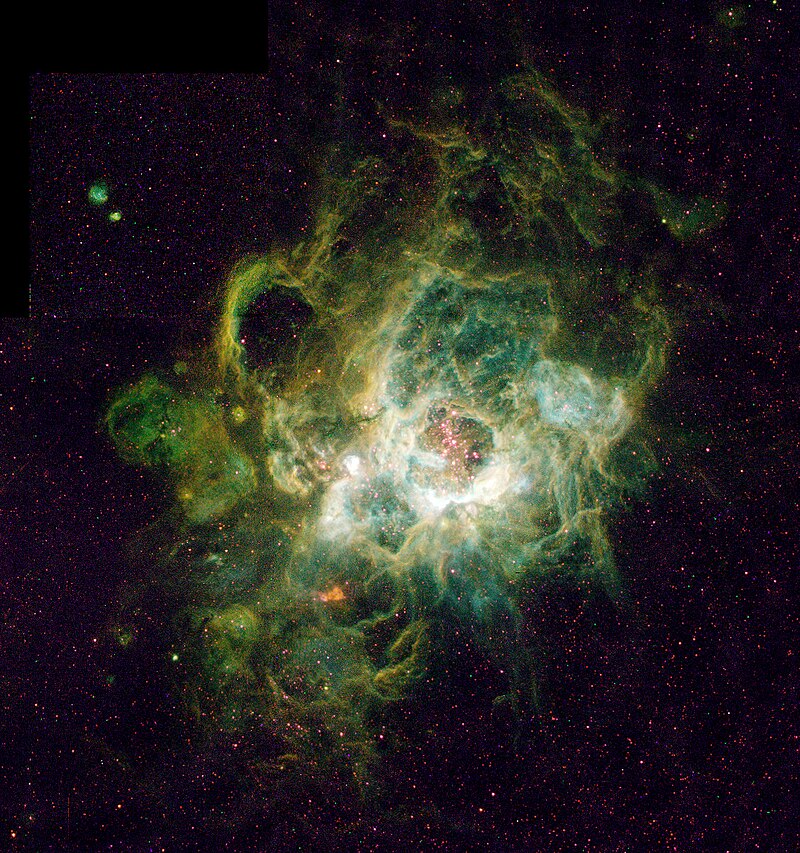
H II region
large, low-density cloud of partially ionized hydrogenium

emission nebula
cloud of ionized gas emitting light of various colors

supernova remnant
remnants of an exploded star

reflection nebula
nebulosity in astronomy

interstellar cloud
accumulation of gas, plasma and dust in a galaxy

Herbig–Haro object
small patches of nebulosity associated with newly born stars
circumstellar disk
torus, pancake or ring-shaped accumulation of matter in orbit around a star
H I region
interstellar cloud composed of neutral atomic hydrogen
deep-sky object
any astronomical object that is not an individual star
Protoplanetary nebula
type of astronomical object
NGC 6727
astronomical object
pulsar wind nebula
nebula powered by the pulsar wind of a pulsar
bipolar nebula
distinctive nebular formation
variable nebula
Nebula with varying brightness

Nebulium
thumb|right|Cat's Eye Nebula (NGC 6543)
thumb|Cat's Eye Nebula (NGC 6543)
Nebulium was a proposed element found in astronomical observation of a nebula by William Huggins in 1864. The strong green emission lines of the Cat's Eye Nebula, discovered using spectroscopy, led to the postulation that an as yet unknown element was responsible for this emission. In 1927, Ira Sprague Bowen showed that the lines are emitted by doubly ionized oxygen (new style O; old style O), and no new element was necessary to explain them.
evaporating gaseous globule
region of hydrogen gas in outer space large enough to shield gas from ionizing UV rays
Wolf–Rayet nebula
nebula which surrounds a Wolf–Rayet star
high-velocity cloud
molecular cloud with speed greater than 90 km/s
Crab
astrophotometrical unit for x-ray sources
integrated flux nebula
extra-planar nebulae