File:Nursery_of_New_Stars_-_GPN-2000-000972.jpg · Wikimedia Commons · See Wikimedia Commons
H II region
Sign in to saveAlso known as HII region
large, low-density cloud of partially ionized hydrogenium
An H II region is a large cloud of gas in space where hydrogen atoms have been stripped of their electrons by radiation from nearby hot stars, creating a glowing cloud of ionized gas. These regions are important because they're where new stars are actively forming and they help astronomers understand star birth and the structure of galaxies.
AI-generated from the Wikipedia summary — may contain errors.
Wikidata facts
- Subclass of
- emission nebula
- Part of
- galaxy
- Material used
- hydrogen
- Image
- Nursery of New Stars - GPN-2000-000972.jpg
Show 4 more facts
- Commons category
- H II regions
- topic's main category
- Category:H II regions
- on focus list of Wikimedia project
- Wikipedia:Vital articles/Level/4
- has effect
- star formation
Sources (2)
via Wikidata · CC0
~19 min read
Encyclopedic overview
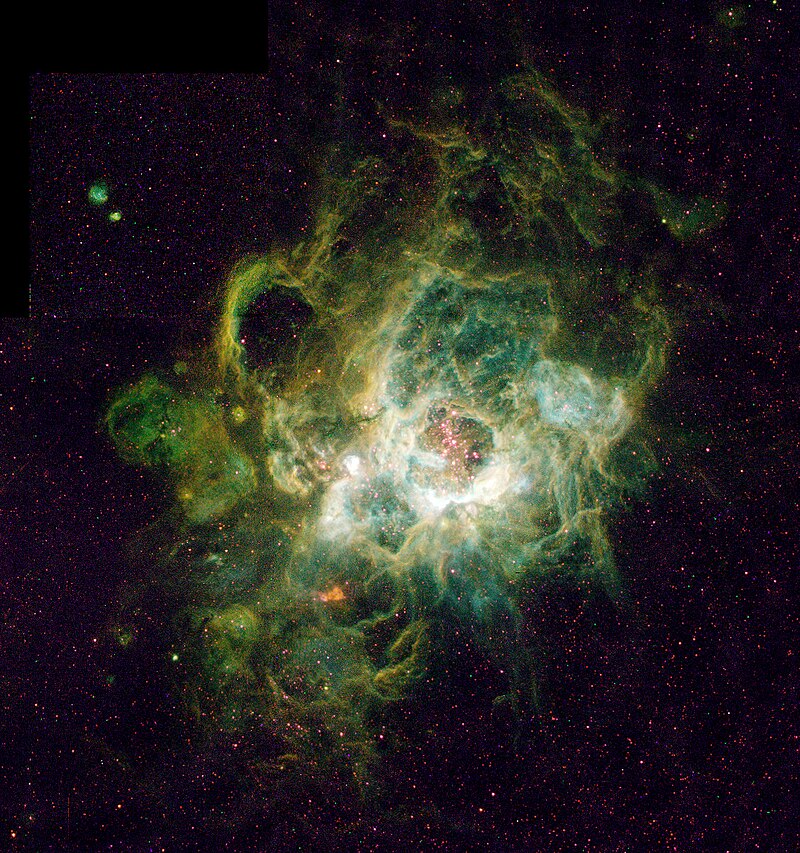
NGC 604, a giant H II region in the Triangulum Galaxy, taken by the Hubble Space Telescope An H II region is a region of interstellar atomic hydrogen that is ionized. It is typically in a molecular cloud of partially ionized gas in which star formation has recently taken place, with a size ranging from one to hundreds of light years, and density from a few to about a million particles per cubic centimetre. The Orion Nebula, now known to be an H II region, was observed in 1610 by Nicolas-Claude Fabri de Peiresc by telescope, the first such object discovered.
The regions may be of any shape because the distribution of the stars and gas inside them is irregular. The short-lived blue stars created in these regions emit copious amounts of ultraviolet light that ionize the surrounding gas. H II regions—sometimes several hundred light-years across—are often associated with giant molecular clouds. They often appear clumpy and filamentary, sometimes showing intricate shapes such as the Horsehead Nebula. H II regions may give birth to thousands of stars over a period of several million years. Supernova explosions and strong stellar winds from the most massive stars in the resulting star cluster ultimately disperse the remaining gas of the H II region.
Excerpted from Wikipedia’s “H II region” article, available under the CC BY-SA 4.0 licence.