Category
page 1Nematocera families
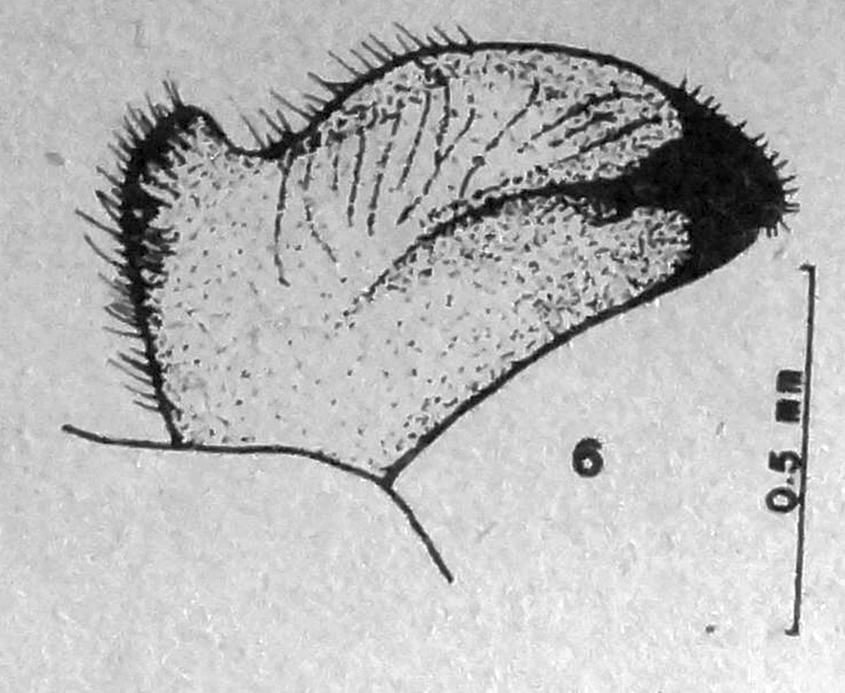
Tipulidae
thumb|right|The maxillary palps are the appendages that extend from the front of the head, then down and back, terminating below the eye.

Chironomidae
thumb|Two lake flies observed in Neenah, Wisconsin, after the yearly hatch in Lake Winnebago
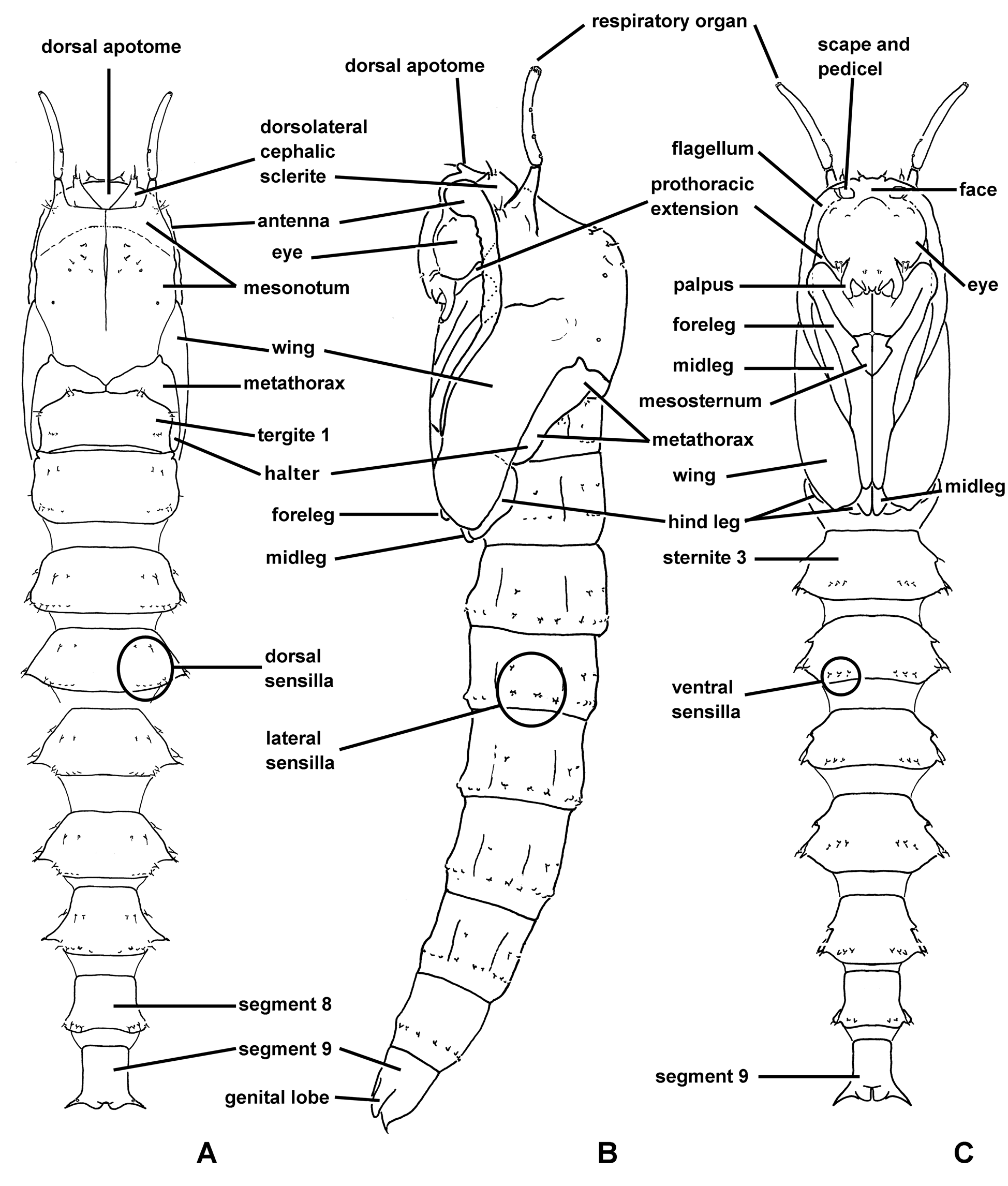
Ceratopogonidae
Ceratopogonidae is a family of flies colloquially known as no-see-ums, sand flies or biting midges, generally in length. The family includes more than 5,000 species, distributed worldwide, apart from the Antarctic and the Arctic. Ceratopogonidae midges are also one of the best-studied cocoa pollinators.
==Description==
See for full details of morphology.
Psychodidae
Psychodidae, also called drain flies, sink flies, filter flies, sewer flies, or sewer gnats, is a family of true flies. Some genera have short, hairy bodies and wings, giving them a "furry" moth-like appearance, hence one of their common names, moth flies. Members of the sub-family Phlebotominae, which are hematophagous (feed on blood), may be called sand flies in some countries, although this term is also used for other unrelated flies, such as horse flies (Tabanidae) and no-see-ums (Ceratopogonidae).

Cecidomyiidae
thumb|right|A cecidomyiid laying eggs on grass
thumb|thumbtime=0:51|Cecidomyiid in copula
thumb|thumbtime=1:40|Cecidomyiid oviposting into boreholes of bark beetles on a fallen beech

Bibionidae
Bibionidae (March flies) is a family of flies (Diptera) containing approximately 650–700 species worldwide. Adults are nectar feeders and emerge in numbers in spring. Because of the likelihood of adult flies being found in copula, they have earned colloquial names such as "love bugs" or "honeymoon flies".

Sciaridae
thumb|A sciarid ovipositing into a leaf of Urtica

Mycetophilidae
thumb|Fossil in Baltic amber
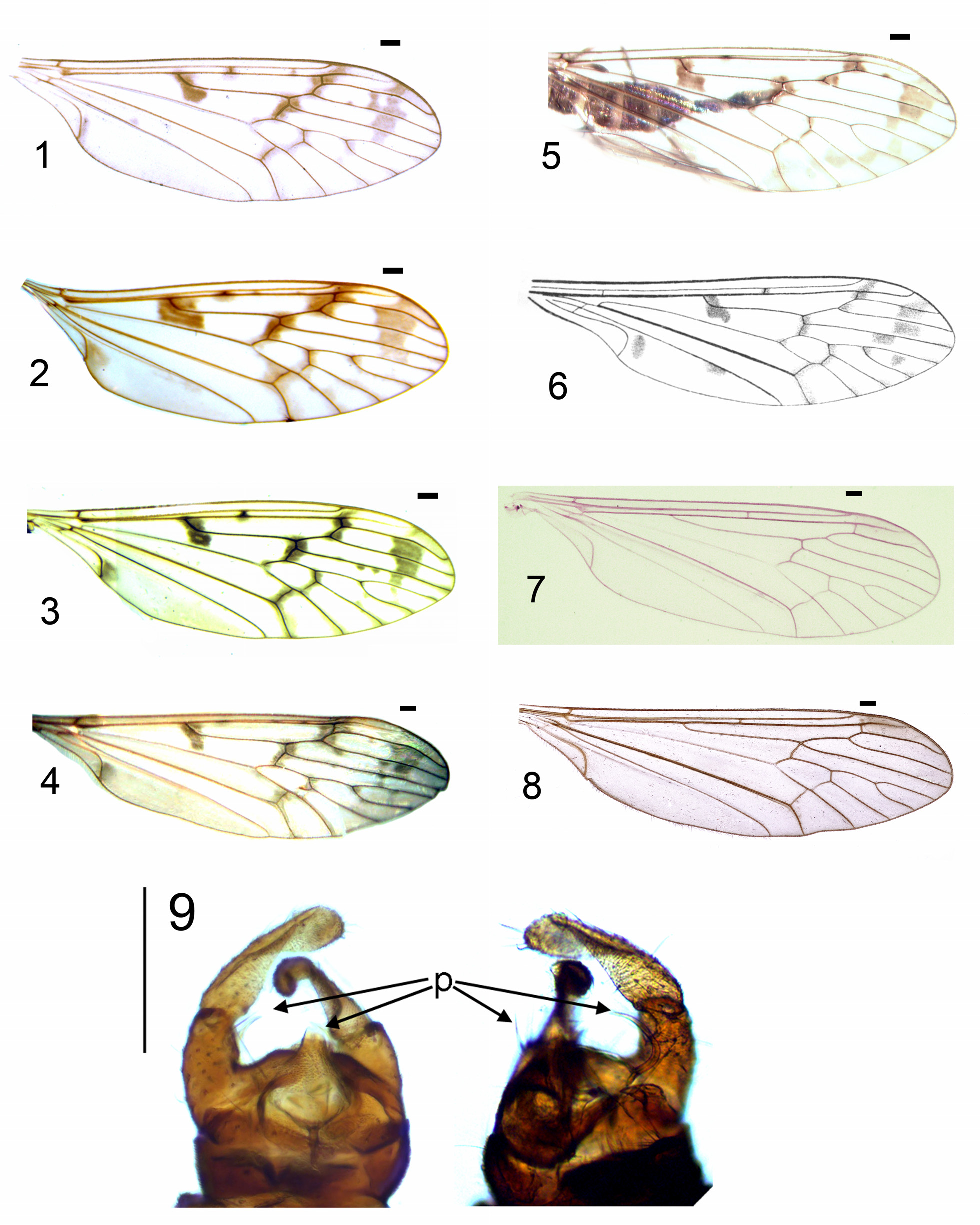
Trichoceridae
Trichoceridae, or winter crane flies, of the order Diptera are long, thin, delicate insects superficially similar in appearance to the Tipulidae, Tanyderidae, and Ptychopteridae. They are the sole member of the superfamily Trichoceroidea. The presence of ocelli distinguishes the Trichoceridae from these other families. There are approximately 160 known species. The adults can be found flying in the fall and the spring and some are active even in the winter, hence their common name. They form dancing, loose swarms of mostly males. Adults can also be found resting inside caves and hollow logs. L
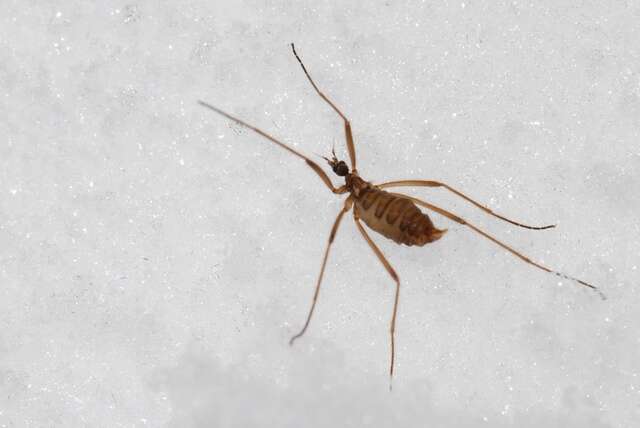
Limoniidae
Limoniidae is the largest of four crane fly families, with more than 10,700 species in more than 150 genera. Some studies have suggested it to be a paraphyletic group, with some limoniids being more closely related to Tipulidae and Cylindrotomidae than to other limoniids. Limoniid crane flies can usually be distinguished by the way the wings are held at rest. Limoniids usually hold/fold the wings along the back of the body, whereas other crane flies usually hold them out at right angles. Snow flies (genus: Chionea) such as Chionea scita have no wings at all. Limoniids are also usually smaller

Anisopodidae
The Anisopodidae are a small cosmopolitan family of gnat-like flies known as wood gnats or window-gnats, with 154 described extant species in 15 genera, and several described fossil taxa. Some species are saprophagous or fungivorous. They are mostly small to medium-sized flies, except the genera Olbiogaster and Lobogaster, which are large with spatulated abdomens. Their phylogenetic placement is controversial. They have been proposed to be the sister group to the higher flies, the Brachycera. Some authors consider this group to be four distinct families – Anisopodidae, Mycetobiidae, Olbiogastr
Scatopsidae
__NOTOC__
thumb|thumbtime=0:36|Scatopsidae on Impatiens
The minute black scavenger flies or "dung midges", are a family, Scatopsidae, of nematoceran flies. Despite being distributed throughout the world, they form a small family with only around 250 described species in 27 genera, although many await description and doubtless even more await discovery. These are generally small, sometimes minute, dark flies (from 0.6 to 5 mm), generally similar to black flies (Simuliidae), but usually lacking the humped thorax characteristic of that family.

Dixidae
The Dixidae (meniscus midges) are a small family of aquatic nematoceran flies (Diptera) of less than 200 species. The larvae live in unpolluted, standing fresh waters, just beneath the surface film, usually amongst marginal aquatic vegetation. They are found in all continents except Antarctica.

Chaoboridae
Chaoboridae, commonly known as phantom midges or glassworms, is a family of fairly common midges with a cosmopolitan distribution. They are closely related to the Corethrellidae and Chironomidae, and adults can be distinguished by specific features of their wing venation. The family includes approximately 55 aquatic species distributed across about six genera.

Blephariceridae
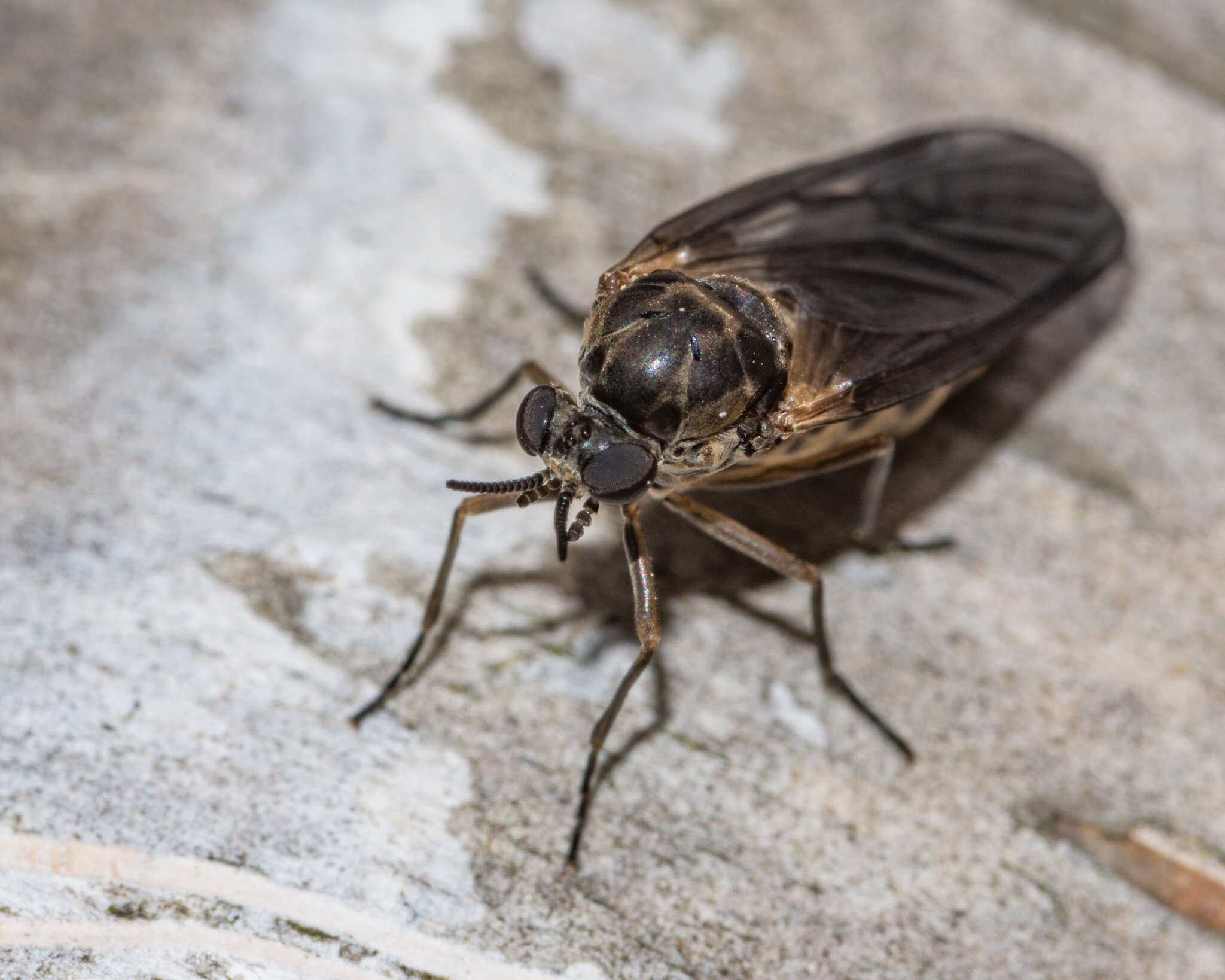
The Blephariceridae, commonly known as net-winged midges, are a nematoceran family in the order Diptera. The adults resemble crane flies except with a projecting anal angle in the wings, and different head shape, absence of the V on the mesonotum, and more laterally outstretched, forward-facing legs. They are uncommon, but dozens of genera occur worldwide, and over 200 species.
Axymyiidae
The Nematoceran family Axymyiidae is the sole member of the infraorder Axymyiomorpha, though it is often included within the infraorder Bibionomorpha in older classifications. It is known from only nine species in four genera, plus eight fossil species.
Pediciidae
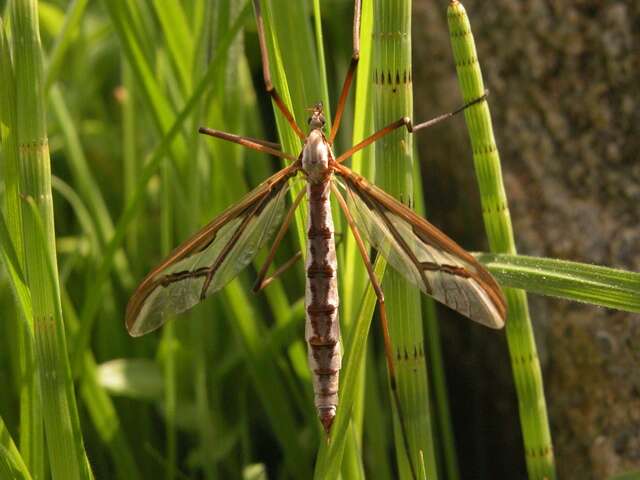
The Pediciidae or hairy-eyed craneflies are a family of flies closely related to true crane flies, with about 500 species worldwide.

Ptychopteridae
The Ptychopteridae, phantom crane flies, are a small family (three extant genera) of nematocerous Diptera. Superficially similar in appearance to other "tipuloid" families, they lack the ocelli of the Trichoceridae, the five-branched radial vein of the Tanyderidae, and the two anal veins that reach the wing margins of the Tipulidae. They are usually allied with the Tanyderidae based on similarities of the mesonotal suture, this group being called the Ptychopteromorpha.
Keroplatidae
Keroplatidae is a family of small flies known as fungus gnats. About 950 species are described, but the true number of species is undoubtedly much higher. The long-beaked fungus gnats, formerly placed in a separate family Lygistorrhinidae, have been placed into Keroplatidae as subfamily Lygistorrhininae. They are generally forest dwellers found in the damp habitats favoured by their host fungi. They can also often be found in caves. Larvae both feed on fungi and are predatory - they can spin webs by secreting acid fluids, which they use to kill smaller invertebrates and capture spores. Some of

Thaumaleidae
Thaumaleidae, the solitary midges or trickle midges, are a group of nematoceran flies related to the Ceratopogonidae, Chironomidae, and the Simuliidae. They are small, stocky, yellow to brown flies (3–4 mm). Very few species are known for this family (about 120 species in five genera). Larvae are found in films on rocks and the nonfeeding adults are usually found on foliage along the same streams in which the larvae are found. A few solitary midges are found in the Southern Hemisphere, but Thaumaleidae are generally an Holarctic family.

Diadocidiidae
The Diadocidiidae are a family of flies (Diptera), containing one extant genus with over 20 species and one extinct genus. Diadocidiidae are found worldwide, except in Africa and Antarctica. They are usually considered close to the Keroplatidae, Bolitophilidae, and Ditomyiidae, and used to be included in the Mycetophilidae. They are woodland flies, found in shaded places in forests or near streams. The larvae spin silken tubes under bark or in dead logs, and feed on hymenium of Polyporaceae fungi. The average body length for adults is around 2.5–5.6 mm.

Cylindrotomidae
thumb|Cylindrotoma distinctissima
Tanyderidae
Tanyderidae, sometimes called primitive crane flies, are long, delicate flies with spotted or mottled wings, superficially resembling true crane flies (Tipulidae). Adults are typically found resting on vegetation near streams, while larvae occur in wet, decaying wood or along sandy and gravelly stream margins. Several fossil species are also known.

Ditomyiidae
The Ditomyiidae are a small (90 species) family of flies (Diptera).They are found worldwide (except in the Afrotropical Region), most species are found in the Australasian and Neotropical realms. There are only two genera in Europe Ditomyia Winnertz, 1846 and Symmerus Walker, 1848
Ditomyia is found in Central Europe Symmerus in Northern Europe
Symmerus is endemic to the Palaearctic.
Lygistorrhinidae
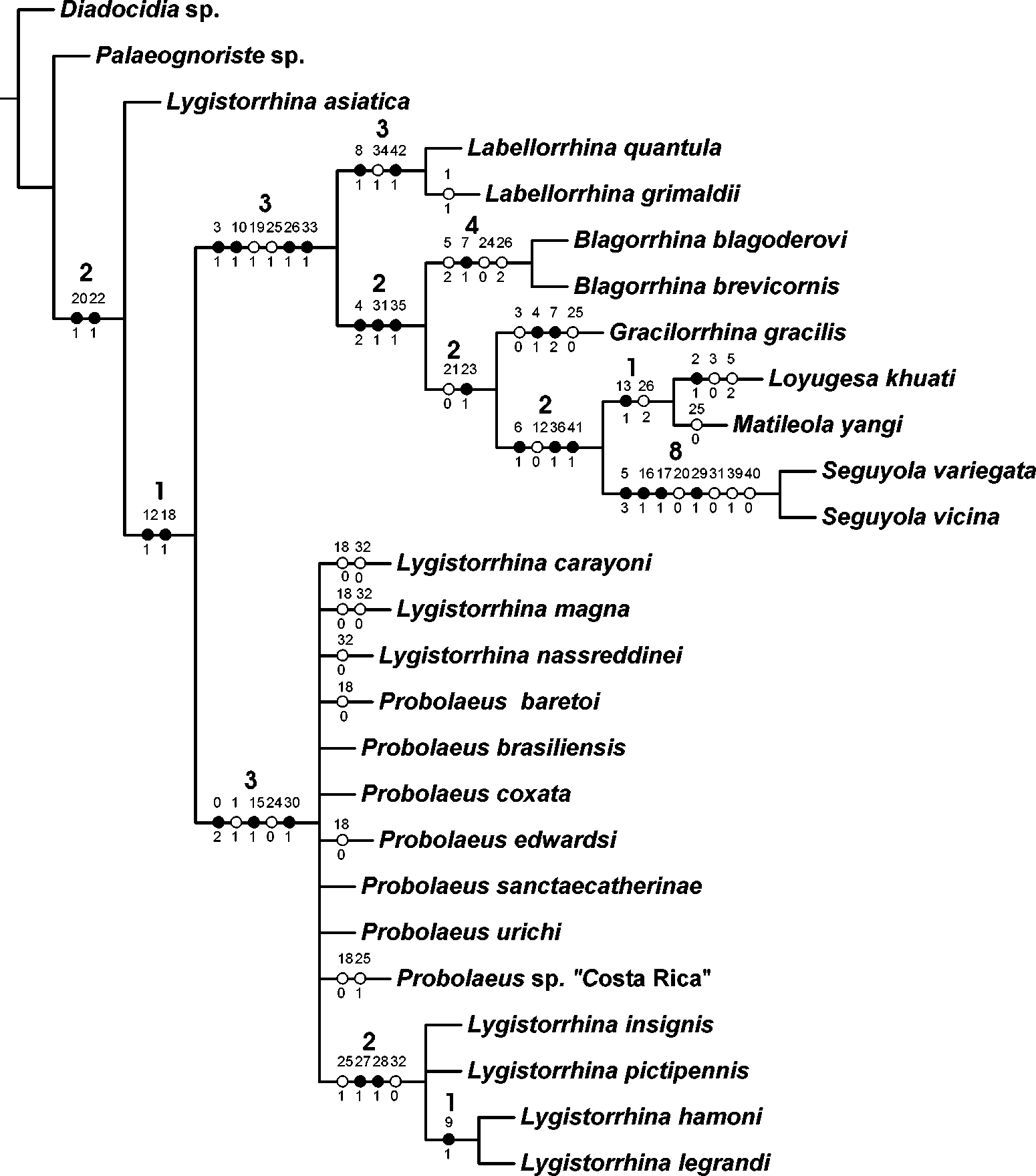
Lygistorrhininae, commonly called long-beaked fungus gnats is a subfamily of flies in the Diptera family Keroplatidae. The groups was long treated as a separate family, but molecular phylogenetic analysis has shown it to belong to Keroplatidae. There are about 7 genera and at least 30 described species in Lygistorrhininae.
Canthyloscelidae
The Canthyloscelidae are a small family of midges closely related to the Scatopsidae.
Pachyneuridae
Pachyneuridae is a family of flies of the infraorder Bibionomorpha, order Diptera. There are at least 8 described species in 7 genera in Pachyneuridae. The larvae live in rotting wood.
Rangomaramidae
Rangomaramidae is a family of flies in the infraorder Bibionomorpha. The family, members of which are known as long-winged fungus gnats, was erected in 2002 by Jaschhof and Didham to include five new species of flies in the genus Rangomarama from New Zealand. The family was then expanded to include several other genera from across the world which were formerly classified as Sciaroidea incertae sedis, but preliminary studies show that the broad family is non-monophyletic.
Nymphomyiidae
The Nymphomyiidae are a family of tiny (2 mm) slender, delicate flies (Diptera). Larvae are found among aquatic mosses in small, rapid streams in northern regions of the world, including northeastern North America, Japan, the Himalayas, and eastern Russia. Around a dozen extant species are known, with two fossil species found in amber, extending back to the Mid Cretaceous. Under an alternative classification, they are considered the only living representatives of a separate, suborder called Archidiptera (or Archaediptera) which includes several Triassic fossil members. The family has char
Perissommatidae
The Perissommatidae are a family of flies (Diptera) that was proposed in 1962 by Donald Colless based on the species Perissomma fusca from Australia. The family now includes five extant species within the single genus Perissomma, four from Australia and one from Chile. The Perissommatidae are unusual as they appear to have four compound eyes. They have a small slender body less than 2 mm in length. Their wings are large in comparison to their bodies and subsequently their flight is weak. Preferring high-altitude forest environments, adults only fly in the winter. The larvae live in decayi
Corethrellidae
Corethrellidae are a family of biting midges, small flying insects belonging to the order Diptera, females of which feed on the blood of frogs. The members of the family are sometimes known as frog-biting midges. The family currently consists of just one genus, totalling 115 extant and 10 fossil species worldwide. Most extant species are found in the lower latitudes, usually associated around the tropics.
Hesperinidae
REDIRECT Hesperinus
Bolitophilidae
REDIRECT Bolitophila
Valeseguyidae
Valeseguyidae is a family of flies, belonging to Scatopsoidea. It contains only one known extant species, Valeseguya rieki, known from a single male specimen found in Victoria, Australia, described in 1990. It was initially classified as a member of the wood gnat family Mycetobiidae, but was later given its own family in 2006. Two fossil species are known, including another species of Valeseguya, V. disjuncta, which is known from Miocene aged Dominican amber from the Caribbean, and Cretoseguya, containing the single species C. burmitica, which is known from the mid-Cretaceous Burmese amber of
Hesperinus
Hesperinus is a genus of flies and the sole genus in the relict family Hesperinidae belonging to the nematoceran infraorder Bibionomorpha. There are about 8 known species, nearly all from the Palaearctic region with one each from the Nearctic and Neotropical regions. Three fossil species from Eocene Baltic amber have been described. These flies have long 12-segmented antennae, legs and abdomen and males have well-developed wings while females have a short one. Little is known, but most species have been collected near streams in woodlands.