Category
page 1Neo-Assyrian Empire

Ashurbanipal
Ashurbanipal (, meaning "Ashur is the creator of the heir") was the king of the Neo-Assyrian Empire from 669 BC to his death in 631. He is generally remembered as the last great king of Assyria. Ashurbanipal inherited the throne as his father Esarhaddon‘s favored heir; his 38-year reign was among the longest of any Assyrian king. Though sometimes regarded as the apogee of ancient Assyria, his reign also marked the last time Assyrian armies waged war throughout the ancient Near East and the beginning of the end of Assyrian dominion over the region.

Sennacherib
Sennacherib ( or , meaning "Sîn has replaced the brothers") was the king of the Neo-Assyrian Empire from 705BC until his assassination in 681BC. The second king of the Sargonid dynasty, Sennacherib is one of the most famous Assyrian kings for the role he plays in the Hebrew Bible, which describes his campaign in the Levant. Other events of his reign include his destruction of the city of Babylon in 689BC and his renovation and expansion of the last great Assyrian capital, Nineveh.
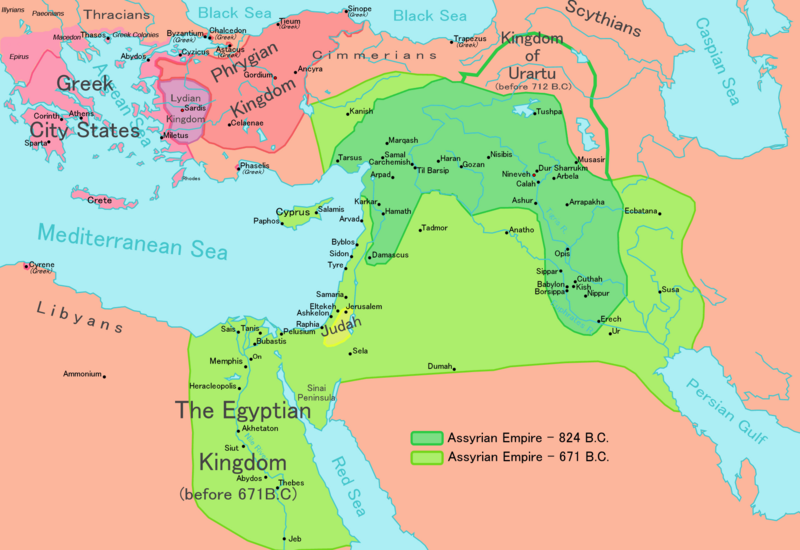
Neo-Assyrian Empire
historical state in Mesopotamia

Tiglath-Pileser III
King of Assyria who ruled 745-727 BCE

Sargon II
king of Assyria (722-705 B.C)

Esarhaddon
Esarhaddon, also spelled Essarhaddon, Assarhaddon and Ashurhaddon (, also , meaning "Ashur has given me a brother"; Biblical Hebrew: ʾĒsar-Ḥaddōn) was the king of the Neo-Assyrian Empire from 681 to 669 BC. The third king of the Sargonid dynasty, Esarhaddon is most famous for his conquest of Egypt in 671 BC, which made his empire the largest the world had ever seen, and for his reconstruction of Babylon, which had been destroyed by his father.

Library of Ashurbanipal
library

Shalmaneser V
Assyrian king

Shalmaneser III
Assyrian king

Ashurnasirpal II
Assyrian king

Ashur-uballit II
Assyrian Last King

Adad-nirari III
King of Assyria

Adad-nirari II
Assyrian king

Shamshi-Adad V
Assyrian king (824-811 B.C)

Ashur-nirari V
Assyrian king

Tukulti-Ninurta II
Assyrian king

Sinsharishkun
Sîn-šar-iškun ( or , meaning "Sîn has established the king")'''' was the penultimate king of the Neo-Assyrian Empire, reigning from the death of his brother and predecessor Aššur-etil-ilāni in 627 BCE to his own death at the Fall of Nineveh in 612 BCE.

Aššur-etil-ilāni
Aššur-etil-ilāni, also spelled Ashur-etel-ilani' and Ashuretillilani (, meaning "Ashur is the lord of the Tree"),' was the king of the Neo-Assyrian Empire from 631 BC to 627 BC. Aššur-etil-ilāni is an obscure figure with a brief reign from which few inscriptions survive. Because of this lack of sources, very little concrete information about the king and his reign can be deduced.

Shammuramat
Shammuramat (Akkadian: Sammu-rāmat or Sammu-ramāt), also known as Sammuramat or Shamiram and Semiramis, was a powerful queen of the Neo-Assyrian Empire. Beginning her career as the primary consort of the king Shamshi-Adad V (824–811 BC), Shammuramat reached an unusually prominent position in the reign of her son Adad-nirari III (811–783 BC). Though there is dispute in regard to Shammuramat's formal status and position, and if she should be considered a co-regent, it is clear that she was among the most powerful and influential women of the ancient Near East and the Iron Age in general; she is

Ashur-dan III
Assyrian king

Shalmaneser IV
Assyrian king

Sin-shumu-lishir
Sîn-šumu-līšir or Sîn-šumu-lēšir' ( or , meaning "Sîn, make the name prosper!"), also spelled Sin-shum-lishir,' was a usurper king in the Neo-Assyrian Empire, ruling some cities in northern Babylonia for three months in 626 BC during a revolt against the rule of the king Sîn-šar-iškun. He was the only eunuch to ever claim the throne of Assyria.
Nimrud lens
piece of rock crystal
Assyrian eclipse
solar eclipse
tree of life
mystic and kabbalistic simbology related to life whose meaning depends on culture or religion
King of the Universe
ancient Mesopotamian title
military history of the Neo-Assyrian Empire
Mesopotamia
Assyrian law
Ancient legal code
Sargonid dynasty
final ruling dynasty of Assyria, founded 722 BC
Old Aramaic
extinct Semitic language
King of the Four Corners
title from ancient Mesopotamia
Pax Assyriaca
historiographical term
King of Sumer and Akkad
Royal title in Ancient Mesopotamia
Jerwan
thumb|Jerwan Aqueducts
Jerwan is a locality north of Mosul in the Nineveh Province of Iraq. The site is clear of vegetation and is sparsely settled.
Libbāli-šarrat
Libbāli-šarrat (Akkadian: Libbāli-šarrat, meaning "the inner city [=Ishtar?] is queen") was a queen of the Neo-Assyrian Empire as the primary consort of Ashurbanipal (669–631 BC). Libbāli-šarrat married Ashurbanipal before he became king, probably in 672 BC, and may have lived beyond her husband's death, as documents from the reign of her probable son, Ashur-etil-ilani (631–627 BC) reference the "mother of the king". Libbāli-šarrat enjoys the distinction of being the only known individual from ancient Assyria who was not a king to be depicted holding court since she is depicted in one of Ashur
State communications in the Neo-Assyrian Empire
Assyrian conquest of Egypt
673–663 BCE military campaign
stelae of Nahr el-Kalb
archaeological site in Lebanon

I Am Semiramis
1962 film by Primo Zeglio
Resettlement policy of the Neo-Assyrian Empire
Policy of resettlement of population by Neo-Assyrian Empire
Imperial Aramaic
official language in Achaemenid Empire
Mullissu-mukannišat-Ninua
Mullissu-mukannishat-Ninua (Akkadian: Mullissu-mukannišat-Nīnua) was a queen of the Neo-Assyrian Empire as the primary consort of Ashurnasirpal II (883–859 BC). She was probably also the mother of his son and successor Shalmaneser III (859–824 BC). Mullissu-mukannishat-Ninua is only known from her tomb, discovered in Nimrud in 1989. She was the daughter of the "great cupbearer" Ashur-nirka-da’’inni and as such probably belonged to the Assyrian aristocracy before she became queen.
Tell el Fakhariya bilingual inscription
Ešar-ḫamat
Ešarra-ḫammat (, meaning "Ešarra is mistress") was a queen of the Neo-Assyrian Empire as the primary consort of Esarhaddon (681–669 BC). Ešarra-ḫammat had been married to Esarhaddon for over a decade by the time he became king, having married him 695 BC. Few sources from Ešarra-ḫammat's lifetime that mention her are known, and she is thus chiefly known from sources dating to after her death in February 672 BC, an event which deeply affected Esarhaddon. Esarhaddon had a great mausoleum constructed for her, unusual for burials of Assyrian queens, and had her death recorded in the Babylonian Chro
Tasmetu-Sarrate
Tashmetu-sharrat (Akkadian: Tašmētu-šarrat or Tašmētum-šarrat, meaning "Tashmetum is queen") was a queen of the Neo-Assyrian Empire as the primary consort of Sennacherib (705–681 BC). Tashmetu-sharrat is mostly known from an inscription by Sennacherib which praises her great beauty and in which the king hopes to spend the rest of his life with her. It is not known which of Sennacherib's children were children of Tashmetu-sharrat; the king's successor Esarhaddon (681–669 BC) was the son of Naqi'a, another woman.
Hama
ancient Assyrian queen
Queens of the Neo-Assyrian Empire
ancient Mesopotamian women
King of the Lands
ancient Mesopotamian title