Category
page 1Neuroptera

Myrmeleontidae
The antlions are a group of about 2,000 species of insect in the neuropteran family Myrmeleontidae. They are known for the predatory habits of their larvae, which mostly dig pits to trap passing ants or other prey. In North America, the larvae are sometimes referred to as doodlebugs because of the marks they leave in the sand. The adult insects are less well known due to their relatively short lifespans in comparison with the larvae. Adults, sometimes known as antlion lacewings, mostly fly at dusk or just after dark and may be mistakenly identified as dragonflies or damselflies.

Neuroptera

Ascalaphinae
Ascalaphidae is a family of insects in the order Neuroptera, commonly called owlflies; there are some 450 extant species. They are fast-flying crepuscular or diurnal predators of other flying insects, and have large bulging eyes and strongly knobbed antennae. The larvae are ambush predators; some of them make use of self-decoration camouflage.
.jpg)
Hemerobiidae
thumb|Campodeiform larva of Micromus

Coniopterygidae
The dustywings, Coniopterygidae, are a family of Pterygota (winged insects) of the net-winged insect order (Neuroptera). About 460 living species are known. These tiny insects can usually be determined to genus with a hand lens according to their wing venation, but to distinguish species, examination of the genitals by microscope is usually necessary.
.jpg)
Nemopteridae
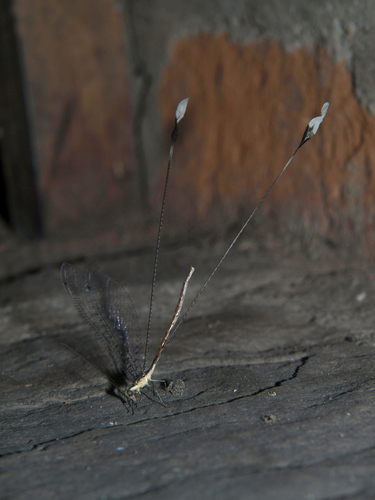
Nemopteridae, the spoonwings, are a family of neuropteran insects. They are also called thread-winged antlions. They are found in the Ethiopian, Palearctic, Australasian and Neotropical realms but absent in North America (though a fossil has been found in Colorado).

Sisyridae
Sisyridae, commonly known as spongeflies or spongillaflies, are a family of winged insects in the order Neuroptera. There are approximately 60 living species described, and several extinct species identified from the fossil record.

Osmylidae
Osmylidae are a small family of winged insects of the net-winged insect order Neuroptera. The osmylids, also called lance lacewings, stream lacewings or giant lacewings, are found all over the world except North and Central America. There are around 225 extant species.

Ithonidae
Ithonidae, commonly called moth lacewings and giant lacewings, is a small family of winged insects of the insect order Neuroptera. The family contains a total of ten living genera, and over a dozen extinct genera described from fossils. The modern Ithonids have a notably disjunct distribution, while the extinct genera had a more global range. The family is considered one of the most primitive living neuropteran families. The family has been expanded twice, first to include the genus Rapisma, formerly placed in the monotypic family Rapismatidae, and then in 2010 to include the genera that had b
Alexander Mocsáry
Hungarian entomologist (1841–1915)

Sponon-winged Lacewing Butterfly
species of insect
Nevrorthidae
The Nevrorthidae (often incorrectly spelled "Neurorthidae") are a small family of lacewings in the order Neuroptera. There are 19 extant species in four genera, with a geographically disjunct distribution: Nevrorthus, comprising 5 species with scattered distributions around the Mediterranean; Austroneurorthus, with two species known from southeastern Australia; Nipponeurorthus, comprising 11 species known from China and Japan; and Sinoneurorthus, known from a single species described from Yunnan Province, China. They are traditionally placed in the Osmyloidea, alongside Osmylidae and the spong

Nemoptera bipennis
species of insect
Osmylus
Osmylus is a genus of large lacewings, typical of the family Osmylidae, first described by Pierre André Latreille in 1802. Species are recorded mostly from Europe and Asia.
Nemoptera
thumb|Nemoptera sinuata
Kalligrammatidae
Kalligrammatidae, sometimes known as kalligrammatids or kalligrammatid lacewings, is a family of extinct insects in the order Neuroptera (lacewings) that contains twenty genera and a number of species. The family lived from the Middle Jurassic to the early Late Cretaceous before going extinct. Species of the family are known from Europe, Asia, and South America. The family has been occasionally described as "butterflies of the Jurassic" based on their resemblance to modern butterflies in morphology and ecological niche.
Nemoptera coa
species of insect
Nemopistha hennini
species of insect
Isostenosmylus
Isostenosmylus is a genus of neotropical osmylid in the subfamily Stenosmylinae. It has been called "the most species-rich genus of lance lacewings in the Neotropical region."
Kalligramma
thumb|left|Restoration of Kalligramma being chased by Anurognathus
Nemia
Nemia is a genus of insects belonging to the family Nemopteridae.
Rhachiberothidae
Rhachiberothidae, sometimes called thorny lacewings, are a family of winged insects in the order Neuroptera. The family has only 14 extant species in four genera found in Sub-Saharan Africa, but has a diverse fossil record extending back to the Early Cretaceous in Lebanon (then part of North Gondwana), Eurasia and North America. Like the closely related Mantispidae members of the group possess raptorial forelegs, which probably only evolved once in the common ancestor of the groups.