Category
page 1Neurotechnology

electroencephalography
Electroencephalography (EEG)
is a method to record an electrogram of the spontaneous electrical activity of the brain. The bio signals detected by EEG have been shown to represent the postsynaptic potentials of pyramidal neurons in the neocortex and allocortex. It is typically non-invasive, with the EEG electrodes placed along the scalp (commonly called "scalp EEG") using the International 10–20 system, or variations of it. Electrocorticography, involving surgical placement of electrodes, is sometimes called "intracranial EEG". EEG is widely used both as a clinical diagnostic tool, particularl

cyborg
thumb|Artist's illustration of a cyborg
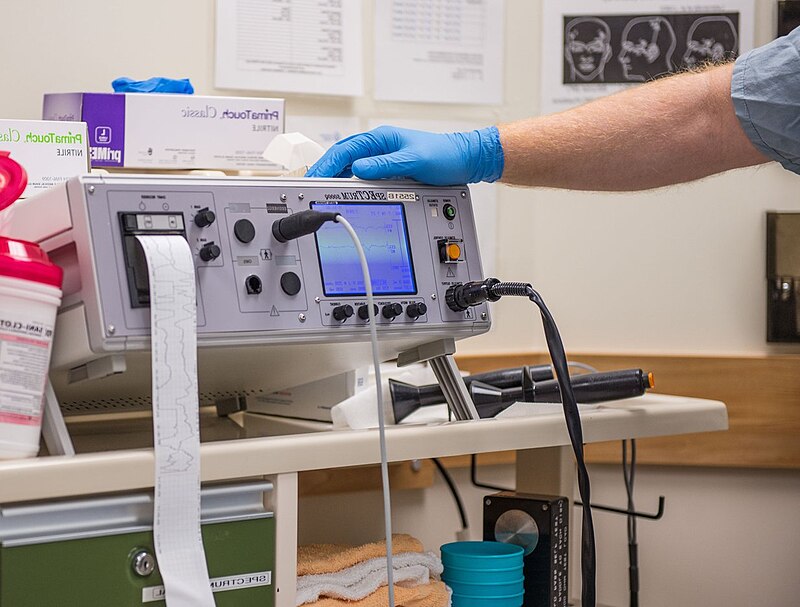
electroconvulsive therapy
medical procedure

brain–computer interface
connection between brain and computer

electromyography
Electromyography (EMG) is a technique for evaluating and recording the electrical activity produced by skeletal muscles. EMG is performed using an instrument called an electromyograph to produce a record called an electromyogram. An electromyograph detects the electric potential generated by muscle cells when these cells are electrically or neurologically activated. The signals can be analyzed to detect abnormalities, activation level, or recruitment order, or to analyze the biomechanics of human or animal movement. Needle EMG is an electrodiagnostic medicine technique commonly used by neurolo
transcranial magnetic stimulation
form of brain stimulation using magnetic fields
deep brain stimulation
surgical treatment involving the implantation of a medical device called a brain pacemaker
magnetoencephalography
Magnetoencephalography (MEG) is a functional neuroimaging technique for mapping brain activity by recording magnetic fields produced by electrical currents occurring naturally in the brain, using very sensitive magnetometers. Arrays of SQUIDs (superconducting quantum interference devices) are currently the most common magnetometer, while the SERF (spin exchange relaxation-free) magnetometer is being investigated for future machines. Applications of MEG include basic research into perceptual and cognitive brain processes, localizing regions affected by pathology before surgical removal, determi
mind uploading
hypothetical copying of a "self" from a brain's neural-networks into a computer, a computer network or a human-like robot
neurotechnology
Neurotechnology encompasses any method or electronic device which interfaces with the nervous system to monitor or modulate neural activity.
electrooculography
Electrooculography (EOG) is a technique for measuring the corneo-retinal standing potential that exists between the front and the back of the human eye. The resulting signal is called the electrooculogram. Primary applications are in ophthalmological diagnosis and in recording eye movements. Unlike the electroretinogram, the EOG does not measure response to individual visual stimuli.

neurofeedback
thumb|470x470px|Neurofeedback training process diagram
transcutaneous electrical nerve stimulation
nerve stimulation for therapeutic purposes
vagus nerve stimulation
medical treatment that involves delivering electrical impulses to the vagus nerve.
transcranial direct-current stimulation
technique of brain electric stimulation therapy which uses low current delivered via electrodesm placed on the scalp
wetware computer
organic computer
electrocorticography
Electrocorticography (ECoG), a type of intracranial electroencephalography (''''''), is a type of electrophysiological monitoring that uses electrodes placed directly on the exposed surface of the brain to record electrical activity from the cerebral cortex. In contrast, conventional electroencephalography (EEG) electrodes monitor this activity from outside the skull. ECoG may be performed either in the operating room during surgery (intraoperative ECoG) or outside of surgery (extraoperative ECoG). Because a craniotomy (a surgical incision into the skull) is required to implant the electrode g
%20is%20a%20technique%20for%20noninvasive%20stimulation%20of%20the%20adult%20brain.jpg)
neurostimulation
Neurostimulation is the purposeful modulation of the nervous system's activity using invasive (e.g., microelectrodes) or non-invasive means (e.g., transcranial magnetic stimulation, transcranial electric stimulation such as tDCS or tACS). Neurostimulation usually refers to the electromagnetic approaches to neuromodulation.
Cranial electrotherapy stimulation
also called transcranial electrotherapy
2045 Initiative
organization that develops a network and community of researchers in the field of life extension
spinal cord stimulator
implanted medical device for chronic pain management
Neurohacking
Neurohacking is a subclass of biohacking, focused specifically on the brain. Neurohackers seek to better themselves or others by "hacking the brain" to improve reflexes, learn faster, or treat psychological disorders. The modern neurohacking movement has been around since the 1980s. However, herbal supplements have been used to increase brain function for hundreds of years. After a brief period marked by a lack of research in the area, neurohacking started regaining interest in the early 2000s. Currently, most neurohacking is performed via do-it-yourself (DIY) methods by in-home users.
Channelrhodopsin
Channelrhodopsins are a subfamily of retinylidene proteins (rhodopsins) that function as light-gated ion channels. They serve as sensory photoreceptors in unicellular green algae, controlling phototaxis: movement in response to light. Expressed in cells of other organisms, they enable light to control electrical excitability, intracellular acidity, calcium influx, and other cellular processes (see optogenetics). Channelrhodopsin-1 (ChR1) and Channelrhodopsin-2 (ChR2) from the model organism Chlamydomonas reinhardtii are the first discovered channelrhodopsins. Variants that are sensitive to dif
Brain–brain interface
direct communication pathway between the brain of one animal and the brain of another animal
God helmet
experimental apparatus developed by Stanley Koren and Michael Persinger
Cyborg Foundation
nonprofit organization
Electromyoneurography
Electromyoneurography (EMNG) is the combined use of electromyography and electroneurography This technique allows for the measurement of a peripheral nerve's conduction velocity upon stimulation (electroneurography) alongside electrical recording of muscular activity (electromyography). Their combined use proves to be clinically relevant by allowing for both the source and location of a particular neuromuscular disease to be known, and for more accurate diagnoses.
neuroenhancement
Neuroenhancement or cognitive enhancement is the experimental use of pharmacological or non-pharmacological methods intended to improve cognitive and affective abilities in healthy people who don't have any mental illness. Agents or methods of neuroenhancement are intended to affect cognitive, social, psychological, mood, or motor benefits beyond normal functioning.
brain-reading
Brain-reading or thought identification uses the responses of multiple voxels in the brain evoked by stimulus then detected by fMRI in order to decode the original stimulus. Advances in research have made this possible by using human neuroimaging to decode a person's conscious experience based on non-invasive measurements of an individual's brain activity. Brain reading studies differ in the type of decoding (i.e. classification, identification and reconstruction) employed, the target (i.e. decoding visual patterns, auditory patterns, cognitive states), and the decoding algorithms (l
pulsed electromagnetic field therapy
medical treatment using electromagnetic fields
SyNAPSE
thumb|300px|A circuit board with a 4×4 array of SyNAPSE-developed chips. Each chip has one million electronic “neurons” and 256 million electronic synapses between neurons. Built on 28nm process technology, the 5.4 billion [[transistor chip has one of the highest transistor counts of any chip ever produced .]]
SyNAPSE is a DARPA program that aims to develop electronic neuromorphic machine technology, an attempt to build a new kind of cognitive computer with form, function, and architecture similar to the mammalian brain. Such artificial brains would be used in robots whose intelligence would s
magnetomyography
Magnetomyography (MMG) is a technique for mapping muscle activity by recording magnetic fields produced by electrical currents occurring naturally in the muscles, using arrays of SQUIDs (superconducting quantum interference devices). It has a better capability than electromyography for detecting slow or direct currents. The magnitude of the MMG signal is in the scale of pico (10^−12) to femto (10^−15) tesla (T). Miniaturizing MMG offers a prospect to modernize the bulky SQUID to wearable miniaturized magnetic sensors.
Sacral nerve stimulation
OAB treatment, Fecal incontinency and constipation